

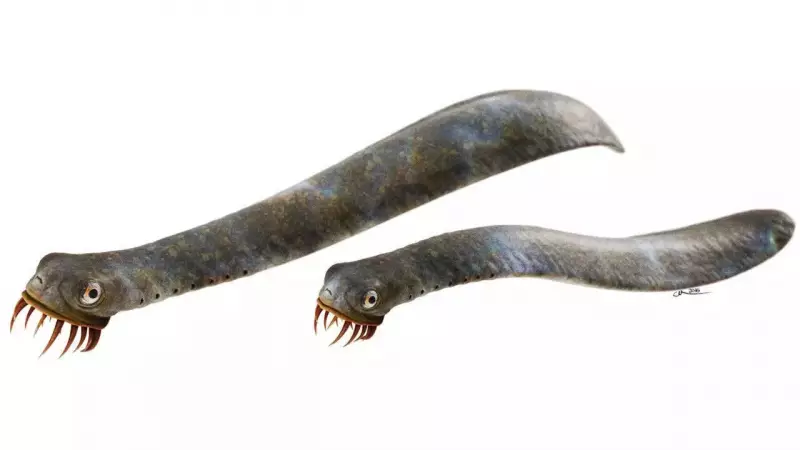
For decades, the title of nature's sharpest bite was held by formidable predators like sharks and large reptiles. However, groundbreaking new research has completely rewritten this chapter of natural history. The new champions of dental sharpness are conodonts, extinct marine animals that swam the oceans hundreds of millions of years ago.
What Were Conodonts and How Did They Feed?
Conodonts were small, eel-like vertebrates that first appeared in the Cambrian period and survived until the end of the Triassic. Unlike modern animals, they did not have jaws. Instead, their feeding apparatus was built from numerous microscopic, mineralised elements often shaped like pointed teeth. These elements, composed mainly of calcium phosphate, were arranged in a complex structure within their mouths.
The study, published in The Royal Society Publishing, focused on species from the Late Carboniferous period, a time of high conodont diversity. Their tooth-like elements, typically less than a few millimetres long, show clear evidence of wear, proving they were actively used for feeding. Their composition is remarkably similar to vertebrate enamel, allowing for precise scientific measurement.

Measuring Sharpness: Science Over Speculation
How do you scientifically measure sharpness? The researchers moved beyond simple visual assessment. They defined sharpness by measuring the radius of curvature at the very tip of a tooth. A smaller radius means a sharper point. Using high-resolution scanning electron microscopy, they captured extreme close-ups of conodont element tips, shark teeth, mammalian teeth, and even manufactured steel blades.
Digital profiles of these tips were then analysed to calculate their curvature mathematically. This objective, repeatable method allowed for a direct, fair comparison across completely different biological and man-made structures, all measured from unworn areas to ensure accuracy.
Surprising Results: Sharper Than a Blade
The findings were astonishing. The measured radii for conodont element tips were extremely small, smaller than those of any living vertebrate tooth included in the study. In fact, their sharpness was comparable to, and in some cases exceeded, that of the steel blades measured using the same technique.
This indicates that conodont elements achieved a level of sharpness pushing the physical limits of their calcium phosphate material. The wear patterns on the fossils confirm this extreme sharpness was functional—flattened tips show they were used to cut or slice food, and even in their worn state, they remained sharper than the fresh teeth of many living animals.
Conodonts vs. Sharks and Mammals: A Study in Contrast
This discovery reshapes our understanding of evolutionary adaptation. Shark teeth, while excellent cutting tools, had larger tip radii than conodont elements. This doesn't make sharks less effective; it highlights that sharpness is just one factor in feeding efficiency, alongside size, jaw strength, and durability.
Mammalian teeth, including those of carnivores, were much blunter by comparison. Mammals need teeth to last, bearing heavy loads over a lifetime. Conodonts, with their rapidly replaced, microscopic elements, could afford to have ultra-sharp but fragile tips, a luxury not available to animals with permanent dentition.
The research brilliantly connects biological form with mechanical engineering principles. It shows how natural selection can drive evolution to produce structures operating at the very edge of physical possibility, even in ancient, tiny creatures. By quantifying sharpness, this study provides a new framework for comparing the biomechanics of extinct and living organisms, revealing that the history of life's sharpest tools is far older and more surprising than we ever imagined.






