

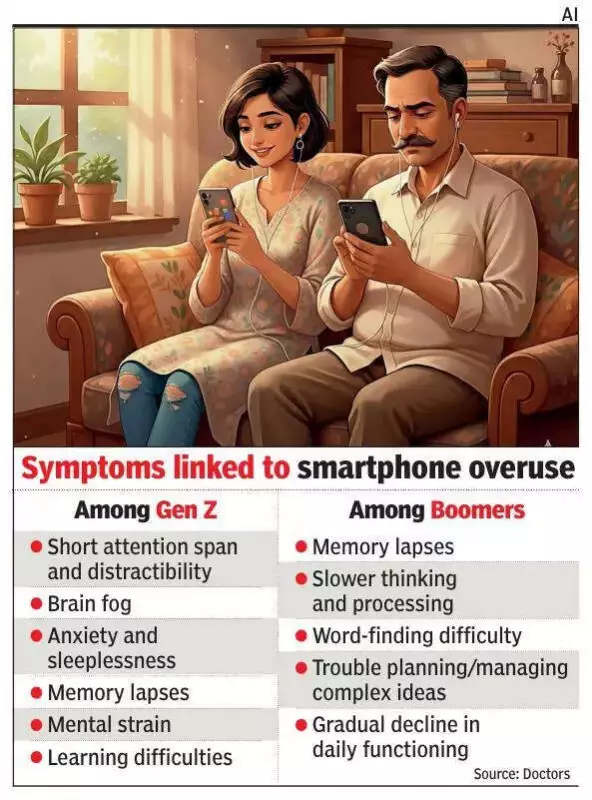
In the tech capital of Bengaluru, a silent neurological shift is underway. The simple, repetitive acts of swiping a screen, tapping for information, or asking an AI chatbot a quick question are subtly but significantly altering how two distinct generations use their brains. Neurologists across the city's leading hospitals are observing an uncomfortable convergence in the symptoms of digitally dependent Baby Boomers and Generation Z.
A Shared Pattern of Cognitive Erosion
Despite being separated by decades, both groups are showing clinical signs of excessive smartphone dependence, accompanied by a measurable decline in fundamental cognitive abilities. Dr Suryanarayana Sharma PM, senior consultant neurologist at Apollo Hospitals on Bannerghatta Road, states that the pattern is strikingly similar. "Gen Z and senior citizens are the two sets who are excessively addicted to smartphones," he explains.
The immediate access to ready information via Google or AI assistants is short-circuiting the brain's natural learning processes. "With Gen Z especially, if you ask them a question, they immediately look for answers on Google or AI chatbots. But if you ask them the same question after an hour, they cannot even retain 50% of that information," Dr. Sharma notes. The core issue, he emphasizes, is not intelligence but the act of learning itself. When the brain is deprived of the strenuous effort required to search, analyze, and recall information, its cognitive muscles are simply not being trained.

Functional Decline vs. Structural Damage
Neurologists are careful to clarify that this is not a case of physical brain damage. Dr Na'eem Sadiq, medical director of Plexus Neuro Centre, asserts, "There is no scientific evidence that young people today have brain damage or early dementia." The problem lies in functional brain health. "While their brains are structurally healthy, what has changed is functional brain health: attention span, emotional regulation, sleep quality, and mental resilience," he adds.
Lifestyle driven by screen overuse is central to this functional decline. Many young individuals spend evenings rapidly switching between Instagram Reels, online games, and late-night chats, leading to poor sleep hygiene. Dr. Sadiq explains, "Prolonged screen exposure, especially fast-paced gaming and short-form videos, overstimulates attention networks and interferes with memory consolidation. The brain is not damaged; it is overstimulated and exhausted."
Language, Lifestyle, and the Generational Divide
The impact extends to language skills. Dr Sujit Kumar, director and senior consultant in neurology at Krishna Institute of Medical Sciences, warns that the constant use of abbreviations, slang, and short forms online may be altering how language-related brain regions are engaged. "The cognitive area responsible for language expands with reading and studying. When short forms dominate communication, it is possible that this area is not being engaged fully," he says. This lack of mental effort is linked to a higher risk of memory issues later in life.
For Baby Boomers, the drivers are more complex, intertwining age-related changes with technology habits. Doctors point to natural neurodegeneration, reduced physical activity post-retirement, and a decline in sustained mental engagement. "In older patients, we often see memory lapses, slower processing, difficulty finding words, and problems planning complex tasks. AI can be useful for seniors if used judiciously, but overdependence is becoming a concern," Dr. Kumar observes.
The prescription from neurologists is straightforward yet challenging in today's connected world. They advocate for:
- Consciously limiting phone and screen time.
- Resisting the urge to outsource basic mental tasks like spelling or simple arithmetic to AI.
- Engaging in regular, deep reading of books or long-form articles.
- Keeping the brain active with puzzles, Sudoku, and crosswords.
The message from Bengaluru's medical experts is clear across generations: the convenience of smartphones and AI comes with a hidden cost. The brain acutely notices—and deteriorates—when it is no longer challenged to do the hard work of thinking.






