

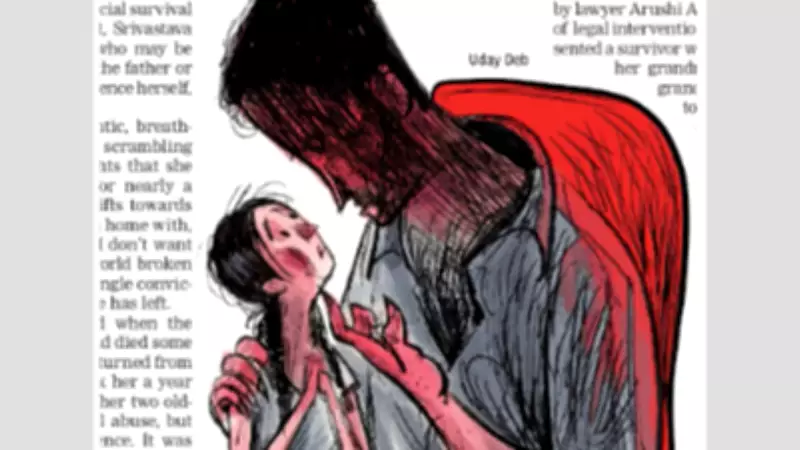
Two sisters in eastern Uttar Pradesh lost their lives after enduring sexual abuse by their father — one succumbed to neglect, the other to suicide. Their tragic story underscores how little has changed for survivors of incestuous abuse in India.
A Life of Despair
Swati, a 17-year-old incest abuse survivor from Jaunpur, Uttar Pradesh, died by suicide earlier this month in a Varanasi government shelter. She was just days away from turning 18. Swati was the youngest of three children born to a Dalit vegetable vendor. After their mother died from a chronic illness, the children became entirely dependent on their father.
In 2022, at age 12, Swati briefly ran away from home with a friend, desperate to escape the trauma she faced. Relatives found her and brought her back. On August 21, 2022, Swati and her brother walked into the Jaunpur superintendent of police's office and filed an application exposing a horrifying domestic reality: she had been raped by her father for a year and a half and was under constant threat of death if she spoke out.

The Fate of Her Sister
Even more horrifying was the fate of Swati's elder sister. Swati testified that their father had repeatedly raped the older girl as well. The sister fell severely ill and was locked in a basement, denied food and medical help. She died soon after. The father was arrested on August 24, 2024, based on Swati's complaint. He was convicted and sentenced to 20 years in prison in 2025.
However, the legal battle took a heavy toll on Swati. During the three years the case was in court, she and her brother faced intimidation and pressure from their extended family to drop the case. With a hostile family around her, Swati's only support was her brother, who had left for Mumbai for work. The boy she had eloped with when she was a minor also cut off contact over time.
As her 18th birthday approached, Swati grew increasingly fearful that no one in the world cared for her. She would have had to leave the children's home upon becoming an adult, but she had no one to turn to. Instead, she chose to end her life.
The Price of Speaking Up
Nimisha Srivastava, executive director at Counsel to Secure Justice (CSJ), a nonprofit working on access to justice for child survivors of sexual abuse, says survivors often face constant taunts, social stigma, and complete excommunication from the family. The most heartbreaking situation for a survivor of incest abuse is when they do not find support from their mother or guardian.
Srivastava recalls a case where a mother, enraged by her daughter's refusal to protect her husband, physically threw ash at the girl in court. In many cases, the mother views the daughter not as a victim to be protected, but as a threat to the economic stability and social survival of the entire household. However, Srivastava adds that blaming the mother, who may be economically dependent on the father or also a victim of domestic violence, is not the solution.
Tripti, another survivor, speaks in a frantic, breathless rush. Her words collide, scrambling to match her racing thoughts that she has struggled to quieten for nearly a decade. When her mind drifts toward the people she once shared a home with, her voice has a certainty: "I don't want to go back to them."
Tripti was 10 years old when the abuse began. Her mother had died some years before, and her father turned from guardian to predator. It took her a year before she could confide in her two older siblings about the sexual abuse, but she was met with indifference. It was only when she gathered the courage to tell a schoolteacher that the state intervened. In 2018, a case was registered under the Protection of Children from Sexual Offences (POCSO) Act, throwing her life into a whirlpool of confusion, stigma, and taunts.

While Tripti was sent to a Delhi government shelter, her siblings were packed off to live with extended family. Between 2018 and 2024, as her case wound through the judicial system, Tripti's family phone calls and visits became a tense battleground. Her siblings and relatives poured their grief and social shame on her, sometimes urging, often demanding, she change her statement and withdraw the case. She did not buckle, and eventually her father was handed life imprisonment in 2024. "I now know that abuse happens in a lot of families, but only a few like me have the courage to report it," she says.
What the Data Says
A 2024 study by Project 39A (now renamed Square Circle Clinic) and Enfold Proactive Health Trust analyzed 264 judgments and found that POCSO cases have a high acquittal rate. Of the cases analyzed, 207 (78%) resulted in acquittals, while convictions for sexual offenses were recorded in just 57 cases (22%). Of these, the father, stepfather, or mother's partner was found to be the abuser in 11% of cases.
When broken down by the relationship between the survivor and the accused, the data reveals a stark paradox: the closer the perpetrator is to the child's life, the harder it is to secure a conviction. The study noted a 54% conviction rate when the accused was a neighbor. This fell to 27% when the predator — either the biological father or the mother's partner — lived in the same household as the victim. For extended relatives, it was a near-identical 27.5%.
These low numbers reflect the immense, coordinated hostility a child faces from their own network when trying to sustain a legal battle. Lawyer Arushi Anthwal, CSJ's director of legal interventions, recently represented a survivor who had been abused by her grandmother's partner. The grandmother, determined to protect her partner, continued to pressure the child to recant. It took years of active legal advocacy and counseling to keep the child safe. Finally, in 2024, the legal team bypassed the family's interference and secured a 10-year prison sentence for the abuser.
Confronting Demons
In many homes, abuse continues unchallenged and unreported, says Anuja Gupta, founder of Rahi Foundation, which has worked for three decades with adult women survivors of incest abuse. "Incest abuse is more difficult to talk about than any other kind of sexual abuse because it gets normalized within the family," Gupta says. Since it usually occurs in domestic spaces, it remains entirely hidden unless an outside witness intervenes.
This lack of external validation creates a surreal, gaslit reality for the victim. "It makes the abuse feel 'unreal,' as if the child is simply imagining it," she adds. Without the language to articulate the trauma or the social confidence that others will believe them, children internalize the violation. "They rationalize the horror through self-blame: 'I'm being abused because I'm a bad person.' This psychological trap binds the child, ensuring their compliance and silence," she says.
According to Gupta, psychological damage does not vanish when abuse ends; instead, it migrates. Because a child cannot safely express complicated feelings of shame, guilt, and terror, the trauma embeds itself directly into their physiology. It manifests later in life as chronic physical illnesses, severe eating disorders, and patterns of deliberate self-harm. Many survivors become overachievers, driving themselves to academic or professional extremes as a subconscious strategy to compensate for, mask, and distance themselves from the deep shame of the abuse.
This physical lodging of trauma can lie dormant for years, only to resurface during what psychologists call an "anniversary reaction" — a major life transition, a broken adult relationship, the death of the perpetrator, or the moment the survivor has a child of their own and fears they will be preyed upon.
A Crack in the Wall
In recent years, there have been efforts to address the stigma and speak up. In India, politician Swati Maliwal and actor Khushboo Sundar, and in the West, talk show host Oprah Winfrey, actor Ashley Judd, and author Maya Angelou have spoken about being survivors of incest abuse.
Film director Saif Hasan, whose film Yes Papa tackled this difficult subject and was released in 2024, says the urge to say "Khamosh raho" (stay silent) within families must be fought. "It was by chance that I found out about a case of abuse within my family. I also realized that my aunt had told the survivor 'khamosh raho,' rather than confront the perpetrator. Around the same time, two young sisters that I knew also spoke about being abused by family members. It stirred something in me, and I hoped the film would start a conversation and find a wider audience," he said.
In recent years, mandatory reporting of abuse by people in authority has brought to light many cases that may otherwise not have been reported. The presence of psychologists and counselors in schools has also helped, but it is a drop in the ocean. Besides awareness and advocacy, Srivastava says that greater attention must be paid to creating a safe space for reporting abuse, protecting privacy, creating approachable police stations, and strengthening one-stop centers that can support survivors.
