

Pune Toddler Triumphs Over Rare 1-in-50,000 Congenital Condition
In a remarkable medical achievement, a one-and-a-half-year-old girl from Pune has been successfully treated for an exceptionally rare congenital vascular disorder known as Abernethy Malformation. This condition, occurring in approximately one in 50,000 individuals, involves blood from the stomach and intestines flowing directly into the heart instead of first being filtered by the liver.
Understanding the Complex Vascular Anomaly
Dr. Ashish Banpurkar, pediatric cardiologist at Vishwaraj Hospital, explained the critical nature of this condition. "In a normal child, blood from the digestive organs travels through portal veins to the liver for filtration before reaching the heart," he stated. "However, in this case, the portal veins were abnormally connected directly to the heart via the Vena cava, completely bypassing the liver."
This abnormal circulation presented multiple serious risks:

- Inadequate development of hepatic circulation
- Potential for pulmonary hypertension
- Risk of abnormal circulation developing into pulmonary arteriovenous malformation
- Complications affecting liver function, lung health, and overall metabolism
Diagnosis and Pre-Procedure Management
The child's condition was identified through antenatal diagnosis, allowing for careful monitoring from the fetal stage. "We were able to plan treatment at the right time because the child was monitored from early development," emphasized Dr. Banpurkar.
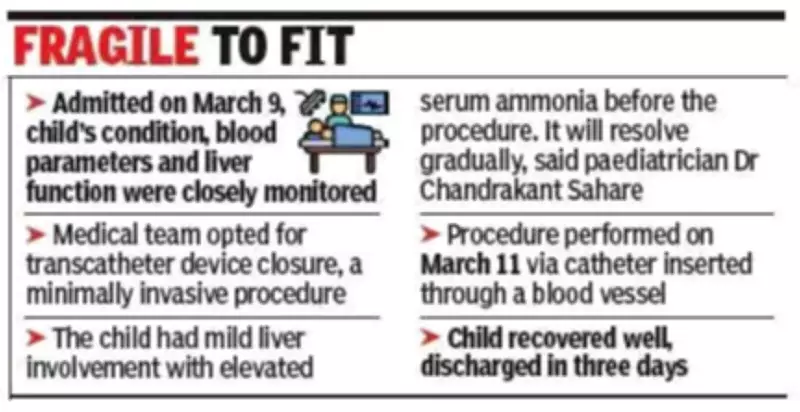
Prior to intervention, the toddler required hospital admission due to mildly elevated blood ammonia levels, which were managed conservatively. Consultant intensivist and pediatrician Dr. Chandrakant Sahare noted the child had shown "mild liver involvement with elevated serum ammonia levels and occasional increased nasal bleeding."
The Minimally Invasive Breakthrough Procedure
On March 9, the medical team at Vishwaraj Hospital admitted the child for comprehensive evaluation of her clinical condition, blood parameters, and liver function. After careful assessment, doctors decided to perform a transcatheter device closure—a minimally invasive cardiac procedure.
Dr. Satyajit Funde, hospital radiologist, explained the approach: "We performed detailed angiography to measure portal venous pressure and blood flow dynamics through catheter insertion."
During the March 11 procedure, cardiac anesthesiologist Dr. Vitthal Shendage described the critical moment: "Once we confirmed the abnormal connection could be safely closed, we deployed a specially designed occlusion device to block the shunt."
Post-procedure imaging and sonography confirmed:
- Correct positioning of the occlusion device
- Successful restoration of blood flow to the liver
- Closure of the abnormal vascular connection
Successful Recovery and Long-Term Outlook
The child responded exceptionally well to the procedure and was discharged within just three days. "We expect normal circulation to continue, and this closure represents a permanent solution with minimal chances of recurrence," added Dr. Banpurkar.
Dr. Sahare expressed optimism about the resolution of previous symptoms: "With the abnormal connection now closed, the issues of elevated ammonia levels and nasal bleeding should gradually resolve."
Importance of Early Detection and Specialized Care
This case highlights the critical importance of early diagnosis and specialized intervention for congenital conditions. The successful outcome was made possible by:
- Antenatal diagnosis allowing for early monitoring
- Multidisciplinary medical team collaboration
- Advanced minimally invasive surgical techniques
- Careful pre- and post-operative management
"If left untreated, such abnormal circulation could lead to severe complications affecting multiple organ systems," warned Dr. Banpurkar, underscoring the importance of timely medical intervention for rare congenital disorders.






