

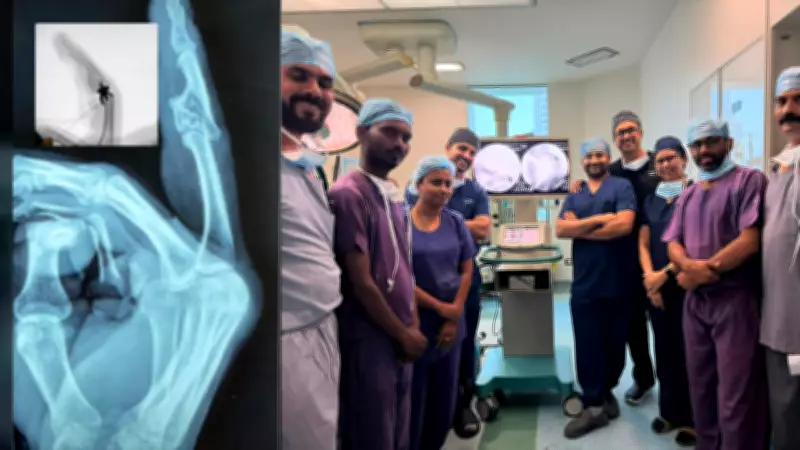
In a rare and highly advanced hand reconstruction procedure, doctors successfully restored movement and function in the hand of a 46-year-old mechanical engineer who was left unable to bend his fingers following a severe road traffic accident. This was a case of finger joint replacement surgery performed for post-traumatic finger joint destruction.
Accident and Initial Treatment
Sandip Sonawane from Mumbai sustained multiple injuries to his right hand and leg after a fatal bike accident in December 2025. While his tibia fracture was treated initially, the injuries to his middle, ring, and little fingers became stiff and deformed over the following weeks due to delayed referral and prolonged immobilization. By the time he reached the specialist hand reconstruction team at Gleneagles Hospital, Parel, nearly three months later, even simple activities like holding a spoon, buttoning clothes, gripping objects, or writing had become extremely difficult.
Staged Surgical Treatment
The treatment was performed in stages by a skilled team headed by Dr. Kushal Shah, Dr. Vashisht Dikshit, and Dr. Raghav Mago. The first surgery, conducted in February 2026, corrected the deformity of the ring and little fingers. The experts performed a corrective osteotomy and fixation with screws to realign the bones and restore movement. Over the next eight weeks, with rehabilitation and physiotherapy, the patient regained near-normal movement in both fingers.

Challenge of the Middle Finger
However, the middle finger posed a significant challenge. The joint had healed in a damaged and deformed position, with severe arthritis and collapse of the middle finger joint, making conventional reconstruction nearly impossible. Dr. Kushal Shah, Hand Reconstructive and Brachial Plexus Surgeon and Head of the AURA Hand Surgery Unit at Gleneagles Hospital, Parel, explained, “The ring and little fingers responded very well after corrective surgery and rehabilitation. But the middle finger joint was extensively crushed and arthritic. Simply fixing the bone would not have restored meaningful movement or hand function.”
PIP Joint Replacement
After detailed evaluation and CT imaging, the team decided to proceed with a proximal interphalangeal (PIP) joint replacement for the middle finger. In simple terms, the damaged finger joint was replaced with an artificial joint, similar in concept to knee replacement surgery performed for arthritis patients. The aim was to restore movement, reduce stiffness, and enhance hand utility. The surgery was successfully performed on May 6, 2026, and the patient was discharged the very next day on May 7.
Recovery and Rehabilitation
According to the doctors, the patient has already achieved nearly 20 to 70 degrees of movement in the operated finger within the first week after surgery, with expectations of further improvement over the next few months through dedicated physiotherapy. “Hand function is deeply connected to independence and confidence. For someone who works with machinery and tools every day, losing finger movement can be emotionally and financially devastating. Restoring movement means helping the patient return not only to work but also to normal life,” the doctors added.
The patient’s recovery has been encouraging so far, with swelling significantly reduced and sutures already removed. He is expected to continue physiotherapy for the next three months to improve flexibility, strength, and long-term function.
Patient's Perspective
Sandip Sonawane shared his experience: “After the accident, my hand slowly became stiff and unusable. I was unable to hold things properly or even do simple daily activities comfortably. It became very frustrating because I could not use my dominant hand the way I used to. The first surgery gave me good movement back in my ring and little fingers, which gave me confidence again. But the middle finger was still very stiff. After this joint replacement surgery, I already feel a big improvement in movement and comfort. I finally feel hopeful about getting back to normal life and work.”

Hospital's Commitment
Dr. Bipin Chevale, CEO of Gleneagles Hospital Parel, said, “This surgery reflects the hospital’s commitment to advanced reconstructive care. Complex hand injuries can severely affect a person’s livelihood, independence, and emotional well-being. Procedures like these require not only surgical expertise but also long-term rehabilitation planning. We take pride in supporting innovative surgeries that help patients regain function and rebuild their lives.”
