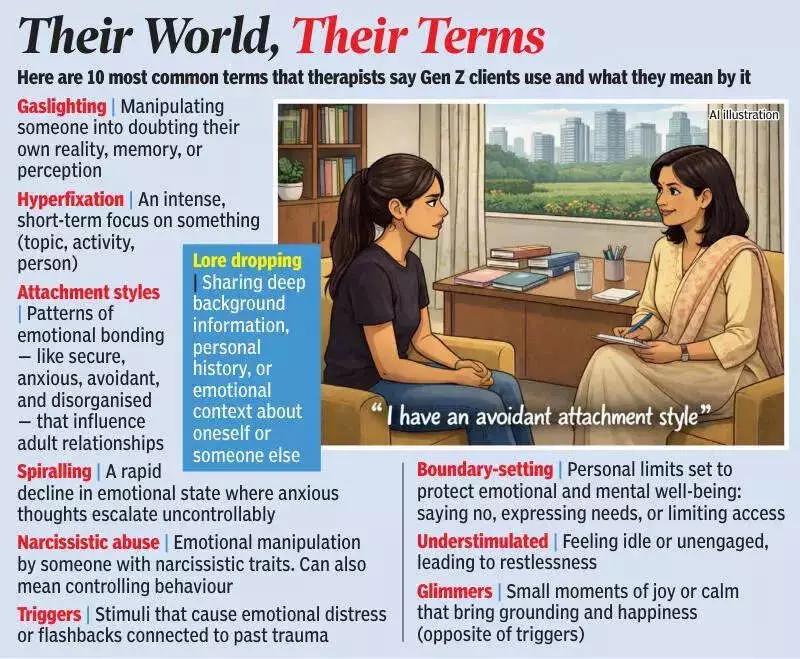
When 19-year-old Aanya from Delhi entered her first therapy session recently, her opening statement took the professional by surprise. "I am looking for someone to lore drop on," she began, before explaining she had "an avoidant attachment style." This encounter is not isolated. Across India, mental health practitioners are noting a significant shift in how the youngest generation articulates emotional distress, borrowing vocabulary directly from Instagram reels, podcasts, and online therapy culture.
The New Lexicon of Distress
The language used by Generation Z to discuss emotions is dramatically different from that of their predecessors. Where older patients might have described feeling "stressed" or "sad," young people today arrive with a ready-made psychological dictionary. Dr. Gorav Gupta, a senior psychiatrist at Delhi's Tulasi Healthcare, observes that this reflects a much greater exposure to mental health conversations online over the past five years.
Dr. Hvovi Bhagwagar, a Mumbai-based psychologist, lists the common terms: "Gaslighting, trauma responses, emotional flooding, low-dopamine mornings, hyperfixation, boundary setting." She emphasizes that this is more than a semantic change. This linguistic shift is actively reshaping how therapy begins, the pathways treatment takes, and how Gen Z conceptualizes their internal world.

The Double-Edged Sword of Awareness
This new vocabulary presents both opportunities and challenges for therapists. On one hand, Dr. Gupta notes that Gen Z clients are often more emotionally expressive, less hesitant to seek help, and better at articulating internal distress. The stigma around mental healthcare is reducing, with many young people, encouraged by online content, seeking therapy independently rather than being brought by parents.
However, a significant downside is the trend of "over-pathologising" normal emotional experiences. Ordinary sadness, academic pressure, or relationship conflicts are sometimes immediately framed as trauma or psychiatric illness. Dr. Bhagwagar explains that much of her initial work now involves asking, "What do you mean when you say this?" to unpack a client's interpretation of a viral term before clarifying its clinical meaning.
The Rise of Problematic Self-Diagnosis
Psychologists across cities report a sharp increase in teenagers arriving with pre-decided diagnoses. Chennai-based psychologist Chitra Arvind meets teens weekly who self-diagnose with conditions like ADHD or borderline personality disorder before any clinical assessment. While some do have these conditions, many are describing common stress or emotional overwhelm.
Dr. Astik Joshi, an adolescent psychiatrist, shared a concerning case from Delhi. A 14-year-old boy presented with gender dysphoria and panic attacks. Upon evaluation, it was discovered his distress stemmed from overexposure to a social media influencer encouraging gender transition. With therapy, his complaints were resolved. In another instance, a 16-year-old girl seeking treatment for PTSD was actually experiencing a psychotic break.
Dr. Bhagwagar points to the explosion of mental health influencers, not all of whom are trained. "Many influencers use catchy words and emotional hooks to go viral, and these terms get picked up and used for self-diagnosis," she said. This leads to another worrying trend: youngsters applying these labels to people around them, believing every disagreement is "gaslighting" or every strict parent is "narcissistic."
Empowerment and a Call for Adaptation
For many young Indians, this language is empowering. Ritvik, a 19-year-old Delhi college student, says terms like "shutdown" or "spiralling" accurately describe his feelings better than vague statements like "I'm sad." Shinjini, a 21-year-old from Kolkata, finds this lexicon provides a fast way to communicate feeling overwhelmed without lengthy explanations.

Recognizing this shift, therapists are evolving their own practices. Skills like media-informed psychoeducation and flexibility in language have become essential. Dr. Bhagwagar learns Gen Z lingo from her son and follows qualified influencers to stay connected. Dr. Gupta summarizes the therapist's new task: to validate feelings while gently reframing them in clinically accurate ways, a translation that has become a core therapeutic skill.
The convergence of pandemic isolation, online schooling, and digital childhood loneliness has accelerated this change. For Gen Z, as Ayushi, a 21-year-old from Noida, puts it, therapy is now viewed as "going to the gym for your mind"—a shift from crisis management to aspirational self-care, narrated in a language born from the screen.