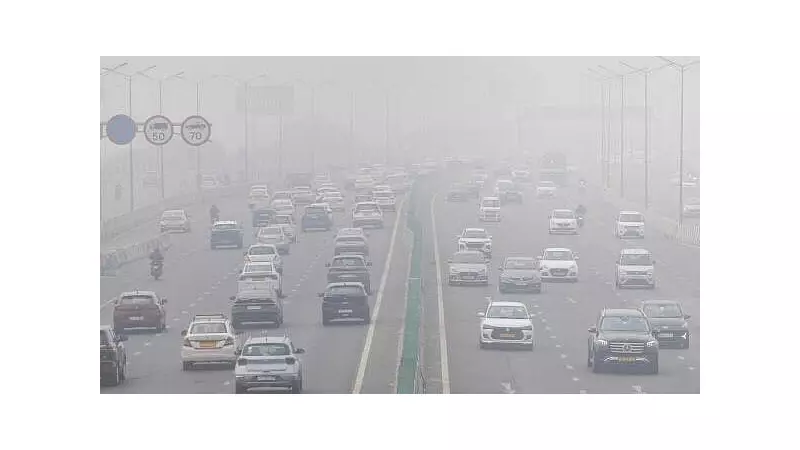
A recent analysis has exposed a critical gap in India's fight against toxic air. While 44 cities across the country have been suffering from chronic air pollution for five consecutive years, the government's flagship National Clean Air Programme (NCAP) currently covers only four of them. This stark finding comes from a report by the independent think tank, Centre for Science and Environment (CSE), based on official data.
The Alarming Scale of Persistent Pollution
The CSE report, titled 'State of India's Environment 2024', scrutinized particulate matter (PM2.5) data from the Central Pollution Control Board (CPCB). It identified 44 cities where the annual average PM2.5 levels consistently remained above the national ambient air quality standard (NAAQS) of 40 micrograms per cubic metre (μg/m³) from 2019 to 2023. This defines them as areas with chronic pollution problems requiring sustained and targeted intervention.
The list of these 44 cities is dominated by regions in the Indo-Gangetic Plain, but also includes urban centers from other parts of India. Major metros like Delhi, Mumbai, Kolkata, and Bengaluru feature on this list, alongside other significant cities such as Pune, Ahmedabad, Chennai, and Hyderabad. The analysis indicates that air pollution is not a seasonal or localized issue for these cities, but a year-round public health emergency.
The NCAP's Limited Reach and the Funding Gap
Launched in 2019, the National Clean Air Programme is a crucial national-level strategy designed to tackle air pollution. It aims to achieve a 20-30% reduction in PM2.5 and PM10 concentrations by 2024 in identified non-attainment cities. However, the CSE report highlights a major shortfall in its implementation scope.
Out of the 44 chronically polluted cities, only four—Delhi, Kolkata, Mumbai, and Pune—are included under the NCAP's city-specific action plans. This means the vast majority of cities battling dangerous air quality levels for years are not receiving the focused, funded attention mandated by the national programme. The report further points out that even among the 131 cities originally identified under NCAP, only 57 have so far been granted funds to execute their clean air plans.
The financial commitment also appears inadequate. The report notes that the total funds sanctioned for city action plans under NCAP stand at approximately Rs 9,000 crore, but a significant portion of this remains unutilized. This underscores challenges not just in designation, but also in the effective deployment of resources.
Implications and the Call for Urgent Action
This discrepancy between the scale of the problem and the scope of the national response has serious consequences. Millions of citizens in the 40 uncovered cities continue to breathe unhealthy air without the benefit of a coordinated, NCAP-driven mitigation strategy. Chronic exposure to PM2.5 is linked to a host of severe health issues, including respiratory diseases, heart problems, strokes, and increased mortality rates.
The CSE report serves as a urgent wake-up call for policymakers. It argues for an immediate and significant expansion of the NCAP to encompass all cities identified with chronic pollution. This expansion must be backed by robust funding, stringent monitoring of implementation, and clear accountability mechanisms. The report also emphasizes the need for stronger source-specific interventions, such as controlling emissions from vehicles, industry, construction, and waste burning, which are common contributors across the identified cities.
As India continues to urbanize rapidly, the quality of the air in its cities is directly linked to the health of its economy and its people. Bridging the gap between the list of chronically polluted cities and those receiving targeted aid under NCAP is not just a bureaucratic necessity, but a fundamental requirement for safeguarding public health and ensuring sustainable development.