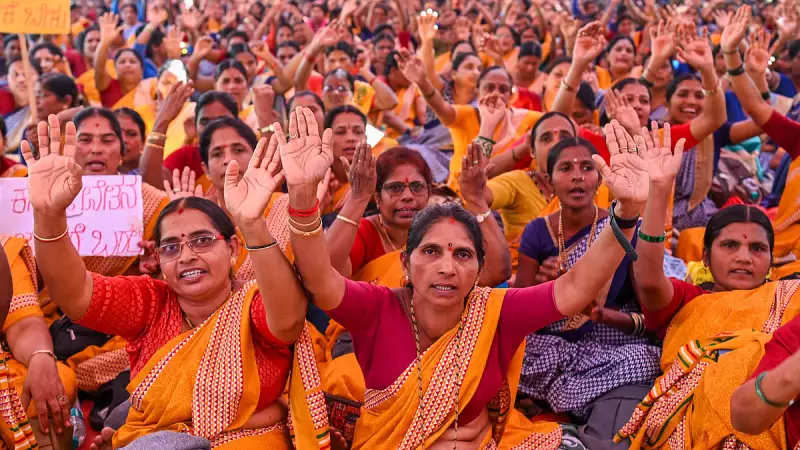
Five decades after their establishment, India's vast network of Anganwadi centres, the frontline of child nutrition and maternal health, continues to grapple with fundamental systemic failures. While governments have rolled out numerous health schemes over the years, the core issues faced by the Anganwadi workers who run these centres remain largely unaddressed.
Schemes Abound, But Core Support Lags
Successive administrations have introduced several initiatives aimed at combating malnutrition and promoting institutional deliveries. These schemes, often launched with much fanfare, are designed to improve health outcomes for women and children across the nation. However, the implementation of these programs hinges on the Anganwadi workers, whose own professional challenges are frequently overlooked in policy planning.
The focus has predominantly been on beneficiary-oriented programs, while the ecosystem required to sustain these workers—including timely funds, adequate infrastructure, and respectful remuneration—has not received commensurate attention. This creates a critical disconnect between policy objectives and on-ground execution.

The Unheard Voices of the Workforce
Anganwadi workers, predominantly women, serve as the crucial link between the community and the public health system. They are responsible for providing supplementary nutrition, pre-school education, and basic health services. Despite their pivotal role, reports consistently highlight problems such as delayed honorarium payments, excessive non-core duties, and a lack of formal recognition as government employees.
These operational hurdles directly impact the efficacy of the very health missions they are meant to support. When workers are burdened with logistical and financial insecurities, their capacity to deliver quality care and nutrition services is inevitably compromised.
A Legacy of Promises Versus Reality
The report, highlighted on 20 December 2025, underscores a persistent trend. As the Anganwadi system marks 50 years, its anniversary is shadowed by unresolved grievances. The situation in Karnataka, as noted in the news, reflects a nationwide concern. The 'fundas' or fundamentals of empowering the workforce are missing, even as funds are allocated for broader schemes.
The long-standing nature of these issues suggests that piecemeal solutions are insufficient. There is a growing call for a holistic review that places the Anganwadi worker's dignity, professional growth, and working conditions at the center of any reform strategy. Without this, the fight against malnutrition and for maternal health lacks its most vital soldier.
The journey of five decades reveals a stark truth: the health of a nation's children is inextricably linked to the well-being of those who care for them at the grassroots. Until their struggles are sincerely addressed, the full potential of India's nutritional and health security framework will remain unrealized.