

Chakan Stray Dog Tragedy: Activists Hold Municipal Council Accountable for Woman's Death
Residents and activists in the industrial town of Chakan have squarely blamed the Chakan Municipal Council's persistent inaction against stray dogs, despite repeated warnings, for the tragic death of a woman in the early hours of Monday. The incident has ignited fierce criticism and demands for accountability, with many asserting that stronger preventive measures could have averted this loss of life.
History of Warnings Ignored
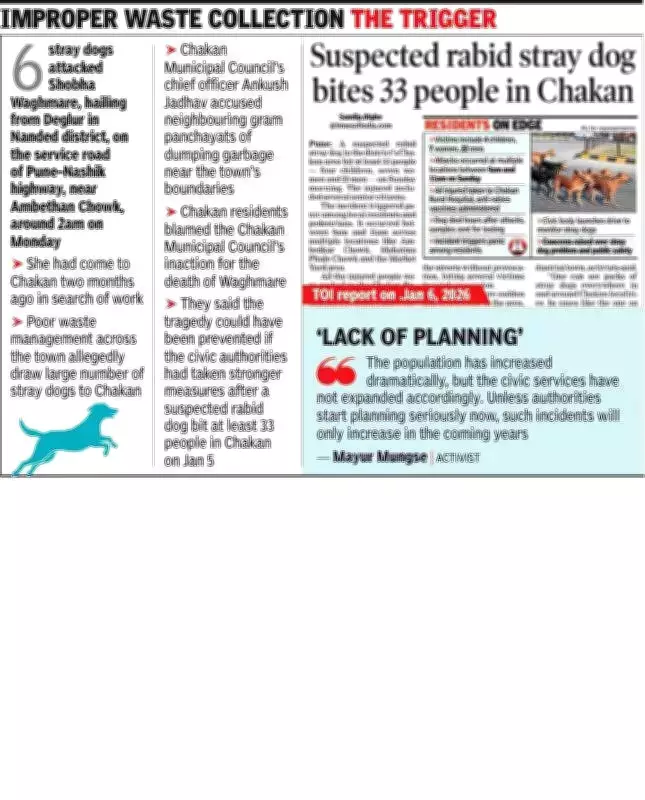
According to local reports, this tragedy follows a serious incident earlier this year where a suspected rabid dog bit at least 33 people on January 5, 2026. The Times of India highlighted this event in its January 6 edition, serving as a stark warning to authorities. Activist Mayur Mungse from Chakan expressed deep frustration, stating, "If they had taken proper preventive measures then, this innocent woman would have been alive today." He emphasized that the council's failure to act on this prior incident directly contributed to the current fatality.
Details of the Attack and Broader Issues
The victim, identified as Shobha Waghmare from Deglur in Nanded district, was attacked around 2 a.m. on Monday on the service road of the Pune–Nashik highway. This attack has once again spotlighted the severe deficiencies in stray dog management and garbage disposal within Chakan. Mungse questioned, "Who is responsible for the death of this woman? The municipal council officials cannot escape accountability." He noted that residents are living in constant fear while authorities continue to offer excuses rather than solutions.

Another activist and lawyer, Mahesh Bhiware, pointed to poor waste management as a root cause, drawing large numbers of stray dogs to the town. "Garbage heaps can be seen at almost every corner. These open dumping spots become feeding grounds for stray dogs," Bhiware explained. He argued that without ensuring basic cleanliness, the council cannot effectively control the stray dog population, creating a vicious cycle of public safety hazards.
Compounding Factors and Public Safety Concerns
The problem escalates significantly during the weekly bazaar, when numerous villagers from across Khed taluka visit Chakan to sell goods at the Agricultural Produce Market Committee (APMC) market. Bhiware highlighted, "Chakan is not just an industrial town, but also a traditional market hub. Thousands of people visit it every week." The presence of aggressively roaming stray dogs in such crowded areas transforms into a critical public safety issue, endangering both locals and visitors alike.
Municipal Council's Response and Defenses
In response to the criticism, officials from the Chakan Municipal Council defended their actions. Chief officer Ankush Jadhav stated that they have intensified stray dog vaccination efforts following the January incident, vaccinating approximately 600 dogs in recent weeks. The council also operates a shelter with a capacity for about 100 dogs, where strays are caught, vaccinated, and released after treatment.
Jadhav shifted part of the blame to neighboring gram panchayats, accusing them of aggravating the problem by dumping garbage near Chakan's boundaries. "Garbage from surrounding villages is often dumped along our borders. This attracts stray animals and creates a major challenge for us," he said. The council has been communicating with these panchayats, urging cooperation to address the issue collectively.
Underlying Infrastructure Challenges
Chakan has experienced rapid population growth over the past decade due to industrial expansion, yet civic infrastructure has struggled to keep pace. Activists warn that without serious planning and proactive measures, such dog attacks are likely to increase in the coming years. Mungse cautioned, "Unless authorities start planning seriously now, such incidents will only increase." This sentiment underscores the urgent need for comprehensive strategies that integrate waste management, animal control, and urban planning to safeguard public health and safety in growing towns like Chakan.






