

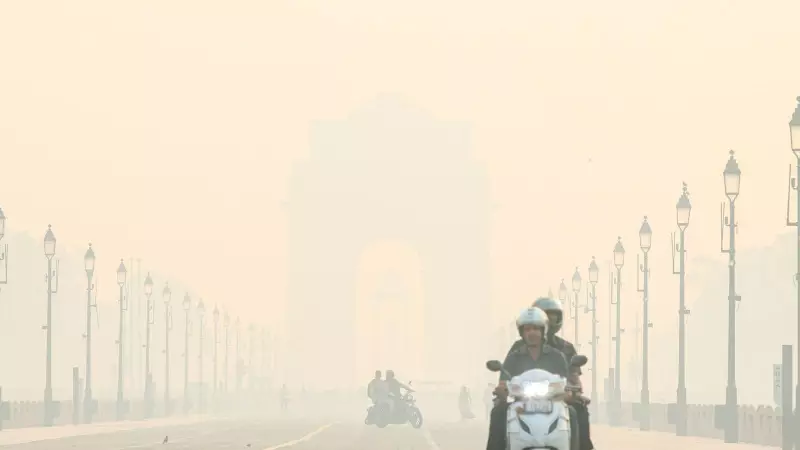
Delhi Wakes Up to a Toxic Blanket as Air Quality Plummets
The national capital, Delhi, found itself shrouded in a dense, toxic layer of smog on Sunday morning, with pollution levels climbing to alarming heights and visibility dropping significantly across the city. According to data released by the Central Pollution Control Board (CPCB), the overall Air Quality Index (AQI) at 7 am was recorded at 391, firmly placing it in the 'Very Poor' category.
Key Areas Gripped by Severe and Very Poor Air
The situation was particularly dire in numerous localities. Data revealed that 22 out of the 39 air quality monitoring stations in the city registered air in the 'Severe' category. The area of Bawana reported the worst air with an AQI of 436, closely followed by Wazirpur and Rohini, both logging an AQI of 435.
Visual evidence from across the city painted a grim picture. Drone footage captured from the Signature Bridge showed the city's skyline almost disappearing into a persistent haze. Morning scenes from prominent landmarks including India Gate, Kartavya Path, Lodhi Road, AIIMS, and Akshardham displayed dense, unsettling layers of smog settling over the capital.

Specific AQI data from Sunday morning highlighted the crisis:
- Akshardham and ITO were in the 'Severe' category with AQIs of 412 and 420 respectively.
- Lodhi Road recorded a 'Very Poor' AQI of 377.
- Other areas like Jawaharlal Nehru Stadium (398), Dwarka Sector 8 (383), and IGI Airport (358) also suffered from 'Very Poor' air quality.
Forecast and the Stubble Burning Factor
The forecast from the Indian Institute of Tropical Meteorology (IITM) offers little respite, predicting that the air quality is very likely to remain in the 'Very Poor' category from November 9 to 11. Adding to the city's woes, the IITM’s Decision Support System forecast indicated that stubble burning would contribute approximately 31% to Delhi's PM2.5 levels on Sunday.
The AQI scale, which classifies air quality from 'Good' (0-50) to 'Severe' (401-500), shows that the higher the reading, the more dangerous the air is for health. With multiple stations breaching the 400-mark, the national capital has entered the 'red zone' of pollution, prompting serious health concerns for its residents.






