

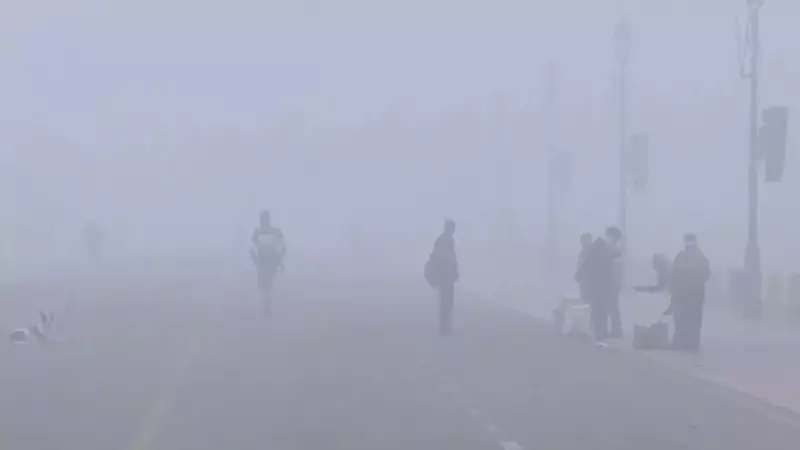
Residents of Delhi and the National Capital Region (NCR) woke up to a hazardous blanket of thick smog on Saturday morning, as air quality plummeted to 'severe' levels across large stretches, severely impacting visibility and health.
Alarming Air Quality Readings Across the Capital
The Central Pollution Control Board (CPCB) recorded an average Air Quality Index (AQI) of 380 for the region at 7 am, placing it in the 'very poor' category. However, numerous monitoring stations reported far more dangerous readings well above 400, which is classified as 'severe'.
Key areas recorded exceptionally high pollution levels:

- ITO area: AQI of 429
- Sarai Kale Khan and Anand Vihar: AQI of 428 each
- Akshardham: AQI of 420
- Ashok Vihar: AQI of 407
- Rao Tularam Marg: AQI of 403
- Barapullah flyover area: AQI of 380 ('very poor')
According to official categorisation, an AQI between 401 and 500 is considered 'severe', posing serious health risks to the public.
Government Swiftly Implements Stage-IV GRAP Measures
In response to the rapidly deteriorating air quality, the Commission for Air Quality Management (CAQM) immediately enforced Stage-IV measures of the Graded Response Action Plan (GRAP) across the entire Delhi-NCR.
The stringent restrictions include:
- A complete ban on all non-essential construction activities.
- Curbs on the entry of certain types of diesel-powered vehicles into the capital.
- Stricter enforcement actions to control all major pollution sources.
On-Ground Inspections and Health Advisory
Earlier on Saturday, Delhi's Environment Minister, Manjinder Singh Sirsa, conducted surprise inspections at several petrol pumps, including those at the Delhi-Gurugram border and Janpath. The inspections aimed to assess compliance with the 'No PUC (Pollution Under Control Certificate), No Fuel' directive, a key measure to reduce vehicular pollution.
The dense smog layer drastically reduced visibility, disrupting the morning commute for thousands and raising significant health concerns among citizens, especially those with respiratory conditions. Authorities have advised people to limit outdoor activities and use protective masks.






