

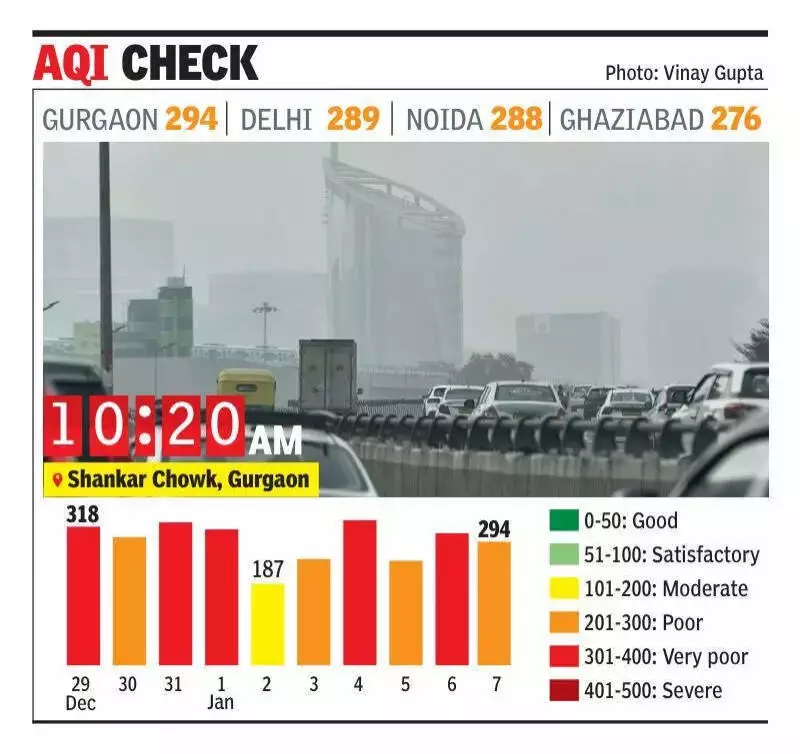
Residents of Gurgaon breathed a cautious sigh of relief on Wednesday as stronger winds swept through the city, helping to clear the dense layer of suspended pollutants that had choked the skyline. This meteorological shift pulled the city's overall Air Quality Index (AQI) down to 294, moving it out of the 'very poor' and into the 'poor' category.
Wind Speed Brings Temporary Respite
The key change came from a significant increase in wind speed, which rose to 10 kilometres per hour on Wednesday from a mere 3 kmph recorded on Tuesday. Officials from the pollution control authorities stated that this marginal improvement in wind speed overnight was crucial in dispersing the fine particulate matter that had accumulated over several days under calm, stagnant conditions.
All four air quality monitoring stations in the city were operational. The data revealed a mixed picture: while the overall situation improved, the Sector 51 station, managed by the Haryana State Pollution Control Board (HSPCB), continued to record the worst air at an AQI of 350, firmly in the 'very poor' range. The other stations reported slightly better numbers: Teri Gram logged an AQI of 294, Vikas Sadan 285, and Gwalpahari 238.

Persistent Health Hazards and Dominant Pollutants
Despite the improvement, experts and doctors were quick to warn that the current levels are still dangerously high. The dominant pollutant remained PM2.5 – microscopic particles that pose the greatest risk to human health. Prolonged exposure at these levels can cause breathing discomfort, especially for vulnerable groups including children, the elderly, and individuals with pre-existing lung or heart conditions.
The alarming concentration of pollutants was starkly evident in Tuesday's data. Sector 51 reported PM2.5 levels at 348 micrograms per cubic metre (µg/m³). Gwalpahari and Teri Gram each recorded 333 µg/m³, while Vikas Sadan reported 328 µg/m³. For the larger PM10 particles, Gwalpahari recorded the highest concentration at 327 µg/m³. These figures are massively above the annual safe limits set by the Central Pollution Control Board (CPCB), which are 40 µg/m³ for PM2.5 and 60 µg/m³ for PM10.
Medical Experts Issue Stern Warning
Dr. Neeraj Gupta, Associate Director of Pulmonology, Respiratory Critical Care and Sleep Medicine at Max Hospital, Gurgaon, explained the severe implications. "Prolonged exposure to high levels of PM2.5 and PM10 can have serious and long-term health consequences," he said. Dr. Gupta emphasized that these tiny particles penetrate deep into the lungs and can even enter the bloodstream, significantly elevating the risk of asthma, bronchitis, chronic obstructive pulmonary disease (COPD), heart attacks, strokes, and reduced lung function.
In light of the persistent poor air quality, medical professionals have advised residents to take precautions. They recommend limiting strenuous outdoor activities when the AQI remains above 200 and using protective masks, particularly in crowded areas or zones with high traffic density.
Forecast: A Rollercoaster of Air Quality Ahead
The temporary relief may be short-lived. Forecasts from the Decision Support System (DSS) indicate that while daytime winds may touch up to 16 kmph, the ventilation index over Delhi-NCR is expected to fluctuate. Dispersion conditions are likely to deteriorate on January 8 and 9, causing air quality to slip back into the 'very poor' category on Thursday and Friday. A slight improvement to the 'poor' range is anticipated around January 10.
In a related development, Delhi's 24-hour average air quality also showed marginal improvement, moving from 310 ('very poor') on Tuesday to 289 ('poor') on Wednesday. Station-wise data for the capital showed 19 stations in the 'very poor' category, 18 in 'poor', and one in 'moderate', with Nehru Nagar recording the worst AQI at 346.






