For three long years, Kamal Bhalla, a resident of Rajendra Park in Gurgaon, has been forced to purchase drinking water. Like many in his neighborhood, he has lost all trust in the water that flows from his tap. "We cannot take the risk. Many households here depend on bottled water," says Bhalla, whose story is a stark reflection of a city-wide crisis. Despite the tragic wake-up call from recent deaths in Indore due to contaminated water, visible change on the ground in Gurgaon remains elusive.
Aging Infrastructure and Invisible Threats
The lifeline of the city's potable water supply runs through pipelines that are 25 to 30 years old. These aging channels have been weakened by rising water pressure, frequent road digging for infrastructure projects, and repeated repairs, leading to inevitable cracks and leakages. However, the problem is not confined to old pipes alone. A glaring lack of maintenance compounds the danger.
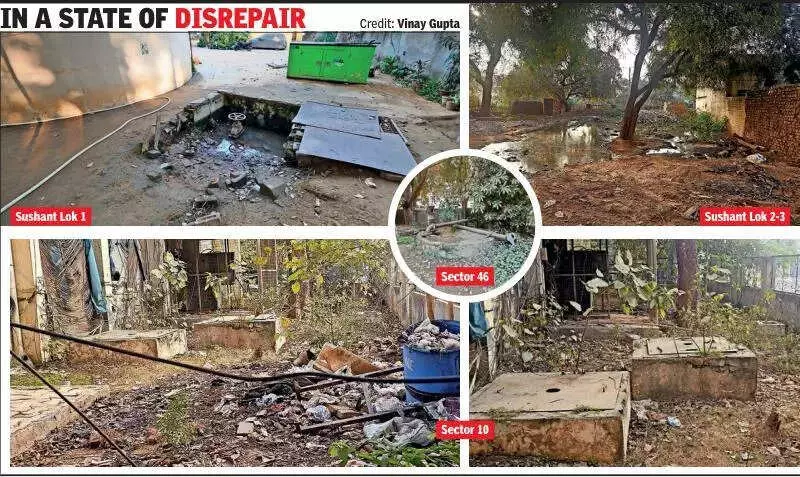
Gurgaon's water supply relies on 144 water boosting stations, critical facilities for storing and pumping water to residential areas. Shockingly, many of these stations lie in a state of severe neglect. Visitors find stagnant water, piles of garbage, overgrown vegetation, and in some cases, overflowing sewers nearby—all posing a direct contamination threat to the drinking water channels. Intermittent water supply further heightens the risk, as empty pipelines can develop negative pressure, sucking in contaminated groundwater or soil when the supply resumes.

Encroachment and a System in Disrepair
The neglect is palpable. Udaybir Singh Yadav from Sector 10A describes boosting stations that are meant to be restricted zones but are accessible to anyone. "Inside the premises, we find people bathing and carrying out other daily activities. There is filth, overgrown vegetation and unhygienic conditions all around," he says. In some locations, parts of the station premises have even been encroached upon by cowsheds and temporary huts.
The division of responsibility between authorities adds another layer of vulnerability. While the Gurugram Metropolitan Development Authority (GMDA) manages the bulk supply, the Municipal Corporation of Gurugram (MCG) is in charge of nearly 75% of the internal distribution network, including boosting stations and pipelines. Officials admit this split has made last-mile supply susceptible to lapses.
Ashok Dalwani, general secretary of Sushant Lok 1 RWA, points to the core issue: "Here, both water and sewer pipelines were laid nearly three decades ago. They were never replaced. Sewer overflows are common... wherever there is leakage or overflow, the risk of contamination increases."
Contamination Incidents and a Plea for Action
The theoretical risks have materialized into real health emergencies. In December last year, over 100 residents of BPTP Astaire Gardens in Sector 70A, including children, senior citizens, and pregnant women, fell ill after consuming contaminated water. Health department tests confirmed the water was unfit due to coliform contamination, indicating sewage had mixed with the supply.
The city's water demand already outpaces supply. GMDA supplies about 670 million litres per day (MLD) against a peak demand of roughly 700 MLD, with the shortfall often met through potentially unsafe municipal borewells and private tankers.
Resident Welfare Association (RWA) heads highlight specific dangers. Pawan Yadav of Sushant Lok 2 and 3 reveals that in his areas, drinking water pipelines intersect with drains and cross sewer manholes. "Any leakage or corrosion can directly contaminate the supply. We have written to MCG to relocate it to prevent any health crisis," he states, adding that underground tanks haven't been cleaned in three years and water from submersible sources receives no chlorination.
Deepak Verma, RWA president of Sushant Lok 1, laments the absence of a scientific monitoring system. "There is no system for routine bacterial testing. Chlorination and bleaching are not carried out. Underground pipelines remain unchecked for years," he says. By the time residents notice foul-smelling or muddy water, contamination has already entered the system.

The Path Forward: A Multi-Pronged Solution
Addressing this deep-seated crisis requires a comprehensive strategy. Experts and officials agree on key steps:
- Replacing decades-old pipelines, especially in older, unplanned areas where they often run perilously close to sewer lines.
- Promptly fixing leakages and ensuring periodic cleaning of underground reservoirs, ideally every two to three years.
- Upgrading and securing the neglected water boosting stations.
- Establishing a robust, routine water quality monitoring regime at the distribution level.
- Training MCG station operators adequately in chlorination and disinfection procedures.
A senior MCG official, while asserting that providing clean water is the corporation's top priority, acknowledged the challenges. A former GMDA engineer explained that contamination risk is highest in older, unplanned localities with narrow lanes, private connections, and crumbling infrastructure.
For residents like Kamal Bhalla, however, official assurances ring hollow against the daily reality of buying water to stay safe. The need for urgent, visible action to secure Gurgaon's drinking water has never been more critical.