

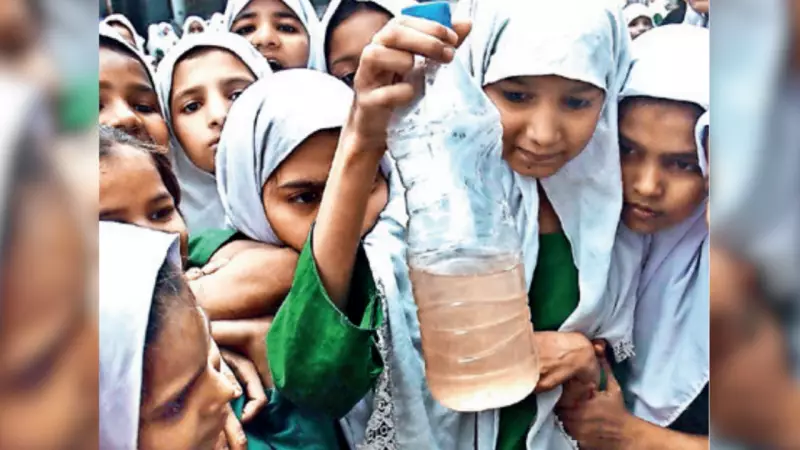
Hyderabad's daily water supply of 600 million gallons is under severe threat, with multiple studies highlighting alarming pollution levels in its primary sources. The city draws water from six locations: Osmansagar, Himayatsagar, Singur, Manjira, Akkampally (Krishna), and Sripada Yellampalli (Godavari). Recent research indicates that four of these crucial sources are contaminated to varying degrees.
Osmansagar in Critical Condition, Faecal Contamination Found
A study titled 'Assessment of Water Quality of Osmansagar', published in September 2025 by scholars from Maulana Azad National Urdu University (MANUU), has sounded a major alarm. It classifies the water quality index of Osmansagar as 'very poor'. The research clearly points to the presence of faecal contamination, indicating significant health hazards for those exposed to or using this water.
The primary reasons for this crisis are the flow of untreated sewage from nearby residential areas and the discharge of industrial effluents into the lake. The study also highlights that the use of pesticides and fertilisers in surrounding agricultural fields contributes to the pollution. It stresses the urgent need to identify the exact points of contamination and seal them. The report recommends stricter regulation of local industries and educating citizens on proper waste disposal to tackle the problem.

Krishna and Godavari Rivers Under Industrial Stress
The pollution problem extends far beyond city lakes. A March 2025 report by the National Institute of Technology (NIT) Warangal details how the Krishna river is polluted by multiple industrial clusters in Telangana. These include pharmaceutical units, heavy water production facilities, and synthetic chemical industries. The report specifically identifies Nagarjunasagar, from where Krishna water is pumped to Hyderabad, as a key affected stretch.
It raises an alarm over water quality for both urban supply and irrigation, noting industrial pollution hotspots in districts like Medak. Similarly, a joint study by the National Environmental Engineering Research Institute (NEERI) and IIT-Hyderabad found that untreated wastewater is being discharged directly into the Godavari river from the Ramagundam and Mancherial regions.
This is particularly concerning because the Sripada Yellampalli project in Peddapalli district, which supplies about 162 MGD of Godavari water to Hyderabad, is located downstream of these pollution sources. The study notes that these issues lead to degraded water quality, damaged aquatic ecosystems, public health risks, and increased challenges for water treatment facilities.
Ageing Pipelines Amplify Contamination Risk
Compounding the source-level pollution is Hyderabad's deteriorating water distribution network. Experts warn that the city's ageing pipeline infrastructure poses an additional, severe risk to drinking water safety. Frequent leakages, corroded pipes, and the close proximity of water lines to sewer networks significantly increase the chance of cross-contamination.
Anant Maringanti, director of Hyderabad Urban Lab, emphasized the immediacy of the danger. He stated that with drinking water and sewer lines often running parallel or intersecting, invisible cracks and weak joints in the old infrastructure mean contamination can happen anywhere, at any time. This is not a theoretical risk but a real and present danger to public health.
The convergence of polluted source water and a vulnerable distribution system creates a perfect storm for Hyderabad's water security, demanding immediate and sustained intervention from authorities and increased public awareness.






