

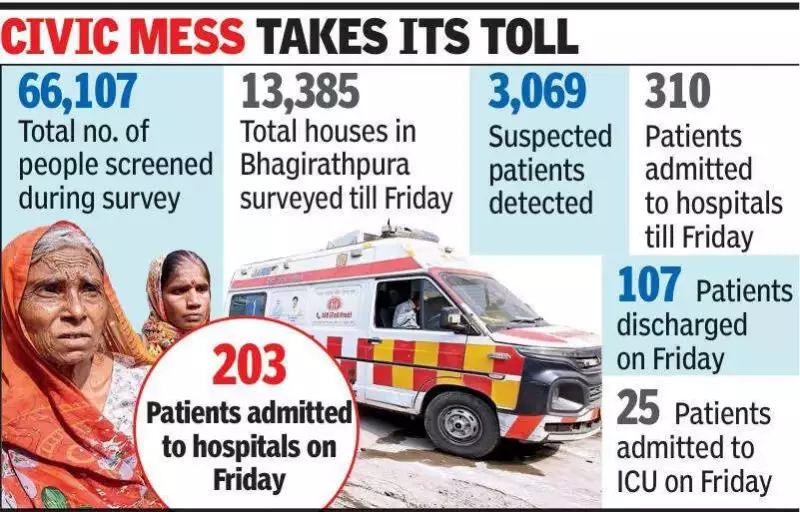
Life in Indore's Bhagirathpura area began a slow and sorrowful return to normalcy on the fifth day of a severe diarrhoea outbreak. Residents started coming back from hospitals to find their neighbourhood buzzing with activity from the Indore Municipal Corporation (IMC) and the health department, a response that many felt was long overdue.
Residents Return Home to Lingering Problems
As families reunited, complaints about the root cause of the illness resurfaced loudly. Subhash Savarkar, a patient in his 50s who spent four days in hospital, expressed the community's frustration. He revealed that residents had been complaining for months about contaminated water and filthy back lanes, but their pleas had fallen on deaf ears until the outbreak forced authorities to act.
The relief of homecoming was palpable for the family of Dhairya Sunahare, the outbreak's youngest victim at just one month and nine days old. He returned home in his father's arms on Friday, while his mother continued her fight against the illness. His father, Shubham Sunahare, recounted the terrifying ordeal, stating the infant was rushed to the ICU with severe diarrhoea and vomiting after being fed milk mixed with tap water. "He had to be given milk through a tube in the nose and we could only watch through a glass partition," the overwhelmed father told reporters.

Health Department Launches Intensive Survey
In response to the crisis, the health department initiated a comprehensive ring survey in Bhagirathpura. The operation involves checking 50 houses around each identified hotspot, with 20 teams deployed on the ground. Dr. Anshul Mishra, a doctor deployed from Dewas, explained that medical staff from Indore and Ujjain divisions are collecting water and drainage samples. The primary goal is to determine if there is any dangerous mixing of sewage with the drinking water supply.
By Friday evening, Dr. Madhav Prasad Hasani, Indore's Chief Medical and Health Officer (CMHO), reported significant progress. In an official release, he stated that 3,679 houses had been surveyed, leading to the identification of approximately 141 patients affected by the outbreak.
Multi-Agency Response and Community Care
Since Thursday, the area has transformed into a hub of containment activity. IMC water tankers are now supplying clean water, sanitation crews are scouring the roads, and officials from the water works department are inspecting pipelines for leaks. Simultaneously, health workers are actively searching for new cases.
Anganwadi workers are playing a critical role in safeguarding the community's children. Kalpana, one such worker, detailed their door-to-door efforts to monitor children's health, particularly those already identified as malnourished. "We have a record of malnourished children. We have also found some of them ill. But no casualties have been noted," she said, adding that these vulnerable children were the most affected by diarrhoea and vomiting, and would be provided with special nutrition.
Amidst the grim statistics, stories of recovery bring hope. 13-year-old Savitri Ahirwar, the only member of her four-person family hospitalized, smiled again after returning home. She credited timely medical intervention for her recovery and has now become vigilant about the water she drinks, a hard-learned lesson from the public health crisis that has shaken her neighbourhood.






