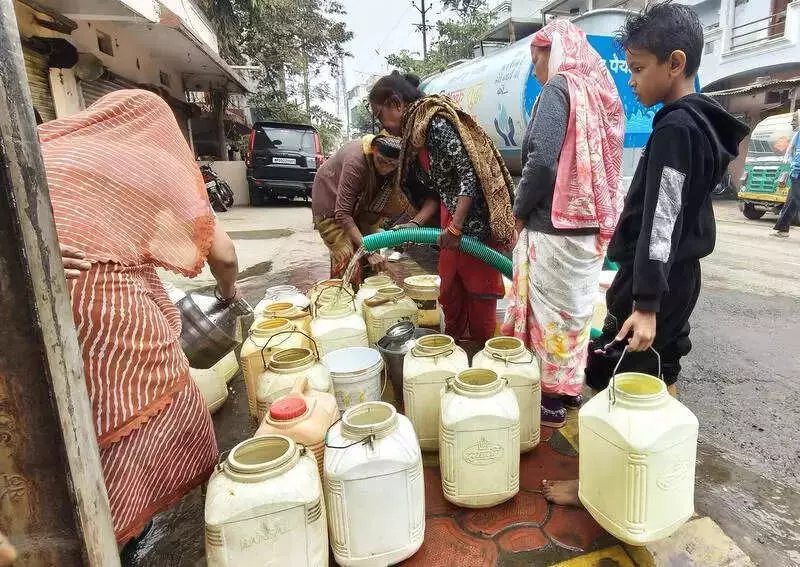
The supply of contaminated, sewage-mixed water in Indore's Bhagirathpura area has been traced back to a critical administrative failure: the prolonged delay in replacing ageing water pipelines, a project that has stretched across the tenures of five different municipal commissioners. Administrative records reveal a story of bureaucratic hold-ups that have compromised water safety for residents.
A Legacy of Improvisation and Delay
Before 1997, Bhagirathpura relied solely on borewells for its water. The landscape changed between 1997 and 2001 when new overhead tanks and pipelines for Narmada water were installed. However, delays in launching the Narmada supply at that time led to a makeshift solution. To initiate distribution, the existing borewell lines were directly connected to the new Narmada network.
This connection was a departure from the original plan, which was to collect borewell water in a central sump. Because the borewells were scattered, they were linked straight to the distribution lines. This created a hybrid system where both Narmada and borewell water began flowing through the same pipes—a practice that continues to this day, long after the Narmada supply commenced.

A Snail's Pace Replacement Project
Efforts to finally separate these systems and replace the old, corroded pipelines began approximately four years ago. The project, part of the larger national AMRUT 2.0 mission, aimed to lay new pipes across the ward.
For the first half of Bhagirathpura, covering 9.80 km, the process saw a series of delays. Tenders were invited in July 2022 after initiation in November 2021. While technical and financial clearances were secured two months later, it took an additional five months for the Mayor/MIC to issue the letter of allotment in February 2023. As of now, this work remains unfinished.
The story repeated for the remaining half of the ward. A separate project to lay 4 km of new lines at a cost of Rs 2.40 crore began in November 2024. Tenders for this phase were invited in July 2025. The tender committee finally granted its approval on December 30, 2025—a date that coincided with an ongoing outbreak of diarrhoeal diseases in the area, highlighting the urgent public health consequences of the delay.
Official Response and Priority
Addressing the crisis, IAS officer Kshitij Singhal, who recently took charge of the Indore Municipal Corporation (IMC), emphasized the administration's commitment. "Providing clean water is our priority," Singhal told TOI. He added that the work under the first tender, issued in 2023, is nearing completion.
The situation in Bhagirathpura stands as a stark reminder of how infrastructure projects, when caught in protracted bureaucratic processes, can directly endanger citizen health. The replacement of all old ACP pipelines is now a critical test for the local administration's ability to deliver on its promises under AMRUT 2.0.