

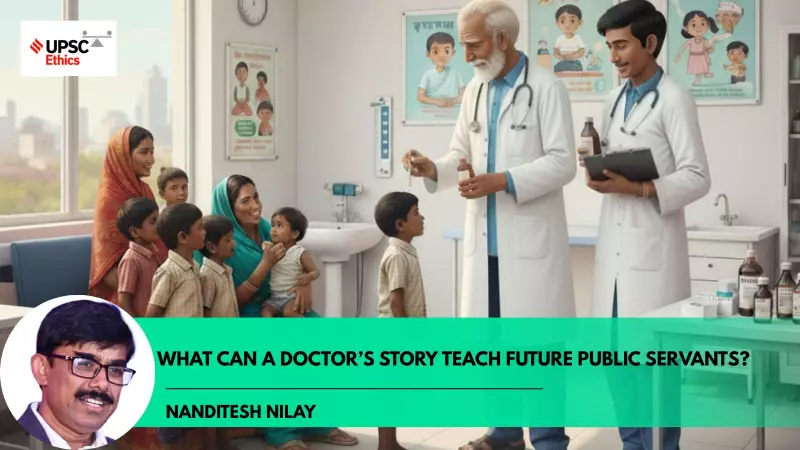
The recent cough syrup tragedy that led to multiple child deaths has sparked urgent conversations about medical ethics and the fundamental principles that should guide healthcare professionals. This incident highlights systemic failures that demand immediate attention, particularly for those preparing for civil services where ethical decision-making forms a crucial part of their future responsibilities.
The Hamdard Story: A Lesson in Medical Ethics
In what serves as a powerful case study for understanding medical ethics, the story of Senior and Junior Hamdard – a father-son doctor duo – demonstrates the core values that should define healthcare professionals. The senior doctor, widely respected in medical circles, and his son, who was still establishing his practice, shared a unique professional relationship built on mutual respect and care.
Their clinic attracted numerous patients, many of whom initially preferred consulting the experienced father. One particular patient, suffering from fever, cough, and cold, expressed confusion about which doctor to consult. Another patient advised him: "If your cough and cold are chronic, see the father. If not, meet the son." The patient eventually consulted Junior Hamdard and recovered completely within a month.

When the same patient returned later for his wife's migraine treatment, he found Junior Hamdard unavailable and had to consult Senior Hamdard. He expressed his appreciation for both doctors, telling Senior Hamdard: "Dr. Sahib, you are a walking God on this earth. Everybody speaks about you. But for me, your son is no lesser God."
The Turning Point in Professional Relationships
The story takes a significant turn when Junior Hamdard expresses concern about his father's health, questioning why the elderly doctor continues to see patients. The father's response reveals the essence of their relationship: "You, my son. You! I am sure you are doing it and you will continue to do so. But don't say I shouldn't see patients. I try to help others and simultaneously get the wonderful feeling of always being there for my son."
The next day, when Senior Hamdard unexpectedly didn't accompany his son to the clinic, patients who had come specifically for the father had to consult Junior Hamdard. While initially hurt by their preference for his father, Junior Hamdard maintained his professionalism, assuring patients: "My father is a better doctor than me. I will always be a student and a humbled son. But don't worry, you will be cured."
The climax occurs when Junior Hamdard discovers his father surrounded by fifty people who were trying to convince the elderly doctor to seek treatment from his own son. In a moment that perfectly demonstrates the ethics of care, Junior Hamdard approaches the gathering and declares: "Baba! He is my Baba. What are you all convincing him about? He is the Senior Hamdard." The father simply hugs his son and whispers: "Any advice for this old man, doctor?"
Connecting to Contemporary Ethical Challenges
This heartwarming story stands in stark contrast to recent healthcare failures, particularly the cough syrup tragedy that caused multiple child deaths. While the Hamdard doctors exemplify care, relationship-building, and responsibility, the syrup tragedy represents a catastrophic failure of these very principles.
Ethics expert Nanditesh Nilay explains that medical ethics revolves around care, relationships, dependency, and the highest form of empathy. Drawing from Carol Gilligan's work on ethics of care, he emphasizes that morality is primarily about care and responsibility rather than merely following impartial or universal principles.
The ethics of care focuses on responding to the needs of those directly or indirectly dependent on us, guided by virtues like love, kindness, and concern for others. This approach becomes particularly relevant in today's scenario where vulnerable groups – children, patients, and the poor – are most impacted by ethical lapses in healthcare systems.

Implications for Public Service and Governance
The Hamdard story transcends medical professional ethics and offers crucial lessons for public service aspirants. The father-son doctors build trust through consistent, caring behavior – exactly what citizens expect from public institutions and officials.
When systems fail, as demonstrated by contaminated syrups reaching children, the consequences are devastating. Ethics of care isn't an optional add-on but central to prevention of harm. Recent incidents show that while protocols may exist, oversight, quality control, and a genuine mindset of caring for the vulnerable were often lacking.
The key takeaway for UPSC aspirants is that ethics in governance means going beyond compliance to proactive care. It requires relational sensitivity and responsiveness rather than just ticking boxes. As future public servants, they must remember that ethics is lived through actions and attention to human needs, not merely through rules and regulations.
The story of Hamdard doctors serves as a powerful reminder that professionals have responsibilities not just to themselves or their careers, but to those they serve and to their relationships – a lesson that becomes increasingly important in light of recent healthcare tragedies.





