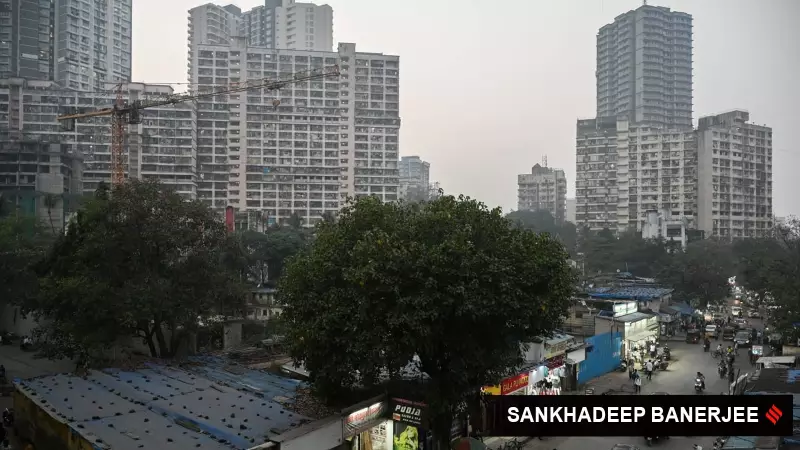
Residents of Mumbai's far-flung R-North ward are struggling to breathe clean air as a construction boom transforms their neighbourhoods. Located at the northern edge of the Brihanmumbai Municipal Corporation's (BMC) jurisdiction, this predominantly residential area, covering Dahisar and parts of Borivali, is witnessing a rapid shift from old low-rise buildings to towering high-rises. This unmonitored redevelopment, locals say, is directly responsible for a drastic dip in air quality, leading to a surge in health problems.
Dust, Neglect, and Failing Green Buffers
The Air Quality Index (AQI) in the area has completely deteriorated, according to local environment activist Himanshu Mehta. He alleges a systemic failure in monitoring construction sites, where basic dust-control measures like water sprinklers are ignored. "The BMC turns a blind eye," Mehta stated, pointing out that local clinics are now crowded with citizens suffering from pollution-induced ailments.
Despite possessing natural assets like the Dahisar River and numerous gardens, these potential buffers against pollution are rendered ineffective due to civic neglect. The long-pending revival and beautification of the Dahisar River, pending for over a decade, remains a broken promise. "Each time a new public representative comes with tall promises, but nobody has delivered on those," said Pankaj Trivedi of the citizens' group Mumbai March.
Public gardens, once a pride of the ward, are in a state of decay. Mehta, a Borivali resident, questioned the civic body's apathy: "What’s the point of having plenty of garden spaces when trees within are dying due to complete neglect?"
Vertical Growth Without Civic Planning
The redevelopment frenzy raises critical questions about the area's infrastructure readiness. Gopal Zaveri, also from Mumbai March, highlighted the lack of planning for the increased demand on essential services. Replacing 3-4 floor buildings with towers could triple the population density.
"Is the existing system of water supply ready to meet the projected increased demand? Are our existing roads prepared to take the load of additional traffic?" Zaveri asked, noting that the civic administration has not begun to address these looming challenges. He also pointed out that the ward's sole civic-run hospital, Bhagwati Hospital, does not operate at full capacity to serve even the current population.
Election Promises vs. Ground Reality
With the BMC elections scheduled for January 15, 2026, these civic failures are at the forefront of residents' concerns. Issues extend beyond middle-class housing societies to sizable slum areas. Sunil Yadav of Sthaniya Samiti noted that even basic resources like water and toilets remain a struggle for residents of Ganpat Patil Nagar in Borivali.
The political landscape is in flux. Historically dominated by the undivided Shiv Sena, which won five out of eight corporator seats last election, alliances have shifted. Four of those five corporators have switched sides, with three joining the Eknath Shinde faction and one strong candidate, Tejaswi Ghosalkar, joining the BJP. Tejaswi, daughter-in-law of Sena (UBT) stalwart Vinod Ghosalkar, is now contesting from Ward 2, creating a family divide as her brother-in-law contests on a Sena (UBT) ticket from a neighbouring ward.
Amidst the campaigning, residents express frustration. "It is ironic to see candidates seeking votes on the basis of their party’s national achievements, while residents here continue to grapple with routine civic issues," Trivedi observed. For the people of R-North ward, the demand is clear: action on rampant pollution, revival of green spaces, and infrastructure that keeps pace with reckless redevelopment.