

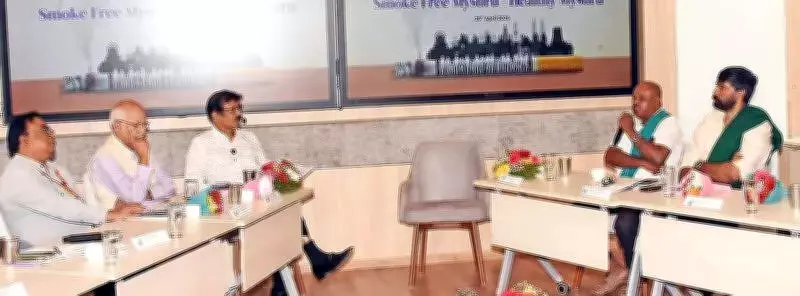
Mysuru: Setting an ambitious target of making Mysuru tobacco-free within 1,000 days, oncologist and chairman of Bharath Hospital & Institute of Oncology, Dr BS Ajaikumar, on Saturday called for urgent, sustained action combining strict enforcement, public participation and long-term health planning.
Chairing the panel discussion on 'Smoke-Free Mysuru, Healthy Mysuru', Dr Ajaikumar said tobacco is one of the biggest public health threats.
"Eliminating tobacco can prevent nearly 40% of health issues," he said, noting that it causes around 2.3 million deaths annually in India and over eight million globally. He pointed out that one in nine individuals develops cancer, largely linked to tobacco use. He also raised concern over second-hand smoke, responsible for 1.2 million deaths worldwide and affecting nearly one-third of adults in India.

He emphasised that enforcement must be strengthened through regular inspections, strict penalties and accessible public complaint systems. He proposed linking business licensing to compliance with smoke-free norms, ensuring accountability becomes part of the system. Beyond tobacco control, he stressed school-level health education in shaping lifelong habits, with children often influencing family behaviour. He advocated a holistic urban health approach—promoting walkable streets, cycling infrastructure, green spaces and continuous public awareness campaigns.
Panellists echoed the possibility of eradicating tobacco, drawing parallels with India's successful polio eradication campaign. The panellists included V Prakash, former CFTRI director, farmer leaders Ramegowda and Manju Kiran, cancer survivors Mahadev and Nagaraj, district tobacco enforcement officer Dr S Gopinath and deputy mayor Pushpavalli.
Dr Ajaikumar's call comes amid growing concerns over tobacco's health and economic burden. The 1,000-day timeline is seen as ambitious but achievable with coordinated efforts across government, civil society, and healthcare institutions. The panel discussion highlighted the need for a multi-pronged strategy, combining regulation, education, and urban planning to create a tobacco-free environment.






