Noida's Prolonged Air Quality Emergency
The city of Noida has been grappling with an unprecedented air pollution crisis, with air quality remaining in the hazardous zone for 22 consecutive days. The situation began deteriorating on November 7 when the Air Quality Index slipped into the 'very poor' category and has consistently stayed in dangerous territory since then.
Residents Struggle with Health Impacts
Local residents are experiencing severe health consequences due to the persistent poor air quality. Manoj Kataria, a resident of Sector 7x, described the alarming situation: "It feels like we are living inside a gas chamber. For over a month, my entire family has been struggling with constant cough and burning throat. Even inside the house, there's no relief."
Kataria further explained that despite running air purifiers continuously, the AQI in his home doesn't drop below 350. The pollution has significantly impacted daily life, with evening walks becoming impossible, children missing outdoor activities, and elderly residents facing breathing difficulties.

Worsening Pollution Data
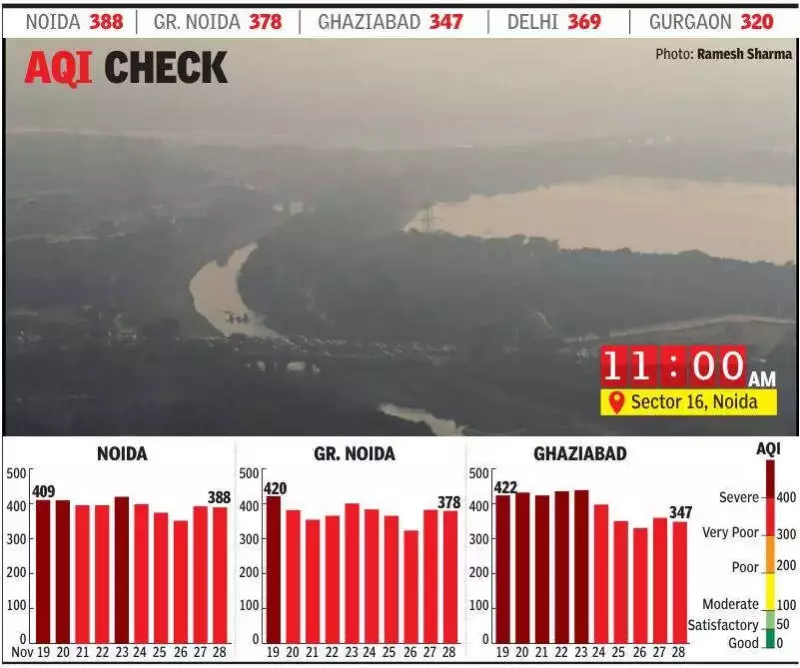
The pollution statistics paint a grim picture of Noida's air quality crisis. The worst spike occurred on November 11, when the AQI soared to 425, well into the severe category. Throughout November, the city recorded:
- 20 'very poor' air quality days
- 5 'severe' air quality days
- Only 3 days in the 'poor' range
On Friday, the overall AQI stood at 388 at 4 PM, showing minimal improvement from Thursday's reading of 391. The situation appears significantly worse compared to last November, when Noida experienced only one 'severe' day and eleven 'very poor' days.
Regional Monitoring Station Readings
Data from specific monitoring stations across Noida revealed alarming pollution levels:
- Sector 116 station recorded an average AQI of 417 (severe)
- Sector 125 area measured 410 (severe)
- Sector 1 registered 376 (very poor)
- Sector 62 showed 345 (very poor)
The Sector 116 station specifically monitors air quality for Sector 7x and nearby residential areas, indicating the severe conditions faced by residents like Kataria.
Neighboring Areas Also Affected
The air quality crisis extends beyond Noida to surrounding regions. Greater Noida witnessed AQI moving from 381 to 378 within 24 hours, with specific stations recording concerning levels:
- Knowledge Park V: AQI of 398
- Knowledge Park III: AQI of 358
Ghaziabad reported equally troubling statistics with eight 'severe' days, seventeen 'very poor' days, and three 'poor' days this month. On Friday, Ghaziabad's AQI was 346, slightly better than Thursday's 358.
Vivek Tyagi, a resident of Indirapuram in Ghaziabad, expressed his frustration: "The city is slowly becoming unlivable. For the last 30 days, the smog has been so dense that I can't see the building opposite mine. My father has severe breathing problems, and stepping outside for even five minutes triggers coughing fits."
Weather Conditions Worsen Situation
The Indian Institute of Tropical Meteorology's air quality early warning system predicts continued poor conditions. The ventilation index, crucial for pollutant dispersion, is expected to remain below the favorable threshold of 6,000 m²/s for the coming days:
- November 28: 4,500 m²/s
- November 29: 8,500 m²/s
- November 30: 6,000 m²/s
- December 1: 4,500 m²/s
IITM experts indicate that air quality will likely remain in the very poor category from November 28 to December 1, with similarly bleak outlook for the following six days.
Current Measures and Temperature Conditions
Currently, the Commission for Air Quality Management has enforced GRAP Stage II measures, which include:

- Mechanical vacuum sweeping of roads
- Regular water sprinkling
- Strict inspections and enforcement of dust control measures at construction and demolition sites
Weather conditions have added to the discomfort, with Friday recording a minimum temperature of 8.1 degrees Celsius, two degrees below normal and the second-lowest of the month. The maximum temperature reached 25.9 degrees Celsius, with similar conditions expected for Saturday.
As Noida and surrounding regions continue to battle this severe air quality crisis, residents await concrete actions and effective solutions to address what many are calling a public health emergency.