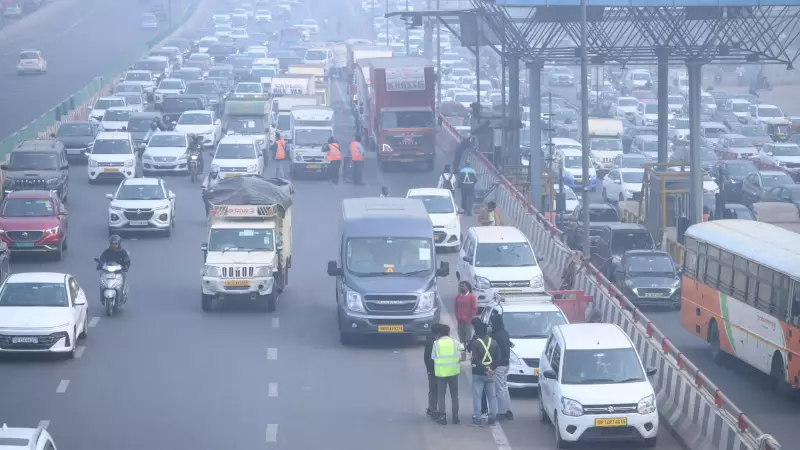
Residents of Delhi and the National Capital Region (NCR) are bracing for a grim New Year's Eve as air quality plummeted to the 'Severe' category and dense fog enveloped the region. The India Meteorological Department (IMD) has issued an orange alert, warning of cold day conditions and severely hampered visibility for Wednesday.
Air Quality Worsens Across the Capital Region
While Delhi's 24-hour average Air Quality Index (AQI) saw a marginal improvement from 401 ('Severe') on Monday to 388 ('Very Poor') on Tuesday, the relief was short-lived and uneven. Neighbouring Noida recorded an AQI of 400, still in the 'Severe' category after Monday's 410. Ghaziabad witnessed a worrying reversal, with its AQI climbing from 393 ('Very Poor') to 404 ('Severe'). Gurgaon was the only area to show notable improvement, moving from 'Very Poor' (318) to 'Poor' (294).
The overall pollution levels remain critically high due to persistent dense fog, negligible wind speeds, and a dangerously low ventilation index, which together prevent the dispersion of harmful pollutants. Visibility at Safdarjung and Palam observatories dropped to a mere 50 metres during the night and early morning hours, severely disrupting life.

IMD's Grim Forecast for the New Year
The weather office has forecast that surface winds over Delhi will remain sluggish, below 5-10 kmph, for the next few days. The ventilation index is also expected to stay well under the favourable threshold of 6,000 m²/s, creating a toxic atmospheric trap. According to the Indian Institute of Tropical Meteorology, the AQI is predicted to worsen back to the 'Severe' category between December 31 and January 1.
A slight improvement to 'Very Poor' levels is anticipated only by January 2. The IMD's six-day outlook suggests the air quality will largely remain in the 'Very Poor' bracket. For New Year's Day itself, the IMD has forecast a generally cloudy sky with the possibility of light rain, which might offer slight temporary respite.
Temperature and Health Advisory
Despite the intense cold feel due to fog, temperatures have been above normal. Delhi recorded a maximum temperature of 21.5 degrees Celsius, which is 1.1 notches above the seasonal average. The minimum settled at 9.4 degrees Celsius, a significant 2.6 notches above normal.
The combination of 'Severe' air pollution and dense fog poses serious health risks, especially for children, the elderly, and those with respiratory or cardiovascular conditions. Authorities advise limiting outdoor activities, especially during morning and late evening hours, and using N95 masks when going outside is unavoidable. The orange alert for a cold day indicates that the maximum temperature is likely to be significantly below normal, adding to the discomfort.