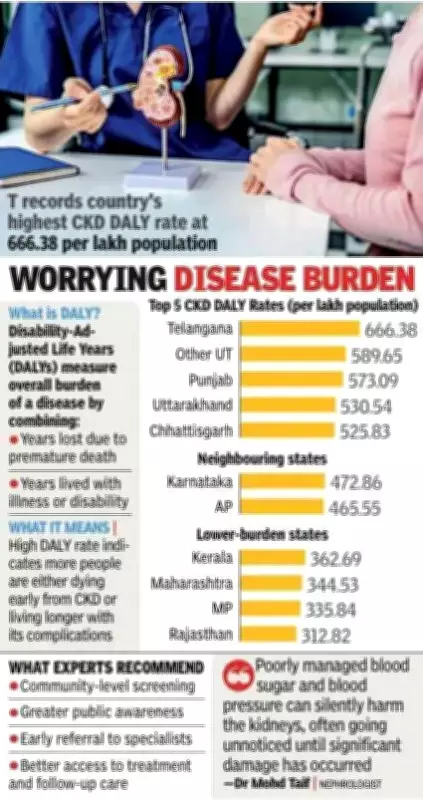
Hyderabad: Despite not having the highest number of chronic kidney disease (CKD) cases, Telangana has reported the highest CKD mortality rate in India, according to a study published in the ICMR’s Indian Journal of Medical Research.
The study, conducted by the Institute of Liver and Biliary Sciences (ILBS), New Delhi, found that Telangana recorded 19.84 deaths per lakh population due to CKD in 2023 — the highest in the country. While the state reported 241.57 new CKD cases per lakh, Haryana topped with 316.35 cases. Yet, Telangana’s death rate remained the worst.
To put it simply: In a stadium of one lakh people, about 242 in Telangana would develop CKD in a year, compared to 316 in Haryana. But nearly 20 in Telangana would die from the disease — more than in any other state. In contrast, states like Kerala and Tamil Nadu reported lower death rates despite higher prevalence, largely due to better detection and treatment access.

After Telangana, the highest CKD death rates were reported in Punjab (15.7 deaths per lakh), Chhattisgarh (14.82), Uttarakhand (14.69) and Goa (13.84). Nephrologists at NIMS said they treat 500–600 new patients monthly, with 50–60 already in advanced stages. Osmania General Hospital and Gandhi Hospital also see hundreds of such cases each month.
BP Major Contributor
The study identified diabetes as the biggest factor behind Telangana’s high CKD deaths, with type 2 diabetes accounting for nearly 25% of all kidney disease fatalities. Hypertension was another major contributor, often leading to poorer outcomes.
Doctors also cited excessive use of painkillers, poor water quality, and misuse of supplements. “Gym-goers who overuse substances like creatine and protein supplements are also leading to kidney ailments. People who develop hypertension in their early 20s are at a higher risk of kidney problems in the next 8 to 10 years,” said Dr Sree Bhushan Raju, head of department, nephrology, NIMS.
Despite better economic growth and healthcare infrastructure than many states, Telangana continues to report poor CKD outcomes. “This indicates that health improvements have not kept pace with economic growth,” said Dr Hari Shankar Meshram, one of the study’s authors.
He warned that CKD is still not a priority under India’s National Programme for Prevention and Control of Non-Communicable Diseases (NP-NCD), contributing to the burden.
Awareness and Gaps
Health officials argued that high CKD incidence reflects improved screening rather than a sudden surge. “Over the past decade, several major govt hospitals have launched kidney health programmes and schemes such as Aarogyasri. Across the state, over 15,000 people are taking free dialysis services at 102 centres,” said a senior official.
But doctors cautioned that awareness alone is insufficient. “Instead of seeking timely medical care, some turn to unqualified practitioners or delay treatment until the disease has progressed significantly. Kidney disease can often be managed and slowed if detected early. The bigger challenge is ignorance and delayed treatment,” said Dr Mohammad Jahangir, assistant professor, urology, OMC.
The study urged that CKD be included as a priority disease under national programmes, with increased funding for dialysis and transplants under Ayushman Bharat, state-level registries, stronger surveillance, and decentralised screening for diabetes and hypertension patients.