

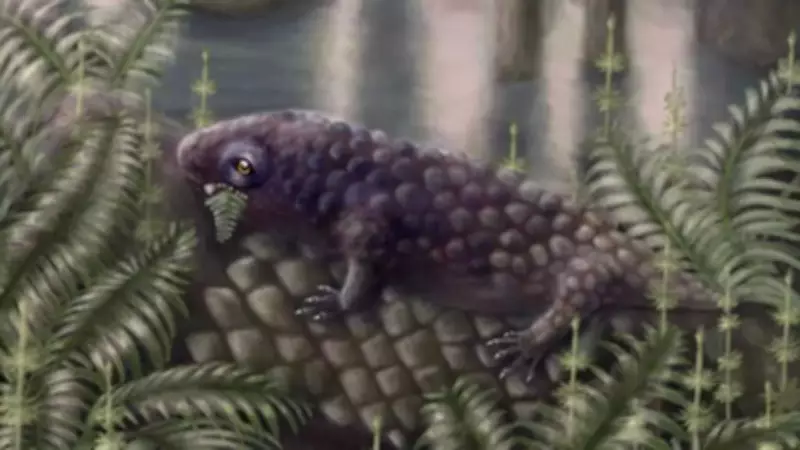
307-Million-Year-Old Tyrannoroter heberti May Be Earliest Plant-Eating Vertebrate
In a groundbreaking discovery, paleontologists have identified Tyrannoroter heberti, a 307-million-year-old land vertebrate, as potentially one of the earliest animals to consume plants. This finding challenges long-held assumptions about the dietary habits of early vertebrates, which were predominantly carnivorous, feeding on insects or smaller animals during that era.
Fossil Evidence and Skull Analysis
The fossilized skull of T. heberti was unearthed in Nova Scotia, Canada, and exhibits a distinctive morphology: wide at the back, narrow at the snout, and heart-shaped. This unique structure suggests adaptations for a mixed diet that could include plant material, as revealed through detailed CT scans. The scans enabled scientists to create a three-dimensional reconstruction, showing a secondary set of teeth used for grinding plant matter, alongside evidence of insect and small vertebrate consumption.
Anatomy and Evolutionary Position
While the complete skeleton of T. heberti has not been found, comparisons with related pantylids indicate it was a stout animal, roughly the size and shape of a football, with a lizard-like appearance. However, it was not a true lizard, as reptiles and mammals had not yet evolved as separate groups. T. heberti belongs to the pantylids, which are stem amniotes—early tetrapods closely related to the lineage that gave rise to modern reptiles and mammals.

Discovery and Historical Context
The skull was first discovered by Brian Herbert, an avocational paleontologist, embedded in a tree. It was later identified as a pantylid microsaur by Arjan Mann, assistant curator of the Field Museum. T. heberti existed during the late Carboniferous period, a time marked by significant climatic changes such as the collapse of rainforests and global warming. These environmental shifts likely contributed to the extinction of this species' lineage.
Implications for Evolutionary Biology
This discovery sheds light on the early evolution of vertebrate diets. Plants began colonizing land around 475 million years ago, but vertebrates remained primarily carnivorous for tens of millions of years. T. heberti represents a critical transitional figure, indicating that some vertebrates had started incorporating plant matter into their diets much earlier than previously thought, offering new insights into the adaptability and diversity of ancient ecosystems.






