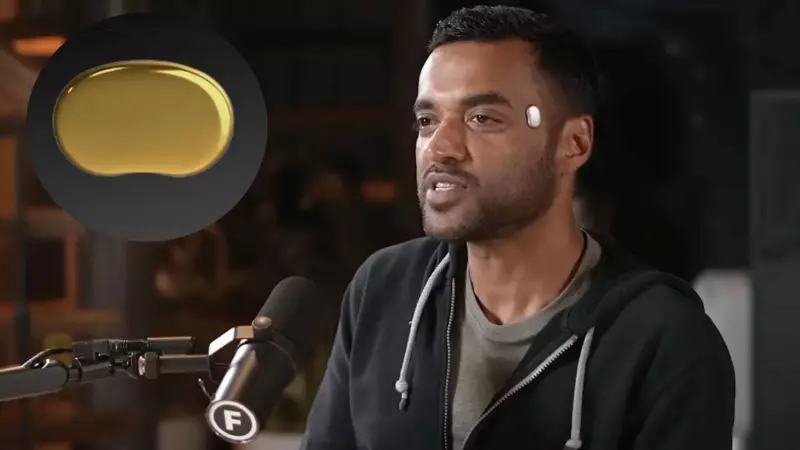
The tech and wellness world in India is abuzz after Zomato founder and CEO Deepinder Goyal was recently spotted wearing a curious device on his forehead during a podcast appearance. The small gadget, named 'Temple', has ignited widespread curiosity and debate about the future of personal brain health monitoring.
What is the 'Temple' Device and Its Purpose?
Spotted on January 7, 2026, during the Raj Shamani podcast, the 'Temple' is an experimental wearable health gadget. It is reportedly developed by a private research initiative backed by Goyal himself. The core idea, as explained by Goyal, revolves around the "Gravity Ageing Hypothesis". The device aims to track minute fluctuations in cerebral blood flow and brain oxygenation in real-time as a person moves, sits, or changes posture.
The goal is to generate data that could help researchers understand how daily activities, posture, and lifestyle impact long-term brain health. Goyal has stated that he has been wearing this research prototype for nearly a year as part of ongoing testing. It is crucial to note that the device is not available for sale and is positioned strictly as a research prototype, not a certified medical product.
Medical Experts Urge Caution and Clarify Limitations
The public display of the device has prompted strong reactions from medical professionals, who are advising the public to exercise caution. Dr. Suvrankar Datta, an AI researcher and radiologist from AIIMS Delhi, took to social media platform X to express skepticism. He stated that the device currently has "0 scientific standing" as a useful tool for consumers and cautioned against spending money on such "fancy toys."
To understand the technology, we spoke to neurological experts. Dr. Sudhir Kumar, a consultant neurologist at Apollo Hospitals, Hyderabad, explained that the device is based on near-infrared spectroscopy (NIRS). "It uses light to estimate changes in brain oxygenation, which indirectly reflects cerebral blood flow, but does not measure blood flow directly," he said. Dr. Kumar added that while NIRS has some scientific backing in research and ICU settings, its accuracy in real-world use is limited by factors like scalp blood flow and motion. "These devices are not diagnostic," he emphasized.
Dr. Sheetal Goyal, consultant neurologist at Wockhardt Hospitals, Mumbai Central, pointed out that in clinical practice, changes in blood flow are studied in conditions like stroke, dementia, and traumatic brain injury using validated imaging tools in controlled environments, not consumer wearables.
The Biggest Concerns and Proven Alternatives
Experts unanimously agree that for healthy individuals, there is no established medical need to routinely monitor cerebral blood flow. The brain has strong autoregulation mechanisms. "The biggest worry is that people may misunderstand the information. They might think the device is diagnosing or improving brain health, but it hasn't been tested for medical use," emphasized Dr. Dipesh Pimpale, consultant neurologist at KIMS Hospitals, Thane.
Dr. Kumar noted that clinical neurology already has robust tools like Transcranial Doppler, CT perfusion, and MRI angiograms that provide far more accurate data. For now, such wearables should be viewed as experimental wellness gadgets.
So, what should one focus on for genuine brain health? Dr. Pimpale and other experts recommend sticking to simple, proven methods: ensuring enough sleep, regular exercise, mental stimulation, managing stress, and seeking timely medical advice. These, they assert, are significantly more effective than relying on unverified technological devices.
While innovations like 'Temple' may find future niche roles in specific research, they currently add no value to routine clinical practice or personal health management for the average individual.