

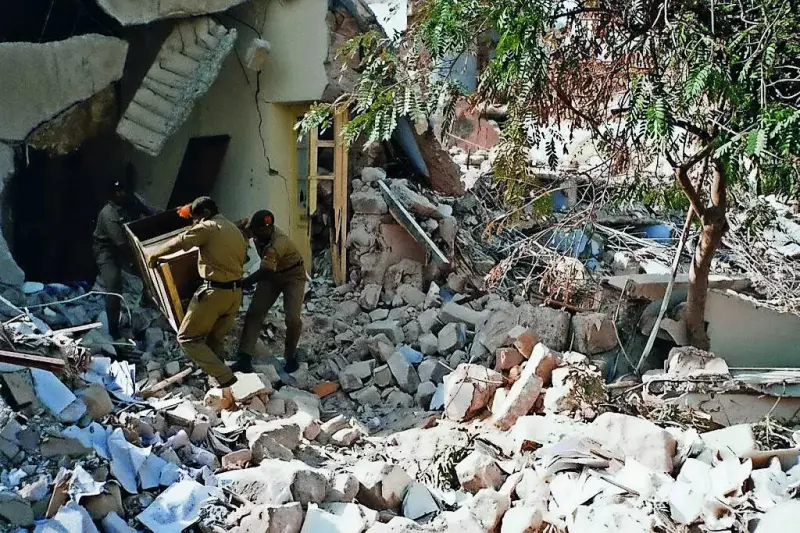
From Rubble to Resilience: Gujarat Earthquake Survivors' 25-Year Journey of Hope
Twenty-five years have passed since the devastating earthquake struck Gujarat on January 26, 2001, but for thousands of survivors, the memories remain vivid. Their stories of unimaginable loss, incredible resilience, and rebuilding lives against all odds continue to inspire. From the rubble of collapsed buildings emerged tales of human spirit that refused to be broken.
Chetna Mota: The Mother Who Raised an Engineer
For three agonizing days, Chetna Mota lay trapped under the rubble of her collapsed home in Bhuj, unaware that her husband and four-year-old daughter had already perished beside her. Her eight-year-old son, Bhargav, was trapped alongside her in the darkness. "There was darkness all around us," Bhargav recalled. "I heard my mother's voice, but my father and sister were silent. That is when I understood they had not survived."
Chetna's injuries were catastrophic. Both her legs had to be amputated, and she spent more than three months in hospital. When discharged, she faced a world without home, husband, or clear path forward. To reduce expenses, she moved with Bhargav to a small village in Mandvi taluka, surviving on handicraft work and government compensation interest.

Bhargav walked miles to college in Bhuj because there was no money for bus fare. His mother's constant lesson kept him going: "Never get frustrated in adverse situations. Fight against all odds and defeat them." He listened, becoming a civil engineer, clearing the Gujarat Public Service Commission exam, and now working with the state irrigation department. "The day my son put his first salary in my hands, I burst into tears," says Chetna, now 54. "That money meant something different."
Nita Panchal: 33 Surgeries and a New Beginning
Nita Panchal lay trapped under concrete for two days, losing her grandmother and cousin in the tragedy. Rescuers finally spotted her through a broken water pipeline and punched holes through wreckage to drag her out. After a spinal cord injury and 33 surgeries, doctors declared she would never walk again. Then her fiancé called off their wedding.
"I kept asking myself. Don't disabled people deserve a social life?" Nita sank into depression until counseling and inspirational films sparked change. She opened a cutlery shop to survive, then entered wheelchair hurdle races, winning silver in 2003 and gold in 2004. "My confidence returned," she says.
After another accident in 2005 required further surgery, she met Parag Panchal from Handicap International. They married in a hospital. Today, Nita runs a disability advocacy group, helping 830 women become self-employed, training over 500 women, and securing government jobs for 90 people. Against medical advice, she gave birth to her son, Bhavya, in 2009. "Becoming a mother was my greatest challenge and my biggest victory," she says.
Nalini Kumbhare: 96 Hours That Changed Everything
Central excise officer Nalini Kumbhare and her one-year-old son Keyur were trapped under their collapsed Ahmedabad building for over 96 hours. When rescuers pulled them out alive, Ahmedabad erupted in joy, but the earthquake had already taken her five-and-a-half-year-old daughter. Her husband survived, needing surgeries and medical care for nearly eight years before dying of a stroke six months ago.
For Nalini, the earthquake remains a present reality. She and Keyur sometimes watch the rescue video the fire department gave them as a memento. "When I was trapped for 96 hours with a one-year-old in my arms, I saw death up close," she says. "Once you have experienced that, every moment of life becomes precious." Today, Keyur is 26 and runs his own business. "My most precious moments now are watching Keyur flourish," Nalini shares.
Mital Thakkar: The Trauma That Never Left
When the ground shakes in Kutch, Mital Thakkar's parents hear about it from her before the news. At 36, she remains hypersensitive to tremors, a lasting mark of January 26, 2001, when 185 schoolchildren and 20 teachers died during a Republic Day rally in Anjar. That morning, Class 6 student Mital was marching with those children, holding the national flag, when buildings collapsed around them.

Buried under a two-storey structure, she regained consciousness hours later, unable to breathe properly in the dust-filled air. Someone spotted her T-shirt beneath debris, and she was pulled out at 2:30 PM with fractured legs. The trauma ran so deep that for three to four months, she crawled despite being physically able to stand. "When I think of that day, it still gives me jitters," Mital admits. "I will never forget that experience till my last breath."
Despite the trauma, she never abandoned her studies, completing her BSc, MSc, and PhD in environmental science. Now married and working as a researcher, she studies diatom algae to understand climatic conditions from thousands of years ago and predict future climate cycles.
Sejal Rajgor: From Orphan to PhD Candidate
"I lost one leg, but today I am standing on my own feet, only because of my parents," says Sejal Rajgor, her voice steady with pride. At just 13 months old on January 26, 2001, she was pulled from the debris of a collapsed building in Bhuj's Lal Tekri area, her right leg requiring amputation. Her entire family was gone.
Relatives Damyanti and Ramesh, who lost all their children in the same building, adopted her. "They adopted me when both of us were trying to survive loss," Sejal recalls. "Nothing came easy." Her adoptive parents worked tirelessly—stitching clothes, driving a rickshaw—to ensure she studied. "They believed education would give me dignity and independence."
It did. Sejal completed her MSc, cleared GSET, and now teaches science in Classes IX and X while pursuing a PhD. "Every day I stand in a classroom, I feel I have won a quiet battle," she says. "Living with a disability is not just physical. It tests your confidence. But my parents never let me feel less."
Dr. Nirmala Sharma: The Doctor Who Stayed
Dr. Nirmala Sharma arrived in Kutch on January 25, 2001—just married, new to the region, a day before the earthquake. A gynecologist from Mumbai, she had moved to Bela, a remote border village, to join her husband, Dr. Devjyoti Sharma, a government medical officer posted there.
On her second day in the village, the earthquake struck. With no medical facilities in border villages and many suffering serious injuries, Dr. Nirmala began treating the wounded with whatever she could find. She stitched deep wounds using household needles and thread, improvised bandages from available cloth, and supported fractures with bamboo sticks.
Villagers started calling her "tanka lagadva vari ben" (the woman who stitches wounds). A medical center was finally set up in Rapar four days later. Until then, she was all they had. She later accepted a government job, served across Kutch talukas, and now runs her own private clinic.
Asha Mehta: The Guilt That Never Fades
On January 25, 2001, Asha Mehta celebrated her son Mitul's eleventh birthday with family. Early the next morning, he left to join the Republic Day rally in Anjar. That was the last time she saw him alive. "Mitul was getting late for the rally," she recalled. "I asked him to have breakfast, but he said he would eat after the rally. He never came back. Only his body returned."
Twenty-five years later, the guilt of that uneaten breakfast stays with her. Mitul was one of 185 children who died that morning when buildings collapsed on marching students. Asha also remembers the confusion that sealed many fates. "There were rumours before Republic Day that Pakistan might attack. When the earthquake struck, everyone believed it was an attack. Some teachers asked the students to lie down." She pauses. "If someone had just told them to run, maybe a few more would be alive today."
Meeta Solanki: Turning Pain Into Practice
Seven members of Meeta Solanki's family died when her house in Bhuj collapsed. She survived, but the lower part of her body lost sensation. Her toes went numb, and even today at 54, she cannot wear chappals. "I was trapped under the debris and rescued after several hours," she recalls. "I was bleeding. There was no proper treatment available."
She remembers that night with brutal clarity: "It was winter. There was nothing to sleep on, and no treatment at first. My name was finally called at around 2:30 AM. The doctor stitched my wounds without giving any anaesthesia." The damage was permanent.
In 2011, seeking relief from chronic pain and trauma, she turned to yoga. The practice helped her physically and mentally, giving her a sense of control she thought lost forever. Today, Meeta is a certified yoga instructor, accomplished garba dancer, and frequently judges major garba events across the region.
Haresh Dholakiya: Listing the Living
When communication collapsed across Kutch, teacher and columnist Haresh Dholakiya proposed something unusual: instead of listing the dead, publish names of those alive. "There were no mobile phones and no proper means of communication," Dholakiya says. "Nobody knew who was alive and who was dead. Many people were missing."
Names came from hospitals, police, and people who walked in to register themselves. For families scattered across devastation, the daily newspaper became their only source of hope. Beyond this effort, Dholakiya and friend Prabodh Mankad traveled to different areas, meeting survivors and offering motivational talks and humor to help people cope with grief. These pieces were compiled into a book, offering rare moments of relief from overwhelming loss.
Viral Dalal: 105 Hours of Darkness to Light
Viral Dalal was 25, home from the US where he was pursuing his master's degree, visiting Bhuj with family when the earthquake struck. He found himself "buried for 105 hours in what felt like a concrete coffin." "I was not worried about myself," he says. "Something told me I was going to be okay. All I wanted was my family."
After four-and-a-half days, rescuers from the UK's International Rescue Corps pulled him out alive. The relief vanished when he learned he was the only one from his immediate family to survive. Today, Viral lives in Virginia with his wife and children, working in IT and honored as one of Loudoun County's 100 most influential people. He shares his journey through corporate talks and his book, Choosing Light. "It was my decision not to choose darkness, but light," he says. "The power of choice always resides in our hands."
Jubilee Ground: When a Stadium Became a Hospital
When Bhuj's civil hospital collapsed, doctors set up a temporary facility at Jubilee Ground, the town's cricket stadium. "There were no hospitals and no way to contact anyone," recalls Dr. Mahadev Patel, now 75. Pharmacists brought whatever medicines they could manage—bandages, dressing material, painkillers, splints.
There were no beds, no bed sheets. Patients were treated on bare ground. Doctors improvised, using clay roof tiles as splints tied with patients' own shirts. Volunteers built a simple pavilion, but conditions remained extreme—no electricity, no X-rays, no CT scans. "The number of dead bodies brought there was overwhelming," says Dr. Patel. "We had to certify them. That was the only day I lost count." Until external aid arrived, Jubilee Ground was Bhuj's only medical lifeline.
Lalan College: Makeshift Classrooms, Solid Futures
Ramji Savji Lalan College in Bhuj, one of the region's oldest government colleges, was completely destroyed. Reconstruction took more than four years, during which the college functioned entirely out of makeshift domes—galvanized iron sheets supported by steel frames. Around 1,500 students attended classes in these temporary shelters with no proper walls or permanent roofs.
Despite conditions, academic work never stopped. "We professors taught with the same dedication as always," recalls Darshna Dholakiya, who taught at Lalan College then and later became in-charge vice-chancellor of Kutch University. "I am proud to say that some of our best students were shaped during those years. Many went on to succeed in different fields."
Murtuza Ali Vejlani: The 'Lucky' Survivor
Murtuza Ali Vejlani was eight months old when the earthquake buried his family. Seven members died, including both parents. Army personnel pulled him out after 104 grueling hours—found beneath his father's arm, stretched out in a final attempt to shield his son. His cradle lay smashed beside them.
"I don't remember that day," says Murtuza, now 26. "But I have lived with its consequences." Raised by his paternal aunt and uncle in a rehabilitation colony on Bhuj's outskirts, he earned the nickname "Lucky Ali" from his rescue. Earlier this year, he married Alfiya from Rajkot and works in the family business, building a life of his own while still learning what his nickname truly means.
These stories, spanning a quarter-century, reveal not just the scale of the 2001 Gujarat earthquake's devastation but the extraordinary resilience of those who survived. From physical disabilities to psychological trauma, from losing entire families to rebuilding from nothing, their journeys stand as powerful testaments to human endurance and hope.





