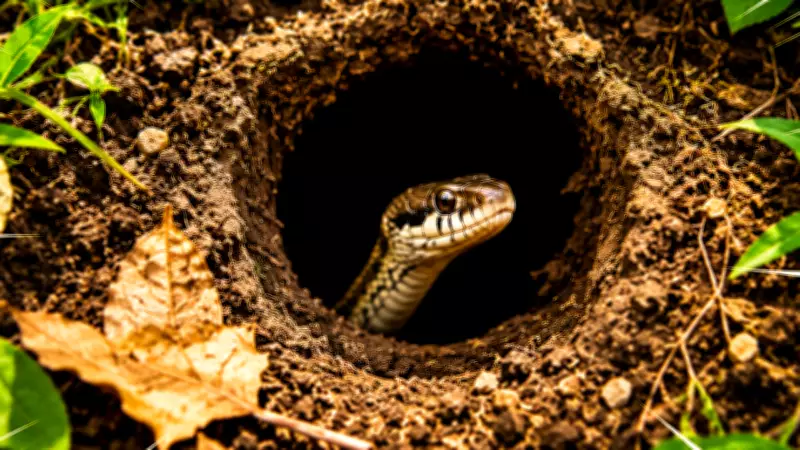
That hole in your yard might not be empty. You're out in the garden, moving a pot or pulling a weed, and you notice a neat, rounded hole in the soil. No dirt pile around it, no obvious tracks, just a clean opening disappearing into the ground. The first instinct for most people is to wonder what made it and, more urgently, whether anything is still inside.
Here's the thing: snakes can't actually dig their own holes. They are opportunistic and take over burrows built by other animals, such as voles, shrews, chipmunks, crawfish, and even tortoises. So what you're looking at is almost certainly a repurposed tunnel. The real question isn't who dug it. It is whether something with scales has since moved in. And that requires knowing what to look for, because the hole itself won't tell you much.
What a Snake Hole Actually Looks Like
Snake holes typically range from the size of a small coin up to about two inches in diameter. They tend to have smoother edges than rodent holes, because the snake's body smooths the entrance as it moves in and out, while rodent holes often look more jagged and have more debris scattered around them.

However, ground holes are not the only place snakes set up home. If no suitable burrows are available, they will take advantage of gaps between rock walls, spaces between concrete steps, foundation cracks, and other tight spots around structures. So if you do not find a neat hole in the lawn but you are still seeing signs, start checking around the edges of your house, garden walls, and any piled-up timber or stones.
Sign 1: Shed Snakeskin Near the Entrance
This is the most reliable indicator. Snakes shed their skin several times a year as part of their growth process. Finding shed skin near a hole strongly suggests a snake has been in the area recently. Experts specifically recommend looking for snakeskin in and around suspected holes to confirm that it is a snake and not a mole or vole using the burrow. The skin might be intact or in fragments, pale and papery, and is often found draped over nearby vegetation or half-tucked into the entrance.
Sign 2: Smooth, Wavy Tracks in the Soil
Snakes leave tracks even without feet. Thin, curving lines in the dirt are a dead giveaway that something has been frequenting a burrow. These are easiest to spot after rain or in dusty, loose soil. You will not see paw prints. You will see smooth, wavy lines leading in or out of the hole, like a series of shallow S-curves pressed into the surface. If you see them heading directly toward a hole, that is a strong sign the burrow is in use.
Sign 3: Snake Droppings Nearby
Snake feces typically appear as thick, pasty, dark brown smears with a white chalky deposit at one end. There may also be small bones and fur within the droppings, remnants of whatever the snake has been eating. They are easy to miss if you are not looking, but checking the ground around a suspected hole is worth doing. Finding droppings close to an entrance is a reliable sign of regular activity, not just a one-off visit.
Sign 4: No Cobwebs or Debris Across the Entrance
This one is simple but surprisingly useful. If there are spiderwebs or debris covering the entrance of a hole, it is most likely empty. If the entrance is clear and clean, there may well be a snake nearby and using it. Spiders build across openings quickly when an entrance has not been disturbed. A clear, open hole with smooth edges and no web across it is a reasonable indicator that something is still coming and going regularly.
Sign 5: Increased Rodent Activity Has Recently Dropped Off
This one takes a little observation over time, but it is worth noting. Snakes typically choose a yard because food and water are nearby. If your property has an ample supply of rodents, frogs, birds, and insects, it is likely part of the appeal. So if you have noticed a sudden, unexplained drop in rodent sightings around a part of your garden, less evidence of gnawing, fewer droppings from mice, that is sometimes a sign that a predator has moved in. Not definitive on its own, but worth factoring in.

Sign 6: Activity Around Early Morning or Late Afternoon
Observing a suspected hole during early mornings or late afternoons, when snakes are more likely to bask in the sun near their shelters, can help identify whether a burrow is active. If you can set up a camera pointed at the entrance for a day or two, even better. You will get confirmation without having to get close, and you will likely get a clear enough image to identify the species, which matters more than most people realize, because the vast majority of garden snakes are completely harmless.
Sign 7: The Hole Stays Clean Over Several Days
Because snakes often take over existing burrows rather than digging their own, the openings tend to hold their shape longer than random ground disruptions caused by weather or small rodents. If you mark a hole and return after a few days of rain and the entrance is still clear, still smooth, and still free of debris, something is likely maintaining it by passing through regularly. A hole that fills in, collapses, or gets overgrown with plant material fairly quickly is probably abandoned.
What You Should Do Next
First, never reach your hand inside a hole in your yard. It does not matter how small the opening is or how confident you feel. If you have spotted several of the signs above and you are concerned, the safest move is to call a wildlife removal service or a pest control professional who can identify the species and advise accordingly.
If the hole appears genuinely empty and you want to keep it that way, you can fill it in with soil or cover it, but make sure you have confirmed nothing is inside before you do. Then address what attracted the snake in the first place: tall grass, wood piles, standing water, and an abundance of rodents are the main draws. Remove those, and you make your garden a much less appealing address.