

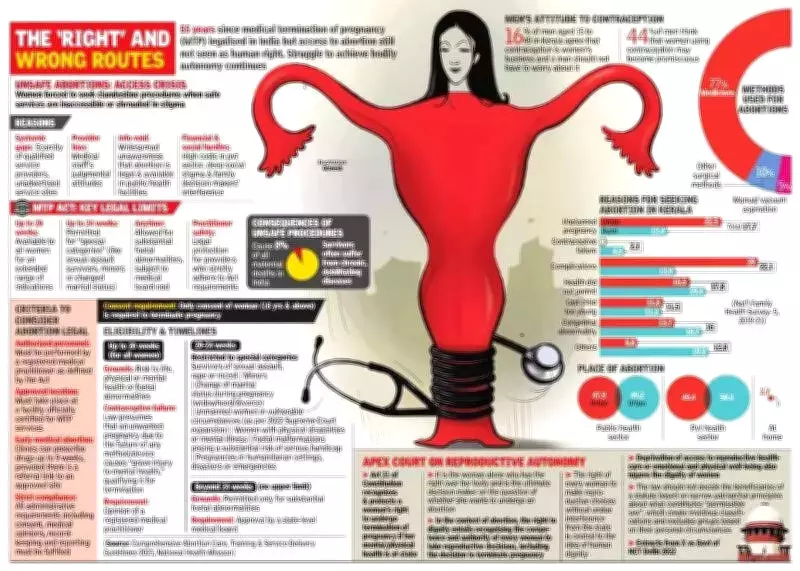
Kerala's Reproductive Rights Crisis: Women Denied Legal Abortion Access
Justice Ruth Bader Ginsburg of the United States Supreme Court once articulated a powerful vision of reproductive autonomy, stating that choice should develop as a woman's fundamental right to control her own destiny, free from intrusive state interference. This ideal stands in stark contrast to the harsh reality faced by women seeking legal abortion services in Kerala, where systemic barriers and moral judgment routinely undermine their rights.
A Harrowing Experience at Ernakulam General Hospital
Swati (name changed), a professional with promising career prospects awaiting her in Bengaluru, found herself navigating this difficult landscape when she and her partner decided to terminate a seven-week pregnancy. After visiting three major hospitals and two clinics in Kochi, they discovered that private sector costs were unreasonably high and exploitative. Turning to Ernakulam General Hospital's gynecology outpatient department, Swati anticipated accessible care but instead encountered hostility and humiliation.
"From the moment my OP sheet was reviewed, I was subjected to hostile, judgmental and humiliating behaviour related to my request for medical termination of pregnancy," Swati recounted. One senior doctor slammed her paperwork on the table and condescendingly questioned why she came to a government hospital after undergoing a scan privately. Her colleague went further, asking why she was making them commit kolapathakam (murder).

Systemic Barriers Across Kerala
Swati's ordeal is not isolated. Accessing Medical Termination of Pregnancy procedures at government facilities has become increasingly difficult across Kerala. Most private sector doctors are either reluctant to perform the procedure or charge exorbitant fees, even for prescribing medication during early pregnancy phases. This lack of access occurs against a troubling backdrop of unintended pregnancies being carried to term, sometimes resulting in children being abandoned, neglected, or killed.
When Swati tried to reason with the doctors about her early pregnancy stage, they continued to morally equate the procedure with murder. "Both doctors responded with laughter and further patronising behaviour. I was asked how this 'mistake' happened and if they were supposed to pay for my mistake?" she said. After being prescribed a blood test and told to return with a "female bystander," Swati sought care elsewhere, bearing significant personal financial burden.
Legal Violations and Professional Failures
In a formal complaint to the hospital superintendent, Swati highlighted how calling a lawful procedure under the MTP Act "murder," pressuring patients, and imposing non-statutory conditions breach the Act's intent and provisions. Mocking, moralizing, and blaming patients violates the National Medical Commission's code of ethics, while questioning her use of a government hospital constitutes harassment and discrimination in public healthcare. She has yet to receive a response.
The couple's search for care revealed a pattern of denial and exploitation. One major private hospital in Kochi refused the procedure outright, while another demanded Rs 70,000, claiming it required hospitalization. A third hospital also denied MTP. At a clinic in Edappally, the conversation turned particularly disturbing when the doctor stated they refused to carry out procedures even for rape victims. "She kept asking what she would get out of it. She said that they were anyway doing a bad thing and at least needed money," Swati recalled. The couple was quoted Rs 25,000 just for medication prescription and Rs 45,000 for a hospital procedure, eventually paying Rs 17,000 at a Tripunithura hospital for medicine-based MTP and necessary tests.
Expert Perspectives on the Crisis
Dr. Edwin Peter, founder of Sex Education Kerala Foundation, explains that planned parenthood remains uncommon in Kerala. "When you switch to a value system where pregnancy is an individual's choice and a serious planned decision, then you become aware that you also have the right to not accept an accidental pregnancy. However, many don't understand it that way due to social, religious or varying value systems," he said.

Dr. Peter emphasizes that while doctors have a duty to protect life, they should not impose moral values on patients. "Religious or social moral values consider a fetus as a life form soon after pregnancy. However, human rights conventions have highlighted the impracticality of assigning human rights to cell structures before birth. What MTP does is terminate the pregnancy, basically withdrawing the support given to the cell group called a fetus from the maternal body. That process cannot be considered as a human rights violation," he explained, adding that it is "childish" to prioritize the rights of cell groups over those of a fully-formed female-bodied person.
Structural Problems and Exploitation
Dr. Praveen Gopinath, a Payyannur-based gynecologist, notes that MTP has become a procedure done in shadows. "Indian law is very favourable for MTP. However, procedures and paperwork were increased to prevent female foeticide. Subsequently, the number of doctors who provide the service came down drastically, facilitating a situation to overcharge," he said. These added requirements have neither reduced female foeticide nor improved gender ratios, instead creating difficulties for patients and favorable conditions for exploiters.
Dr. Peter adds that most women in Kerala recognize pregnancy when periods are delayed. During first-trimester pregnancies without complications, MTP is possible through medications with basic investigations like ultrasound and blood tests. "It is an OP procedure where the cost of these basic investigations is levied and the medication is prescribed," he said, noting that unmarried persons are particularly exploited through higher charges or forced hospital admissions.
Social Stigma and Lack of Advocacy
Author and rights activist Dr. Jayasree A.K. observes that society has largely turned against MTP, unlike in the 1980s when less stigma was associated with the procedure. "Unlike in the past, of late, especially in the aftermath of the widespread campaigning by the global pro-life movement, MTP is considered a sin in Kerala," she said, recalling significant social media backlash when the women and child development department posted about MTP as a necessary service.
This social disapproval makes doctors reluctant to provide services. "When it's something that society doesn't accept, the risk increases. More so at a time when there have been frequent conflicts between the public and medical practitioners on various issues," Dr. Jayasree explained. She emphasizes that public pressure is essential for accessing rights, yet no civil society or women's organizations are openly demanding better MTP access.
Call for Government Action
Dr. Peter advocates for government initiative to establish MTP-specific clinics. "At least one MTP clinic with doctors willing to provide the service should be started in every district. They can at least provide medicine-based MTPs," he urged. This structural solution could address the current crisis where women's reproductive autonomy, guaranteed by law and Supreme Court rulings, remains theoretical rather than practical in Kerala's healthcare system.
The situation reveals a profound disconnect between legal protections and ground realities, where women seeking to exercise their reproductive rights face judgment, exploitation, and denial of services. As Kerala grapples with these challenges, the need for systemic reform, professional accountability, and social awareness becomes increasingly urgent to ensure that reproductive rights are not merely theoretical guarantees but accessible realities for all women.





