

Kolkata's Historic Medical College Hosts Immersive Heritage Walk on 192nd Foundation Day
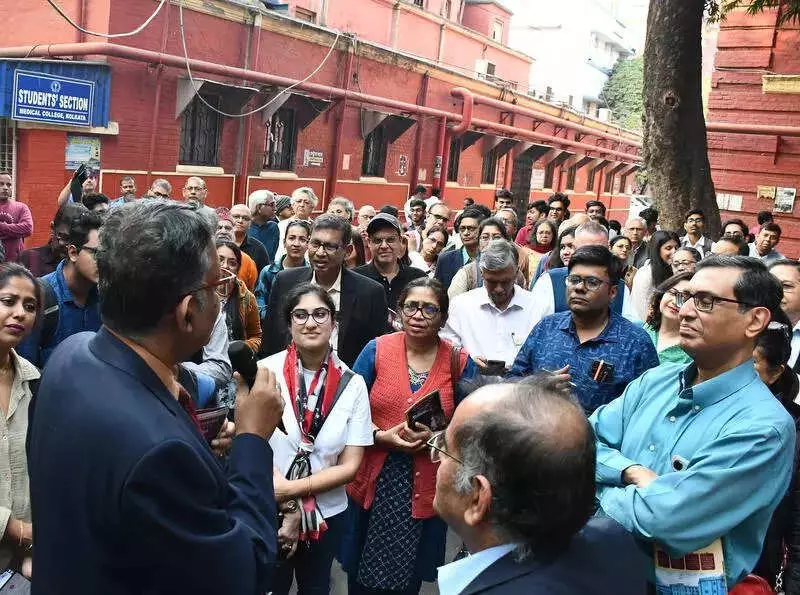
An immersive heritage walk through the historic buildings and grounds of Calcutta Medical College recently traced the evolution of medicine, education, and society in Kolkata. This event, organized by the Medical College Ex-students' Association (MCESA), celebrated the institution's 192nd foundation day, situating its rich history within the living and breathing campus of today.
Honoring a Layered Legacy Through Storytelling
MCESA vice-president Abhik Ghosh emphasized that the walk honors the institution's layered legacy—medical, architectural, intellectual, and human. Another member, Anirban Dalui, highlighted the need to make medical history accessible to non-specialist audiences through engaging storytelling. Around 150 participants gathered in front of the Victorian-style administrative block, erected in 1911, to embark on this curated journey through distinguished institutional spaces.
Pioneering Beginnings and Historic Milestones
Established on January 28, 1835, during a time when colonial Calcutta faced public-health emergencies like malaria, cholera, and kala-azar, the Medical College of Bengal was founded to address the urgent civic need for modern, evidence-based healthcare. Mountford Joseph Bramley was appointed as the first principal, and Henry Goodeve served as the first professor of medicine, despite the absence of a separate medicine department then.

Alumnus and event convenor Amit Ghose, who conducted the walk, shared pivotal moments. At the anatomy building, Madhusudan Gupta performed the first human cadaver dissection by an Indian in 1836 under Goodeve's guidance, challenging deep-seated taboos. This building still houses the dissection hall and a museum with 150 anatomic specimens preserved.
Exploring Iconic Hostels and Hospitals
The walk included stops at Swarnamoyee Hostel and Bidumukhi Hostel. Sujoy Majumdar, another alumnus guide, explained that Maharani Swarnamoyee of the Cossimbazar Raj estate donated Rs 1,50,000 to build the hostel for female medical students. Bidumukhi Hostel was named after Bidumukhi Bose, one of the first female medical students, showcasing early strides in women's medical education.
Participants also visited Eden Hospital, inaugurated as a 100-bed facility in April 1882 by Sir Ashley Eden, Lt Governor of Bengal. A crucial feature was its isolation ward for cholera patients, the first of its kind in Asia, where Sir Leonard Rogers conducted cholera research. Over time, this ward evolved into a 259-bed obstetrics and gynaecology unit, marking significant advancements in medical care.
Architectural and Surgical Evolution
The David Hare Block, opened in 1910 to address the lack of a separate surgical ward, was initially named Prince of Wales Hospital to commemorate his visit to India. It was renamed in 1976 as a tribute to David Hare, the only non-medical principal, on his bicentennial birth anniversary. Ghose recalled spending ten years in this ward, noting the privilege of a sunlit operating theatre with Italian marble and a gallery for observing surgeries.
Conclusion at the Oldest Building
The walk concluded on the iconic stairs of the MCH building, the oldest on the premises. Constructed to accommodate a hospital for recognition from the Royal College of Surgeons of England and University of London, Lord Dalhousie laid its foundation stone in 1848, and it was inaugurated in 1852 to house 350 patients. This event not only celebrated medical history but also reinforced the enduring impact of Calcutta Medical College on healthcare and society in India and beyond.






