Manipur's Children Sketch Trauma: Drawings Reveal Violence in Relief Camps
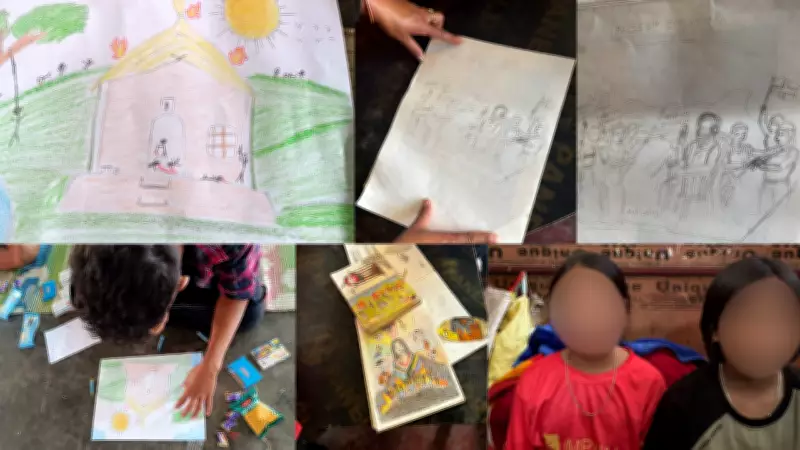
In the Trade & Expo Centre relief camp at Lamboikhongnangkhong in Imphal West, a 10-year-old Meitei boy picked up a pencil and ink in August 2024. On paper meant for arithmetic, he sketched a haunting scene: a man hanging from a tree, his neck twisted at an angle. To the right, a house burns, flames swallowing the roof. Above the smoke line, on the hills, four figures stand on a ridge, rifles pointed downward. Below them, bodies lie still—one face down beside a bicycle, another with arms outstretched, circled in red. Only the blood had color in his monochrome drawing.
Drawings as Memories, Not Reports
This was not an isolated incident. Across Manipur, in camps set up inside colleges, government halls, and community buildings—from Ideal Girls’ College in Akampat to classrooms in Kangpokpi and temporary shelters in Sajiwa—children responded to a simple invitation: draw what you feel. Volunteers had distributed paper and crayons, and the results were starkly similar. Pages that once carried handwriting exercises now held houses burning, bodies lying still, figures running, and smoke advancing across the horizon.
Keisham Pradipkumar, chairperson of the Manipur Commission for Protection of Child Rights, explained, "These aren’t reports. They are memories replaying themselves." He described the images as "spatial memories"—impressions mapped onto terrain, with violence rarely abstract. "Many of these children saw what they were drawing. They are not inventing dramatic scenes," he emphasized.

Precision and Pain in Every Stroke
In one camp, a boy drew a house with its roof on fire. Halfway through, he paused, erased the door twice, then redrew it with a heavy bolt across it. He pressed so hard the paper tore slightly at the edge. When a counsellor asked why, he said the door needed to be stronger this time.
Among the drawings Pradipkumar showed was one where gunmen stood on a slope firing into smaller figures below. The villagers appeared mid-flight, their feet angled toward the lower margin of the page. At the bottom stood a house with a single padlock drawn so large it dwarfed the door. The child said he had made the lock oversized so no one could break in.
Another drawing depicted a woman at the edge of a fire, her arms extended not in triumph or surrender but in something harder to name. Around her lay smaller figures—some upright, some horizontal, one turned toward another as if shielding them. The flames were drawn evenly across the roofs, with red pooled where the bodies fell, while the rest remained monochrome.
Scale of Displacement and Mental Health Risks
Official state figures list approximately 18,000 displaced children living in relief camps. Child rights advocates place the number closer to 25,000, including those living in rented accommodation, with relatives, or outside the state. This displacement has led to severe mental health concerns.
Child psychiatrist Dr. Jina Heigrujam, who visited several relief camps to identify children experiencing PTSD, stated, "If stress is prolonged and the child isn’t able to adjust to it, what happens is there are a myriad of mental health issues that can come out of it. Most common is post-traumatic stress disorder or depression in childhood or anxiety." She highlighted art therapy as an effective technique, noting, "In order to help them out, we’ve dived deep into the layers to understand how badly they are affected."
A clinical psychologist working with displaced children in Imphal added, "We have to pay attention to both presence and omission. Children process experience visually before they can organise it into language. Early drawings often capture threat. Later drawings may reflect what the child longs for. Neither stage tells the whole story."
Tragic Consequences and Calls for Action
Since 2024, at least four minors linked to the displacement have died by suicide, three of them inside or near relief sites. Community workers in districts including Bishnupur and Jiribam documented additional cases that did not enter formal records. While the numbers are small compared to the scale of displacement, they have unsettled those working inside the camps.

Pradipkumar warned, "When a child takes that step, it is rarely about a single incident. It reflects accumulated distress." The drawings serve as a poignant reminder of the trauma these children endure, underscoring the urgent need for counselling and mental health support to prevent longer-term conditions and help them heal from the violence they have witnessed.