

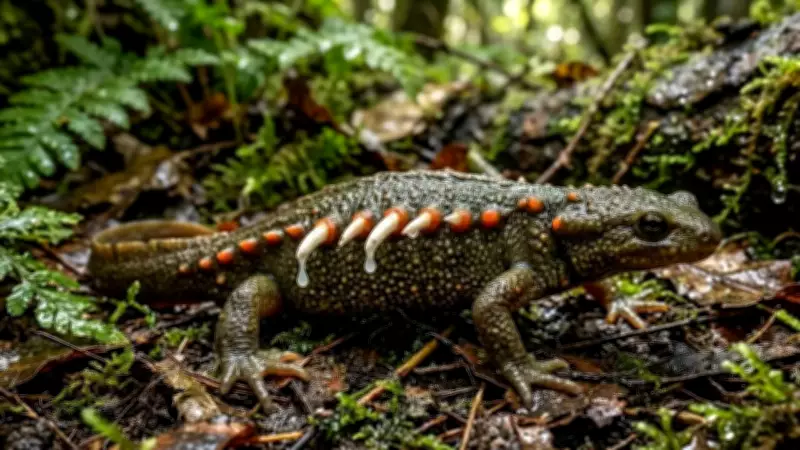
The Iberian Ribbed Newt: Nature's Living Switchblade
In the fascinating world of amphibians, the Iberian ribbed newt (Pleurodeles waltl) stands out with one of the most extraordinary defense mechanisms ever documented. This creature has earned the moniker 'real-life Wolverine' due to its ability to weaponize its own skeleton in a dramatic display of evolutionary adaptation.
A Biological Switchblade Emerges
When threatened by predators, the Iberian ribbed newt performs a remarkable anatomical maneuver. It can rotate its ribcage forward by up to 50 degrees, creating enough internal pressure to force the sharp tips of its ribs through its own skin. This action transforms the newt's exterior into a formidable array of bony spikes that protrude from its sides, creating an immediate physical deterrent to any would-be attacker.
Double-Layered Defense: Mechanical and Chemical
According to research published in the Journal of Zoology, this mechanical defense is only half the story. As the ribs puncture through the skin, they become coated with a lethal white poison secreted from specialized glandular warts. This toxic substance creates a painful chemical reaction in any predator attempting to consume the newt.

The combination of these two effects—sharp bony projections and poisonous coating—creates an exceptionally severe deterrent. Predators that manage to ingest the newt typically experience such discomfort that they vomit the amphibian back up and learn to avoid similar creatures in the future, as detailed in the Journal of Morphology.
Miraculous Healing Without Scars
Perhaps even more astonishing than the defense mechanism itself is what happens afterward. The Iberian ribbed newt possesses an extraordinary capacity for rapid tissue regeneration. The self-inflicted wounds where ribs pierced the skin heal within seconds or minutes at the cellular level, leaving no scars and preventing infection.
This scar-free recovery extends beyond simple skin repair. The newt can regenerate complex tissues including muscle and even some organ systems through coordinated cellular activity that researchers are only beginning to understand.
Scientific Implications for Human Medicine
The unique biological 'switchblade' aspect of the Iberian ribbed newt is providing researchers with invaluable insights into vertebrate tissue repair and evolutionary survival strategies. Following successful genome sequencing, scientists are now identifying specific regenerative genes in these amphibians.
By mimicking this rapid, scar-free regeneration, medical researchers hope to develop:
- Advanced medical adhesives that promote faster wound closure
- Novel wound-healing treatments that minimize scarring
- Regenerative therapies for complex tissue damage
Evolutionary Innovation for Survival
As noted in Nature Scientific Reports, the Iberian ribbed newt represents a definitive example of Earth's evolutionary innovation. By physically weaponizing their internal skeletons, these amphibians have found a niche defense against significantly larger predators.
They serve as a living laboratory for investigating extreme survival strategies in the natural world while providing researchers with understanding of how vertebrate species evolve such idiosyncratic structures to escape predation. The study of these remarkable creatures continues to reveal nature's ingenious solutions to survival challenges.






