

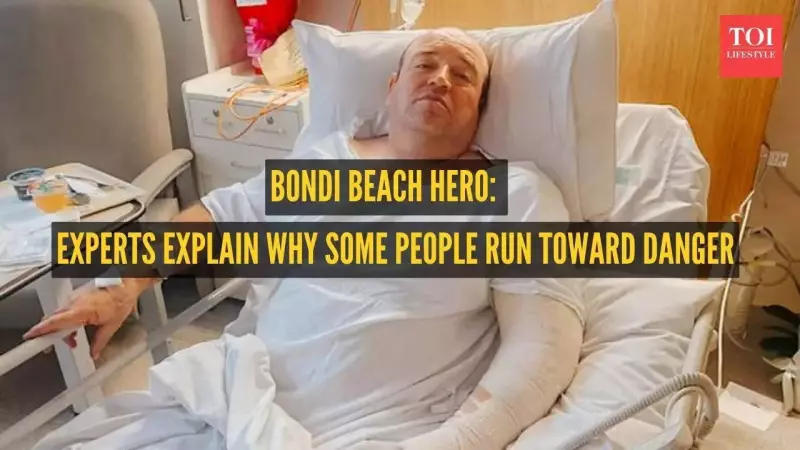
When a threat emerges, the natural human instinct is to seek safety and flee. Yet, history is punctuated by extraordinary acts where individuals do the opposite—they charge directly into the heart of danger. This profound human contradiction has been reignited by the actions of a hero at Bondi Beach, whose bravery offers a real-life lens into the psychology of courage.
The Brain's Crisis Response: Beyond Fight or Flight
In moments of acute crisis, the human brain typically triggers one of three primal reactions: fight, flight, or freeze. For the vast majority, the immediate impulse is to flee or become paralysed by fear. However, a distinct minority feels a compelling urge to confront the threat. Speaking to The Guardian, neuroscientist Dr Daniel Glaser clarified that while the "fight or flight" response is a universal mammalian reaction to threat, it does not predetermine the choice of action.
"It prepares your muscles, and to some extent your brain, for action, but the action that you take depends on a bunch of other things," Dr Glaser explained. He emphasised that an individual's perception, shaped by personal experiences, prejudices, and expectations, ultimately guides their response. Therefore, the bravery displayed by those who run towards danger is not a simple instinct but is often rooted in life experiences and prior training.

Echoing this, Professor Craig Jackson, a chartered psychologist specialising in violence, stated there is no specific "profile" for a hero. "It’s just as likely to be an angry mum in defence mode as it could be a fit, healthy rugby-playing male," he noted. This unpredictability, he suggests, is reassuring as it means potential attackers can never be sure who might rise to challenge them.
The Psychological Forces That Forge a Hero
According to David Berez, a retired police officer and behavioural expert, three key psychological forces converge to explain heroic action: self-determination, self-efficacy, and courage.
Self-determination addresses the 'why'—it is the deep-seated knowledge that intervening aligns with one's core identity and purpose, and that it can make a tangible difference. However, will alone is insufficient. This is where self-efficacy becomes critical. Defined by psychologist Albert Bandura, it is the belief in one's own capability to execute the necessary actions. For trained first responders, this comes from drills; for civilians, it may stem from past experiences that kick in like muscle memory.
When the 'why' and the 'how' are present, the final ingredient is courage—the force that allows an individual to overcome fear and act despite the palpable risk. Together, these elements create a framework of optimistic action, enabling extraordinary feats in the face of peril.
Heroes in Their Own Words: Split-Second Decisions
The theoretical framework is powerfully illustrated by the accounts of those who have lived through such moments. During the London Bridge attack on November 29, 2019, Darryn Frost tackled a knife-wielding terrorist wearing a fake suicide vest. "I don’t think it comes naturally to anyone," Frost recalled. "I saw Saskia (who was killed by the attacker) fall... So the next thought in my mind was: ‘I need to prevent that from happening to anyone else’."
Similarly, Roy Larner, who fought three terrorists during the 2017 London Bridge attack, sustained severe stab wounds. "I started fighting back... but it gave that 20 or 30 people a chance to get out," he said, acknowledging his split-second decision. "You should run. [But] you can be an idiot and take three on... There was an older bloke with us, about 78, and I think that was the reason why I stood there."
These narratives underscore that while the immediate inspiration may vary—protecting a stranger or defending a vulnerable person—the essence of heroism remains the same: a conscious choice to place others' safety above one's own. The recent case of Ahmed al Ahmed, the Bondi Beach hero who wrestled a gun from an attacker, stands as a potent modern example. He saved lives not with superhuman power, but with raw, human courage.

As we celebrate fictional superheroes, it is vital to remember that real-world inspiration flows the other way. It is ordinary people like Ahmed, Darryn, and Roy—armed with conviction and courage—who truly define the essence of a hero.





