

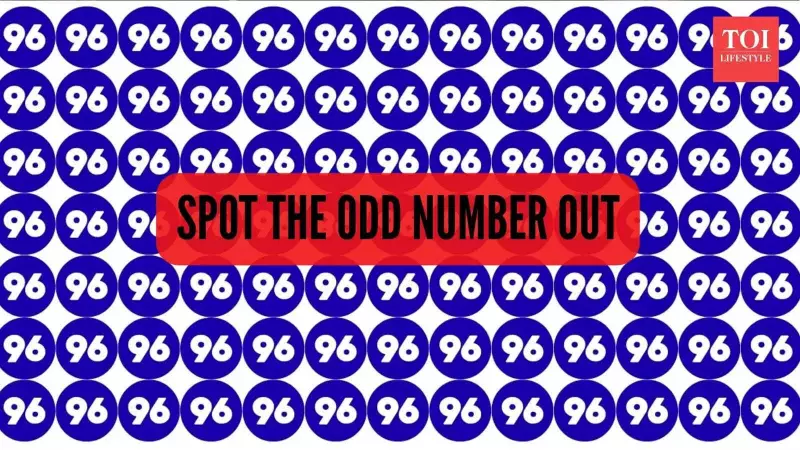
Are you ready for a dual challenge that tests both your visual sharpness and mental agility? A fascinating optical illusion combined with an IQ-style puzzle is taking the internet by storm, designed to evaluate just how keen your powers of observation truly are. At first glance, it appears deceptively simple, yet a vast majority of people fail to crack it within the allotted time.
The 5-Second Visual Challenge
The premise of the test is straightforward. You are presented with a neatly arranged grid filled with numbers. Almost every single digit in this pattern is the number "96." Concealed cleverly among this sea of ninety-sixes is one rogue number: an inverted "98." The catch? You have a mere five seconds to identify the odd one out. While many approach it with confidence, the ticking clock often proves the task is harder than it seems.
Why This Brain Teaser Is So Tricky
The genius of this illusion lies in the similarity between the shapes of "96" and "98." Our brains are wired for efficiency; they quickly scan familiar patterns and make assumptions. When faced with a uniform set of "96s," the mind expects consistency and often glosses over minor discrepancies. The twist of the odd number being flipped upside down adds a significant layer of difficulty. This inversion disrupts our normal reading process, confusing the eyes and causing the brain to momentarily stall as it tries to process the anomaly.

Success in this puzzle isn't solely dependent on perfect eyesight. It demands a combination of acute attention to detail, rapid visual processing speed, and the ability to override the brain's tendency to take shortcuts. Individuals who can spot the inverted "98" quickly typically demonstrate strong observational skills and focused concentration.
The Benefits of Optical Illusion Workouts
Why engage with such puzzles? They serve as an excellent and fun mental exercise. Engaging regularly with optical illusions can help enhance visual perception and train the brain to notice finer details. They force our cognitive processes to slow down and analyze information more carefully, countering the habit of rushing through visual data. This practice can sharpen overall cognitive function and improve pattern recognition abilities over time.
If you didn't spot the inverted "98" on your first attempt, you're in good company. Many require a second or third look. Practical tips for solving it include viewing the image from a different angle, scanning row by row systematically, or slightly squinting your eyes to alter your visual focus. It's important to remember these are entertaining brain teasers, not formal medical eyesight exams, but they do offer intriguing insights into the complex collaboration between our eyes and brain.
Whether you aced the test instantly or needed more time, the core takeaway remains: sometimes, the simplest arrangements hold the most compelling challenges. Continuously engaging with such puzzles is a great way to keep your mind agile, proving that the smallest details can indeed make the biggest difference.






