

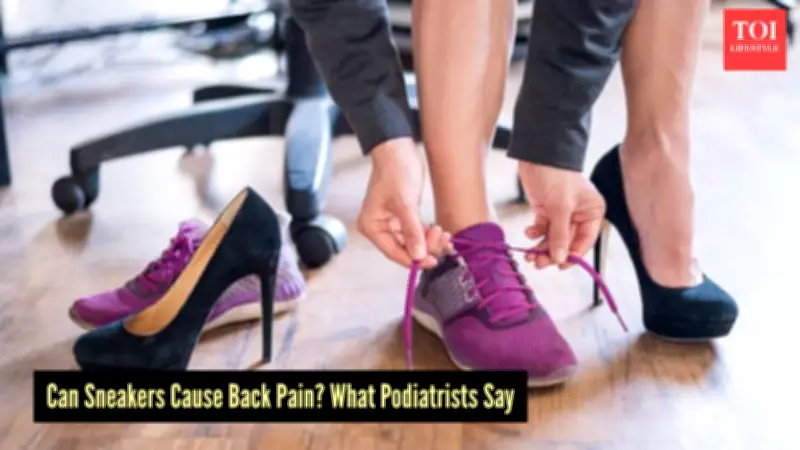
The Hidden Danger of Worn-Out Sneakers: How Your Favorite Shoes Are Harming Your Spine
We all have that one cherished pair of sneakers. You know the ones—they are scuffed, the logo is fading, and the laces might be frayed, but slipping your feet into them feels like a warm, familiar hug. They have molded perfectly to the unique contours of your feet, convincing you they are the most comfortable shoes you own because they do not pinch or rub.
However, here is the uncomfortable truth: that "molded" feeling is not true comfort. It is a sign of structural collapse. That nagging lower back pain you have been experiencing after a long day of walking? It might not be your mattress; it could very well be your favorite shoes betraying you from the ground up.
The Invisible Betrayal: Understanding Footwear Fatigue
The problem with worn-out sneakers is almost never visible on the outside; it is what is deteriorating on the inside. Most sneakers rely on a midsole made of materials like EVA or polyurethane foam, which acts as a shock absorber for your body. When you walk, you hit the ground with approximately 1.5 times your body weight. For the first few months, that foam springs back resiliently, like a fresh marshmallow.

Over time, however, the foam suffers from a phenomenon known as "compression set." It bottoms out, losing its air pockets and ability to rebound. This is what experts call "Footwear Fatigue." The shoe might look structurally intact, but its shock absorption capacity is gone. Instead of the shoe absorbing the impact, that force travels straight up your legs and slams into your lumbar spine, leading to pain and discomfort.
The Domino Effect: From Heel to Spine
Biomechanics experts refer to the "Kinetic Chain," which describes your body as a connected system of gears. If the bottom gear—your feet—becomes unstable or misaligned, the top gears, including your knees, hips, and spine, must work harder to compensate. When your sneaker's support collapses, it rarely happens evenly.
Typically, the inner support gives out first, causing your foot to roll inward in a motion called over-pronation. This twists your shin bone, rotates your thigh bone, and tilts your pelvis forward, resulting in an "anterior pelvic tilt." This condition forces your lower back to arch excessively, a state known as hyperlordosis. Essentially, you are walking around with your lower back muscles in a constant state of panic, trying to stabilize a structure that your shoes abandoned months ago.
The Autopsy: How to Know if Your Shoes Are Dead
You do not need advanced medical equipment to diagnose dead shoes; a simple kitchen table will suffice. Here are three easy tests to determine if your sneakers are past their prime:
- The Table Test: Place your sneakers on a flat surface at eye level. Examine the heels. Are they standing straight up, or are they tilting inward or outward? If they are leaning, the internal heel counter is broken. Walking in such shoes is akin to building a house on a crooked foundation.
- The Wrinkle Check: Look at the white foam on the side of the sole. Do you see deep, horizontal compression lines that resemble wrinkles? This is a clear sign of dead foam, indicating that the elasticity has vanished.
- The Twist Test: Pick up the shoe and wring it gently like a wet towel. A supportive shoe should resist your efforts. If you can twist it effortlessly, the "shank"—the shoe's spine—is snapped. A shoe with no spine cannot support yours.
The Fix: The 300-Mile Rule
Breaking up with old sneakers can be difficult, but your spine will thank you for it. The golden rule for sneaker lifespan is 300 to 500 miles. For the average urban walker, this translates to roughly six to eight months of regular wear. To prolong the lifespan of your shoes, avoid wearing the same pair two days in a row.
Foam needs about 24 to 48 hours to "decompress" and return to its original shape. By rotating between two pairs, you allow the material to recover, maintaining its shock absorption capabilities for a longer period. So, take a hard look at those trusty old sneakers by the door. They have served you well, but if they are dead, they are taking your back down with them. It is time to let go and invest in a new pair for the sake of your health.






