

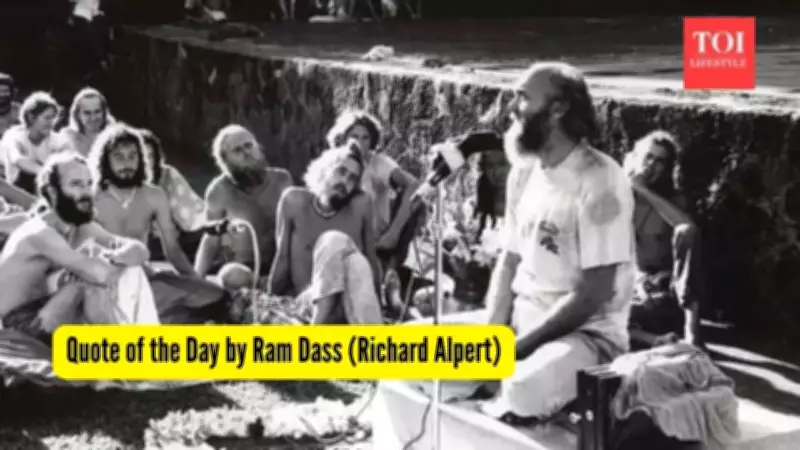
The Transformative Journey of Ram Dass: From Harvard Professor to Spiritual Icon
Ram Dass, originally named Richard Alpert, stands as one of the most influential spiritual teachers of the 20th century. Born in 1931, his extraordinary evolution from a Harvard psychology professor conducting controversial LSD experiments to a revered guru in white robes represents a profound personal and cultural transformation that continues to resonate across generations.
Early Life and Academic Brilliance
Richard Alpert grew up in an affluent Boston suburb as the eldest son of George Alpert, a prominent Jewish lawyer who later became president of the New York, New Haven & Hartford Railroad. Despite material privilege, his family environment lacked emotional warmth, creating what he later described as a "pathological" need for love that would shape his spiritual quest.
His academic journey demonstrated exceptional intellect: earning a psychology bachelor's from Tufts University in 1952, a master's from Wesleyan University in 1954, and a PhD from Stanford University by 1957. Yet beneath this brilliant exterior, Alpert felt profoundly adrift, engaging in excessive drinking and womanizing while struggling with deep-seated insecurities.

The Psychedelic Revolution at Harvard
In 1960, Alpert's life took a dramatic turn when he met Timothy Leary at Harvard University. Together, they launched the groundbreaking Harvard Psilocybin Project, exploring consciousness expansion through psychedelic substances. Their research expanded to include LSD, which they administered to graduate students, prisoners, and divinity scholars in what became known as the Good Friday Experiment of 1962.
This controversial study produced remarkable results, with half of the participants reporting profound mystical experiences. However, growing scandal surrounding undergraduate drug use and rumors of orgies led to their dismissal from Harvard in May 1963. Leary famously quipped they were considered "the most dangerous men on campus."
From Millbrook to Spiritual Awakening
Following their Harvard expulsion, Alpert and Leary established a psychedelic community at Millbrook, a 4,000-acre estate in New York funded by heiress Peggy Hitchcock. Here, they conducted numerous "acid tests" and consciousness seminars that attracted seekers from across the country. Alpert co-authored The Psychedelic Experience in 1964, adapting principles from the Tibetan Book of the Dead for psychedelic journeys.
Despite growing fame that included a Time magazine cover story, Alpert experienced increasing disillusionment with psychedelics as a spiritual path. By 1966, he recognized that while these substances could provide temporary enlightenment experiences, they couldn't sustain lasting transformation. This realization prompted his journey to India in search of deeper wisdom.
Transformation in India: Becoming Ram Dass
In 1967, Alpert arrived at the Kainchi ashram in India, guided by references from Autobiography of a Yogi. There he encountered Neem Karoli Baba, affectionately called Maharajji, who would become his spiritual master. Their first meeting proved transformative—when Alpert said, "I feel you know me," Maharajji responded, "How could I not?" claiming they had met previously in visions.
Maharajji renamed him Ram Dass, meaning "Servant of God," and guided him through months of silent meditation, seva (selfless service), and spiritual practice. This period completely transformed Alpert's understanding of spirituality, moving him beyond psychedelic shortcuts to embrace traditional yogic paths.
Return to America and Lasting Legacy
Ram Dass returned to the United States transformed, wearing white dhoti robes and mala beads, ready to share his spiritual insights. His 1971 book Be Here Now became a cultural phenomenon—part memoir, part spiritual guide, hand-lettered and illustrated in psychedelic style. The book sold millions of copies and established Ram Dass as a bridge between Eastern spirituality and Western seekers.

He founded the Hanuman Foundation in 1974 to provide spiritual resources and established the Seva Foundation in 1978, which has served millions through initiatives like eye camps in India and Nepal. Ram Dass recorded over 900 lectures that continue to inspire through modern podcasts, sharing timeless wisdom with new generations.
Final Years and Enduring Wisdom
In his later years, Ram Dass faced significant health challenges, including a massive stroke in 1997 that left him partially paralyzed. He approached this adversity with remarkable grace, viewing it as another aspect of his spiritual journey. He continued teaching and writing until his passing on December 22, 2019, at age 88 on Maui.
One of his most enduring teachings addresses authenticity: "When you take off your mask, it's easier for everyone else to do it. Our culture is so mask-driven. Imagine an office with no mask." This simple yet profound insight encourages genuine human connection by removing social facades that create division and misunderstanding.
Ram Dass's legacy extends far beyond his bestselling books and charitable foundations. He fundamentally reshaped Western spirituality by demonstrating that enlightenment could be accessible and human, blending Eastern wisdom with Western psychology in a way that continues to inspire millions worldwide. His message of "love everyone, serve everyone, remember God" remains a guiding light for spiritual seekers across cultures and generations.





