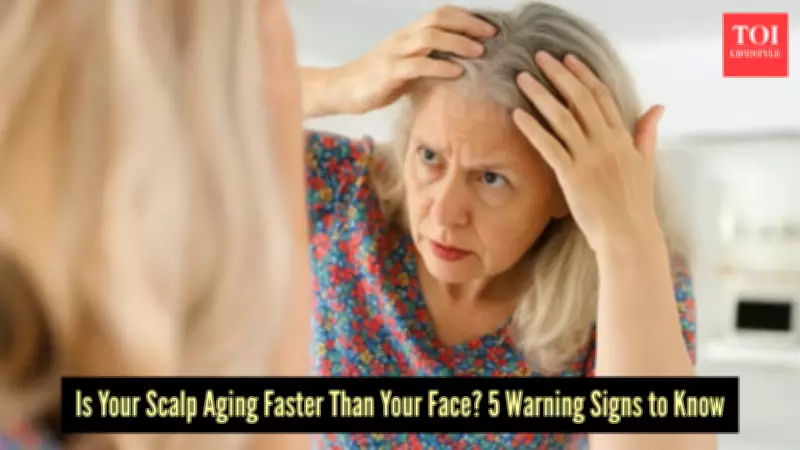
Your Scalp Ages Six Times Faster Than Your Face: The Hidden Anti-Aging Battle
We invest significant resources in retinols, peptides, and high-SPF sunscreens to maintain the youthful plumpness and elasticity of our facial skin. However, while meticulously applying serums to target crow's feet and fine lines, there exists a critical patch of skin merely inches above that is biologically deteriorating at a dramatically accelerated pace. Scientific investigations and dermatological studies indicate that the scalp ages at a rate up to six times faster than the skin on your face. The alarming reality is that, concealed beneath your hair, this damage often goes unnoticed until it manifests as persistent "bad hair days" that defy conventional solutions. If your hair has recently exhibited uncharacteristic behavior, the culprit may not be environmental factors or your shampoo formula. It could very well be your scalp signaling distress and premature aging.
Five Critical Indicators Your Scalp Is Aging Prematurely
Recognizing these signs is the first step toward intervention. Here are five definitive signals that your scalp requires immediate anti-aging attention.
1. The Dramatic Sebum Production Decline
Recall the teenage years necessitating frequent hair washes to combat excessive oiliness. If you now comfortably extend periods between washes to four or five days, you might perceive this as a convenience. Biologically, however, it represents a significant warning sign. While facial skin may retain oiliness into your thirties, your scalp's sebum production undergoes a steep decline with age. Hormonal shifts, particularly in estrogen levels, cause the sebaceous glands to diminish in size. A scalp that feels persistently tight, itchy, or dehydrated—even days post-wash—is likely experiencing "senile xerosis." This condition signifies not just cleanliness but a fundamental loss of the scalp's intrinsic hydration capability.

2. Invisible Hair Thinning and Follicle Miniaturization
Observing hair accumulation in the shower drain can be distressing, but the true marker of scalp aging extends beyond mere shedding. The critical process is "follicle miniaturization." As the scalp's foundational collagen and elastin degrade, the hair follicles physically contract. A follicle once capable of producing a robust, thick strand now generates a fine, wispy hair. You may not notice distinct bald patches, but your ponytail may feel less substantial, or your hair parting might appear wider. This phenomenon reflects a loss of hair density and follicle health, not just strand quantity.
3. Altered Hair Texture Turning Wiry and Unmanageable
Have you encountered stray grey hairs that resist styling or a general frizziness unresponsive to intensive conditioning? This texture alteration originates at the scalp level. With aging, microcirculation—the blood flow delivering essential nutrients to the hair bulb—slows considerably. Deprived of consistent nutritional support, the hair cuticle forms unevenly. The consequence is hair that feels coarse and rough to the touch, often defying styling tools like blow dryers and becoming increasingly unmanageable.
4. Premature Greying Concentrated at Temples and Crown
Genetic predisposition largely governs the greying process. However, premature greying, especially when localized around the temples or crown, frequently signals underlying distress. Unlike our faces, which we routinely shield with sunscreen, our scalps remain perpetually exposed to ultraviolet rays and environmental pollutants. This exposure generates free radicals that aggressively damage the melanocytes—the pigment cells within hair follicles. This constitutes "photo-aging" specifically for your hair. The emergence of grey hairs alongside scalp dryness strongly suggests your scalp is under sustained environmental assault.
5. Heightened Scalp Sensitivity and Thinning Epidermis
An aging scalp becomes thinner and less resilient, analogous to the skin on your hands or neck. The cellular turnover rate decelerates, resulting in a thinner epidermal layer. If your scalp feels tender during brushing, sunburns rapidly, or stings upon application of previously tolerated products, this sensitivity is a direct consequence of aging. It is the skin's explicit communication that it has diminished its protective and resilient capacities.

The Essential Solution: Embracing "Skinification"
So, what is the definitive course of action? Cease treating your scalp as an isolated entity. The contemporary imperative is "skinification"—applying the same high-caliber, targeted ingredients to your scalp that you dedicate to your facial skincare regimen. Proactively seek out specialized scalp serums formulated with:
- Hyaluronic Acid: To deliver deep, sustained moisture and combat dehydration.
- Peptides: To provide crucial collagen support and reinforce scalp structure.
- Salicylic Acid: To gently yet effectively exfoliate the slowed-turnover skin on the scalp's surface.
Furthermore, adopt proactive protection. During sun exposure, wearing a hat is no longer merely a fashion choice but a critical anti-aging measure for your scalp. Remember, your scalp is skin—it unequivocally deserves the same rigorous, preventative anti-aging treatment you afford the rest of your complexion.