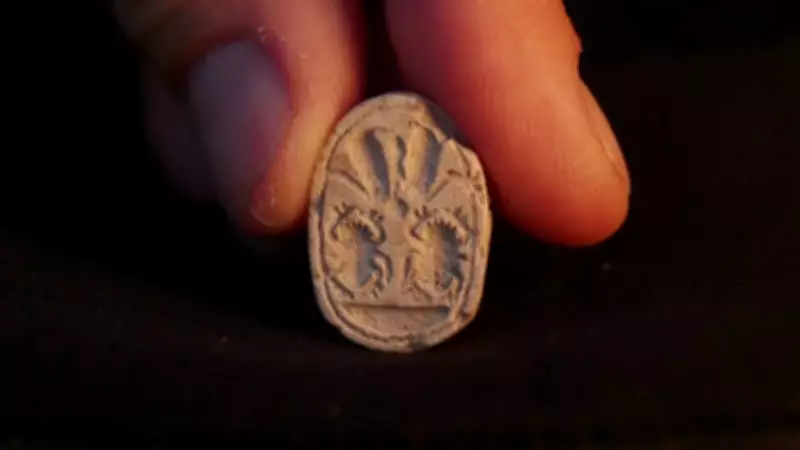
Toddler's Remarkable Discovery: A 3,800-Year-Old Scarab Amulet
In an extraordinary find that archaeologists are calling "of biblical proportions," a three-year-old girl in Israel has uncovered a 3,800-year-old Canaanite amulet while on a family stroll. The discovery, made by Ziv Nitzan at Tel Azeka in the Judaean Foothills, provides significant new evidence about the close cultural and religious ties between Canaan and Egypt during the Bronze Age.
From Ordinary Stone to Archaeological Treasure
What initially appeared to be just another stone among countless others in the sand turned out to be an ancient artifact of immense historical value. Ziv Nitzan spotted the small, curious object during a family walk and picked it up. When she rubbed away the sand, the true nature of the object became apparent. Archaeologists later confirmed it was a Canaanite amulet dating back approximately 3,800 years, likely used as either a seal or a protective talisman.
Her sister Omer recounted the moment with pride, explaining how the family quickly realized they had found something special. The Israel Antiquities Authority was notified immediately about the discovery, and young Ziv was awarded a certificate of appreciation for her remarkable find.

The Sacred Scarab: Symbolism and Cultural Exchange
The amulet discovered by Ziv is shaped like a scarab beetle, a design considered sacred in Ancient Egyptian culture. While the dung beetle might seem like an odd symbol today, in Egyptian tradition it represented new life and creation. The scarab rolls its dung ball, lays eggs within it, and from that small mound emerges new life—a powerful metaphor for rebirth and regeneration.
Experts note that the Egyptian name for the beetle literally derives from the verb "to come into being" or "to be created." This particular amulet demonstrates how Egyptian symbolism and religious concepts influenced Canaanite culture during the Bronze Age. Such scarabs were commonly found in graves, homes, and public buildings throughout the region, serving both religious purposes and indicating social status.
Archaeological Significance and Historical Context
Professor Oded Lipschits of Tel Aviv University, who has been excavating the Azekah site for 15 years, called the discovery "remarkable" and noted that it adds to a long list of Egyptian and Canaanite finds in the area. The amulet provides valuable insights into ancient religious practices, social structures, and the cultural exchange between these two important Bronze Age civilizations.
Tel Azeka itself holds significant historical importance as the site of the ancient town of Azekah, mentioned in 1 Samuel 17:1 during the famous battle between David and Goliath. Archaeologists have been excavating this location for decades, uncovering layers of history from the Middle Bronze Age through the Late Bronze Age. The area represents a rich tapestry of ancient civilizations and historical events.
Uncovering Layers of Ancient History
Walking through Tel Azeka today, it's easy to imagine the ancient armies and bustling towns that once occupied this landscape. The site has yielded numerous archaeological treasures over the years, each adding another piece to our understanding of the region's complex history. Now, thanks to the sharp eyes of a three-year-old girl, a new chapter has been added to this ongoing story of discovery.
The scarab amulet found by Ziv Nitzan represents more than just an ancient artifact—it serves as a tangible connection to a world 3,800 years ago, offering glimpses into the religious beliefs, social practices, and cultural exchanges that shaped the ancient Near East. As archaeologists continue to study this remarkable find, it promises to shed new light on the intricate relationships between Canaan and Egypt during a pivotal period in human history.