In Hindu epics, family is never just background—it is the emotional core of the story. Kings make impossible choices because of their children. Mothers carry grief, faith, sacrifice, and fierce devotion in the same breath. Children, in turn, grow up shaped not only by destiny but also by the tenderness, restraint, and courage of the people who raised them. What makes these stories powerful is that they do not present parenthood as something perfect or easy. It is often complicated, painful, and full of longing. A father sends away a beloved son to honor a promise. A mother protects her child through exile and uncertainty. Another mother raises a divine child who does not even belong to her by birth, yet loves him as though he does. These are not just ancient tales. They are emotional maps of what it means to nurture, to sacrifice, and to love without keeping score. Read closely, and the epics feel startlingly human. They remind us that the bond between parent and child is one of the oldest stories ever told. Here are five unforgettable stories from Hindu epics that capture the tenderness, sacrifice, heartbreak, and unconditional love between parents and children across generations.
Dasharatha’s Heartbreak Over Rama
One of the most moving parent-child stories in the Ramayana begins not with celebration but with sorrow. King Dasharatha adores Rama, his eldest son, and sees in him not just a child but the future of his kingdom. Rama is obedient, wise, calm, and deeply loved. Dasharatha’s affection for him is so intense that it becomes central to the king’s emotional world. That is what makes the exile of Rama so devastating. Bound by a promise he once made, Dasharatha is forced to send Rama away for fourteen years. The scene is heartbreaking because the father is not cruel; he is trapped. He loves his son too much to watch him leave, yet he cannot break his word. In that conflict lies one of the most human portraits of fatherhood in Indian epics. Dasharatha’s grief shows that parental love is not only about protection. Sometimes it is about losing what you love most while still choosing duty. His death, soon after Rama’s exile, is remembered as the collapse of a father whose heart could not bear the separation.
Kaushalya’s Quiet Strength
If Dasharatha’s love is dramatic and tragic, Kaushalya’s is softer but no less powerful. She is the mother who watches her son leave for exile, knowing that she cannot shield him from fate. Unlike a loud or expansive kind of affection, her love is quiet, dignified, and deeply enduring. It is the kind of love that steadies rather than performs. Kaushalya’s role in the Ramayana reveals a different face of motherhood: the willingness to let a child follow dharma even when the path is painful. She does not try to stop Rama from going. She does not turn her pain into a demand. Instead, she blesses him, grieves privately, and carries the ache of separation with extraordinary restraint. In many ways, that is what makes her unforgettable. She embodies the mother who gives her child the courage to walk into suffering with integrity intact. Her bond with Rama is rooted not in possession but in trust.

Yashoda Raising Krishna as Her Own
Few stories in Hindu tradition capture the tenderness of parenthood as beautifully as Yashoda and Krishna. Yashoda is not Krishna’s birth mother, yet she becomes one of the most beloved maternal figures in Indian storytelling. She feeds him, scolds him, chases him, worries over him, and tries to keep him safe even when he is clearly far beyond ordinary childhood. The divine child in her home is also a mischievous boy who steals butter, breaks pots, and disappears into trouble with a smile. What makes this bond so moving is its intimacy. Yashoda’s love is practical and embodied. She ties him down with rope when he misbehaves. She frets over his safety. She sees him not as an incarnation, not as a theological idea, but as her son. That is why the story feels so universal. It says that parenthood is built in the ordinary acts of care: feeding, disciplining, protecting, and loving through exhaustion. Yashoda’s relationship with Krishna is one of the tenderest portraits of a mother’s heart in all of Indian mythology.

Vasudeva and Devaki’s Devotion to Krishna
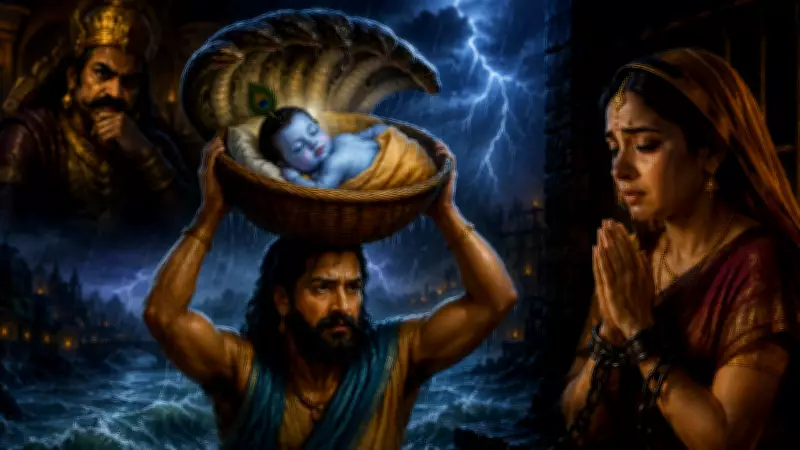
The story of Krishna’s birth adds another layer to the theme of parental love: sacrifice under extreme danger. Vasudeva and Devaki know that their child will be pursued by Kansa, the tyrant who fears prophecy. Their son’s arrival is not greeted with peace but with immediate peril. Devaki gives birth under imprisonment. Vasudeva must carry the newborn across a stormy night to safety, risking everything to save him. This story is powerful because it captures the fear that sits at the edge of parenthood. Parents do not simply love; they also worry, calculate, and endure. Vasudeva and Devaki’s devotion is made extraordinary by the conditions under which it unfolds. They are separated from their child, denied the ordinary joy of raising him, and forced to love him through distance and danger. Yet their sacrifice becomes part of the larger moral architecture of Krishna’s life. The bond here is not defined by comfort but by a willingness to protect a child even when the cost is unbearable.
Kunti’s Lifelong Burden of Love
Kunti’s story in the Mahabharata is one of the most emotionally complex in Indian epic literature. As a mother, she carries love, secrecy, shame, loyalty, and grief all at once. Her bond with her sons is shaped by decisions that cost her dearly. She raises the Pandavas through hardship, guiding them with a mixture of tenderness and discipline. Her life is marked by the constant effort to protect children in a world built for conflict. What makes Kunti’s motherhood unforgettable is that it is never simple. She loves all her sons, yet her greatest pain often comes from the choices she must make in order to keep them safe or uphold larger duties. The most heartbreaking aspect of her story is how love and loss stay inseparable. In Kunti, the epics show that motherhood can be both sustaining and tragic. It can demand silence, sacrifice, and moral endurance. Her devotion is not always visible in grand gestures but in the long emotional labor of holding a family together while history breaks around it.
These five stories from Hindu epics remind us that the bond between parent and child is timeless, transcending mythology to speak to the human heart. They show that love is not always easy, but it is always worth remembering.