Ancient 8-Foot Iron Spear Unearthed in Tamil Nadu: India's Longest Iron Age Artifact
In a remarkable archaeological breakthrough, researchers from Tamil Nadu have excavated an impressive 8-foot-long iron spear from Thirumalapuram, located approximately 80 kilometers from Sivagalai in Tuticorin. This discovery follows the recent dating of Iron Age materials from Sivagalai to 3,345 BCE, making it one of the oldest known Iron Age sites in the region.
Unprecedented Discovery of Iron Age Weaponry
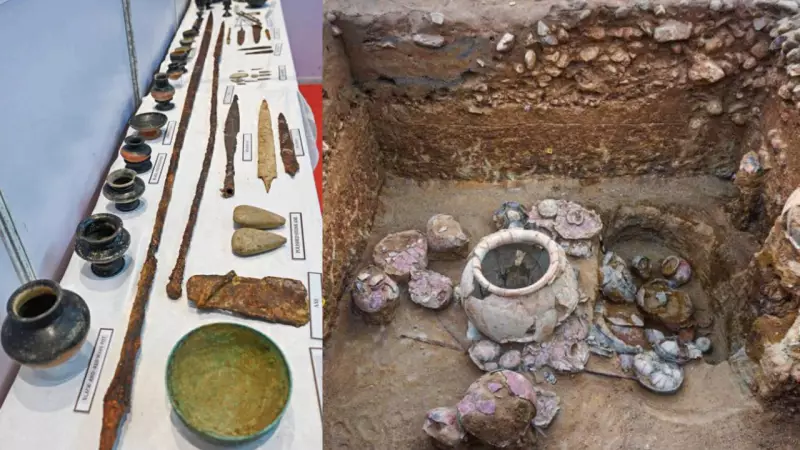
The excavation team, led by archaeologist K Vasanthakumar, uncovered not one but two ancient spears arranged in a distinctive 'X' formation beside a burial urn. While the shorter spear measures 6.5 feet in length, the longer specimen stands at a remarkable 8 feet, establishing it as the longest iron implement from the Iron Age ever discovered in India.
"We found two spears placed in an 'X' formation next to an urn. One was 8ft long and the other 6.5ft. There were also gold objects inside the urn," explained Vasanthakumar, detailing the significant find. The longer spear features a slightly rounded end, suggesting it was designed for comfortable handling, possibly by ancient warriors.

Insights from Archaeological Experts
Vibha Tripathi, an esteemed Iron Age expert and retired professor of archaeology at Banaras Hindu University, provided context for the discovery. "It might have been used by ancient warriors, as such burial sites have thrown up several weapon-grade objects such as daggers, swords, knives, and spears," she noted. Tripathi emphasized the exceptional preservation conditions in Tamil Nadu compared to other regions of India.
"Preservation of iron is much better here than in other parts of the country. In the Gangetic plains, the soil is moist, making iron corrode faster, so much that sometimes we get only an impression of iron," she added, highlighting the significance of the find's condition.
Ceremonial Significance and Social Status
R K Mohanty, former professor of proto and ancient Indian history at Deccan College in Pune, offered an alternative perspective on the spear's purpose. He suggested that the exceptionally long spear might have been a customized ceremonial piece rather than a practical weapon.
"It might have been made to show the social status and position of the person buried in the urn," Mohanty proposed, indicating that such artifacts could have served as symbols of power and prestige in ancient societies.
Call for Expanded Research and Technological Analysis
Both Tripathi and Mohanty have urged the Tamil Nadu State Department of Archaeology to conduct more comprehensive studies to better understand the evolution of iron use in the region. "It takes high temperatures of 1,200°C to 1,500°C to smelt iron. We should expand the studies to other sites within the region and outside Tamil Nadu," Mohanty emphasized, pointing to the advanced metallurgical knowledge required for such craftsmanship.
K Rajan, academic and research adviser to the Tamil Nadu State Department of Archaeology, contextualized the discovery within broader historical timelines. "It is the technological expression of that period. The iron product was in existence in Tamil Nadu between 3000 BCE and 2500 BCE," he stated, underscoring the region's early adoption of iron technology.
Future Research Initiatives
R Sivanandam, joint director of the Tamil Nadu State Department of Archaeology, revealed plans for systematic investigation. "In two years, the department, in partnership with department of metallurgy at IIT Gandhinagar, will conduct a study of various iron age sites across the state to track the evolution of iron technology," he announced. This collaborative effort aims to provide deeper insights into ancient metallurgical practices and secure global recognition for these significant archaeological findings.
The discovery of these ancient spears, particularly the unprecedented 8-foot specimen, offers valuable glimpses into the martial traditions, social hierarchies, and technological capabilities of Iron Age societies in southern India. As research continues, these artifacts promise to rewrite our understanding of early ironworking and cultural practices in the subcontinent.