Ahmedabad Heritage Seminar Charts Path for UNESCO Review with Comprehensive Proposals
As Ahmedabad gears up for a crucial UNESCO heritage review scheduled for March 18, a city-level heritage seminar held last week has put forward a robust set of recommendations to enhance the management and preservation of the historic Walled City. The event brought together a diverse group of stakeholders, including officials from the Ahmedabad Municipal Corporation (AMC), urban planners, conservation experts, and community representatives, to address pressing challenges and opportunities.
Moving Beyond Monuments: Heritage as a Living Framework
Manvita Baradi, director and founder of the Urban Management Centre (UMC), emphasized a paradigm shift in how heritage is perceived. "Heritage is a framework," she asserted, describing Ahmedabad as a "Living City" where historical layers must be intricately connected to contemporary urban planning. This holistic approach aims to integrate cultural legacy with modern development needs, ensuring sustainability and relevance.
Digital Innovation and Financial Planning
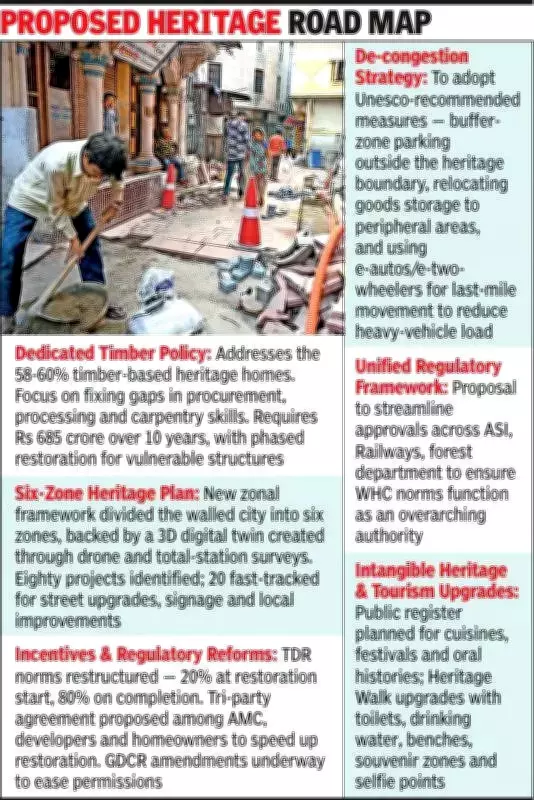
Anurag Anthony from UMC showcased a groundbreaking 3D "digital twin" of the Walled City, developed using advanced drone and total-station surveys. This digital model serves as a vital tool for visualization and planning. Anthony detailed UNESCO's four priority areas for the revised Zonal Plan:

- Zonal improvements to enhance urban functionality
- Public space design to foster community interaction
- Timber policy for structural preservation
- Decongestion efforts to alleviate urban density
The seminar produced a significant financial estimate, projecting Rs 685 crore required for timber-structure restoration over the next decade, highlighting the scale of investment needed.
Streamlining Approvals and Governance Reforms
A senior AMC assistant commissioner acknowledged existing delays in restoration permissions and announced the formation of a new committee to expedite approvals, aiming to reduce processing times to six-eight months. He proposed innovative "tri-party agreements between homeowners, developers and the government" to ensure quicker benefits and efficient project execution. Additionally, he confirmed that "GDCR reforms are underway," signaling ongoing efforts to update development control regulations.
Integrating Development with Heritage Philosophy
Municipal commissioner Banchha Nidhi Pani underscored the importance of balancing growth with preservation. He stated that the city's future development "must stand on the philosophy of development as well as heritage," advocating for a synergistic approach that respects historical integrity while fostering progress.
Addressing Mobility and Environmental Concerns
Mobility expert Shivanand Swamy highlighted practical solutions for the Walled City's narrow streets, recommending the introduction of micro-buses to improve accessibility. He warned that poor walkability and insufficient green cover are directly contributing to increased surface temperatures, urging immediate action. Swamy also pressed for relocating warehouses to buffer zones to "decouple trade from storage," reducing congestion and enhancing urban livability.
Bridging Gaps in Conservation Practice
Speakers at the seminar pointed out existing gaps in conservation efforts. City-based historian Rizwan Kadri reminisced about Ahmedabad's historical "sahkar" (cooperation) and its rich food heritage, calling for their integration into preservation strategies. Development professional Bhavna Ramrakhiani shared a success story from the women's craft collective at Sarkhej Roja, where historical stone designs were creatively translated into crochet souvenirs, demonstrating how heritage can be leveraged for economic and social empowerment.
Looking Ahead to the UNESCO Review
With the UNESCO heritage review imminent, the seminar's proposals aim to position Ahmedabad as a model for heritage-led urban development. The comprehensive plan, encompassing digital tools, financial investments, governance reforms, and community engagement, sets a proactive agenda for safeguarding the city's cultural legacy while addressing contemporary urban challenges.