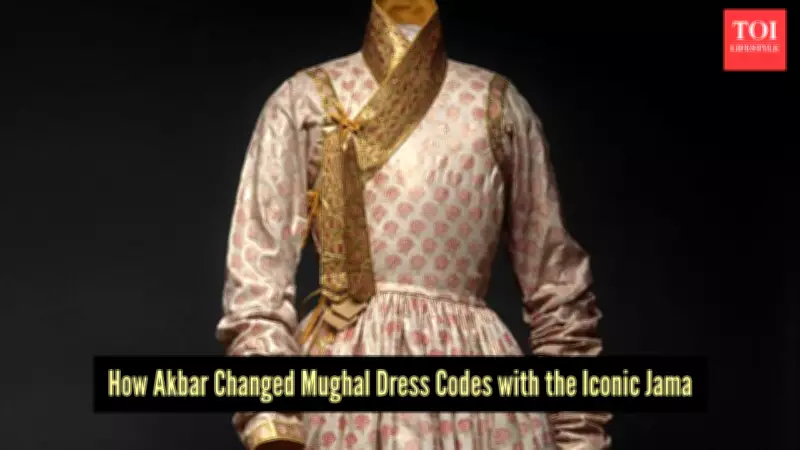
Akbar's Sheer Jama: A Political Statement in Mughal Fashion
When we imagine a Mughal emperor, the mind typically conjures images of heavy velvet, thick brocades, and multiple layers of silk that seem exhausting even to contemplate. This is the opulence traditionally associated with Central Asian conquerors. However, a closer examination of portraits of Emperor Akbar reveals a striking departure from this norm. The heavy robes are conspicuously absent. Instead, he is draped in something light and almost sheer—the iconic jama. For centuries, historians assumed this was merely a practical adaptation to India's scorching heat, where woolen garments would cause heatstroke. But emerging research indicates this wardrobe change was far more significant. It was a massive, calculated public relations maneuver. Akbar was not simply dressing for the climate; he was dressing strategically to consolidate his rule.
The Sartorial Clash of Civilizations
To comprehend why a simple white tunic held such profound importance, one must understand the two distinct cultural worlds Akbar sought to unite. On one side stood the Islamic tradition from which the Mughals originated. In this worldview, the body was considered private, modesty was non-negotiable, and clothing served to conceal the human form rather than celebrate it. Nudity, or even the appearance of it, was deemed shameful.
On the other side was the Indic tradition of his new subjects, which presented a completely opposite philosophy. Here, the body was not something to hide but a window to the soul. Ancient Indian texts and art frequently celebrated the physical form, with kings depicted bare-chested or in diaphanous drapes, as a healthy, radiant body was viewed as evidence of inner virtue and divine favor.

Thus, Akbar faced a complex dilemma: How could he dress as a pious Muslim ruler while simultaneously appearing as a divine Indian king? This sartorial challenge required a solution that would resonate across both cultural spheres.
The Fabric of Cultural Compromise
The answer lay in cotton, specifically the exceptionally fine, translucent muslin for which India was renowned. This fabric provided the perfect middle ground. By adopting the jama—a long, flowing tunic tied at the side—Akbar executed a masterful sartorial magic trick. As a full-body garment, it technically satisfied the Islamic requirement for coverage. Yet, due to its sheer quality, it subtly hinted at the body underneath, acknowledging the local belief that a king should have nothing to conceal. This was a brilliant exercise in visual politics; Akbar was literally wearing a compromise.
Radiant Skin and Divine Light
The research delves even deeper into the reasons behind this transparency. It was not solely about staying cool. The sheer white cotton allowed the emperor's skin to show through, creating an effect of radiance. In the courtly culture of the era, smooth, glowing skin and "perfumed sweat" were not merely beauty standards but indicators of a mahapurusha, or "great being," destined for power. By wearing fabric that let his skin shine, Akbar was effectively branding himself. He was cultivating the myth of farr-i izadi, or "divine light." He did not require a painted halo; his attire made him appear as if he were glowing from within, reinforcing his image as a divinely appointed ruler.
A New Aesthetic for a New Empire
This sartorial shift extended beyond one man's wardrobe, signaling a broader transformation within the empire itself. Just as Akbar blended Persian arches with Indian stone brackets in his architectural endeavors, he fused Central Asian tailoring with Indian textiles in his fashion choices. He adopted the jama, a garment with deep indigenous roots, and established it as the official uniform of the Mughal court. This sent a clear, powerful message: the Mughals were no longer mere tourists or invaders. They were becoming an integral part of the land's fabric—quite literally.
Therefore, the next time you encounter a miniature painting of Akbar in that crisp, flowing white silhouette, do not merely see a summer outfit. Recognize it for what it truly was: a meticulously crafted political manifesto, expertly stitched in cotton. This fashion choice was a strategic tool of statecraft, blending aesthetics with ideology to forge a new imperial identity.