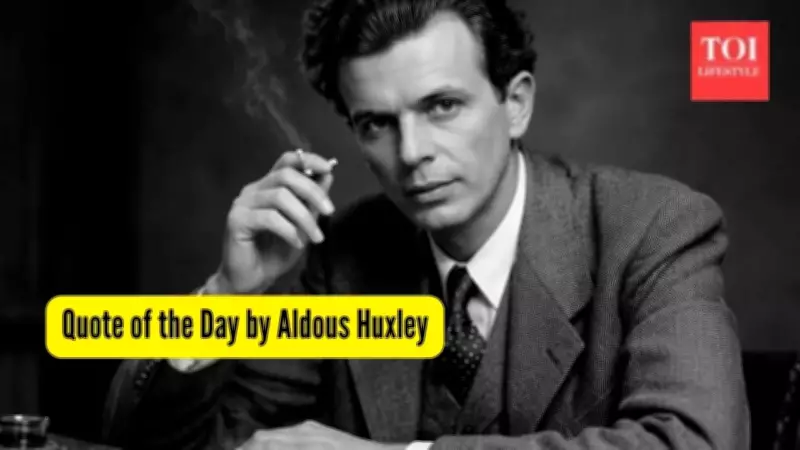
Aldous Huxley: The Intellectual Seer Who Saw Tomorrow
To enter the mind of Aldous Huxley is to encounter a prophetic intellect that dissected the soul of the 20th century with uncanny precision. Born in 1894 into an esteemed family of intellectuals in Surrey, England, Huxley was far more than a mere philosopher; he was a visionary who perceived the contours of modern society long before they became visible to the masses.
Early Life and Literary Beginnings
Despite facing significant personal challenges, including temporary blindness from keratitis at age sixteen, Huxley's intellectual curiosity remained undimmed. He pursued his education at Eton and Oxford, eventually emerging as one of the most brilliant minds of his generation. His literary career commenced with the publication of his first novel, Crome Yellow, in 1920, marking the beginning of a distinctive oeuvre that masterfully blended satire, science fiction, and mysticism.
During the 1920s, Huxley became a celebrated figure in London's literary circles, particularly within the influential Bloomsbury Group. However, he maintained the perspective of a keen observer, crafting sharp caricatures of post-World War I English society in works like Antic Hay (1923) and Point Counter Point (1928). These early novels offered biting critiques of a generation obsessed with hedonistic pursuits of sex, art, and social status.

The Dystopian Masterpiece: Brave New World
Huxley's literary legacy was forever transformed with the publication of Brave New World in 1932. This groundbreaking dystopian novel presented a chilling vision of a future society where human beings are manufactured in hatcheries, systematically categorized into rigid castes (from Alphas to Epsilons), and pacified through a pleasure-inducing drug called Soma. The society's motto—"Community, Identity, Stability"—replaced traditional family structures and intellectual freedom with engineered contentment.
Huxley drew inspiration from contemporary trends, including Henry Ford's assembly line efficiency, behaviorist psychology pioneered by figures like Pavlov and Watson, and the disturbing popularity of eugenics theories. In subsequent essays such as "Science, Liberty and Peace" (1946), he explicitly warned about technology's potential to erode human freedom. Although initially receiving modest commercial success, Brave New World gained tremendous relevance following World War II, as readers recognized disturbing parallels between Huxley's fictional world and emerging realities of consumerism and propaganda.
The novel's enduring impact is evidenced by its translation into more than sixty languages and numerous adaptations across theater, opera, and television, including a notable NBC miniseries in 2020. Huxley himself revisited his creation in Brave New World Revisited (1958), acknowledging that nuclear proliferation and overpopulation had rendered his fictional horrors comparatively tame.
American Transition and Mystical Exploration
In 1937, disillusioned with the political climate in Europe, particularly after residing in Fascist Italy, Huxley relocated to the United States. In Hollywood, he contributed screenwriting treatments for projects including Walt Disney's adaptation of Alice in Wonderland. This period also marked a profound spiritual transformation, influenced by his wife Maria and Indian philosopher Gerald Heard.
Huxley's experimentation with mescaline under the supervision of psychiatrist Humphry Osmond—who coined the term "psychedelic"—resulted in his influential work The Doors of Perception (1954). This book not only inspired Jim Morrison's band name but also significantly shaped the psychedelic movement of the 1960s. Huxley viewed these experiences as pathways to higher consciousness, synthesizing Eastern Vedanta philosophy with Western scientific inquiry. His spiritual explorations culminated in works like The Perennial Philosophy (1945), which argued for a universal truth underlying all religious traditions.

Literary Legacy and Enduring Influence
Huxley's prolific output encompassed over fifty books across multiple genres, including novels, essays, poetry, biographies, and screenplays. He remained a committed advocate for humanism, ecological awareness, and peace, co-founding initiatives like the Congress of Cultural Freedom. His intellectual evolution saw him transition from critiquing superficial hedonism to promoting spiritual education as a bulwark against totalitarianism.
His warnings about overpopulation and resource conflicts, articulated in essays like "The Double Crisis" (1960), resonate powerfully with contemporary United Nations reports on exponential growth challenges. Huxley's influence extends across diverse spheres, from George Orwell's dystopian visions to Steve Jobs, who reportedly read The Doors of Perception annually and credited it with life-changing insights.
In academic circles, Huxley's work remains foundational to discussions in bioethics, particularly regarding genetic engineering, and philosophical debates about biotechnology's role in human happiness. His distinctive writing style—characterized by elegant, ironic prose that seamlessly integrates references from Marcel Proust to quantum physics—maintains a unique balance of intellectual depth and accessibility.
The Philosophy of Happiness
One of Huxley's most enduring insights concerns the nature of happiness, encapsulated in his famous observation: "Happiness is not achieved by the conscious pursuit of happiness; it is generally the by-product of other activities." This quotation, from Chapter 3 of Brave New World Revisited (1958), reflects his critique of direct happiness-seeking, which he saw as leading to the numbed contentment depicted in his dystopian novel through Soma use.
Huxley drew upon mystical traditions like Taoism and psychological insights from figures like William James to argue that genuine happiness emerges indirectly through engagement in meaningful activities—whether creative work, relationships, or mindful daily tasks. This perspective offers a powerful counterpoint to consumerist cultures that market happiness as a commodity, reminding us that authentic fulfillment arises from purposeful engagement rather than direct pursuit.
In an era dominated by digital distractions and superficial satisfactions, Huxley's wisdom remains profoundly relevant: true happiness flows not from relentless seeking, but from wholehearted participation in life's deeper currents.