Ancient Rock Carving in Sinai Reveals Early Egyptian Dominance and Expansion
Archaeological research has unveiled a significant discovery in South Sinai, where a remarkably ancient rock carving was found at the site of Wadi Khamila. This important find emerged during comprehensive archaeological surveys conducted in 2025 and is now being published for the very first time. The carving dates back to approximately 3000 BC, presenting a vivid scene that illustrates Egyptian supremacy over the indigenous population of the region. This discovery adds a crucial new location to the known map of early Egyptian activities beyond the Nile Valley, shedding light on their historical reach and influence.
Detailed Analysis of the Wadi Khamila Rock Panel
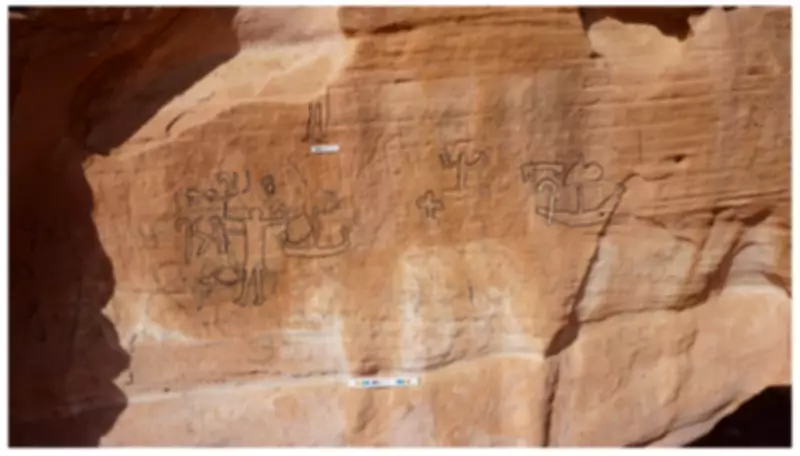
According to the research paper titled "Wadi Khamila, the god Min and the Beginning of 'Pharaonic' Dominance in Sinai 5000 years ago", the rock panel features a powerful and straightforward image. One figure is depicted striding forward with arms raised high, a gesture that traditionally signifies victory and triumph. Positioned in front of this dominant figure is another individual, shown kneeling with arms bound behind the back and an arrow piercing the chest. Behind the standing figure, a boat is carved, completing a scene that unmistakably conveys themes of control, defeat, and authoritative power.
Symbolism and Historical Context of the Carving
The standing figure in the carving represents Egyptian authority, potentially depicting either an Egyptian ruler or a deity associated with the control of borderlands. In contrast, the kneeling figure symbolizes the local Sinai population, portrayed in a state of subjugation. This imagery was not intended to document everyday life but rather to communicate a potent message about power dynamics in the region. Prior to this discovery, only three sites in south-western Sinai were known to contain similar Egyptian rock images from this early period. With Wadi Khamila now identified as the fourth site, the evidence strengthens the argument that Egypt maintained an organized and deliberate presence in Sinai much earlier than previously believed.

Egypt's Motivations and the Significance of the Boat Symbol
Egypt's interest in Sinai was primarily driven by the region's abundant natural resources, particularly copper and turquoise. These materials were essential for crafting tools, creating ornaments, and enhancing prestige. Egyptian expeditions would travel to Sinai seasonally to mine these valuable resources. Over time, they began carving Egyptian images and symbols into the landscape, effectively marking the territory as part of their sphere of influence.
The boat carved behind the standing figure holds particular importance. In early Egyptian art, boats frequently symbolize the ruler and the act of territorial control. Even when a specific king is not named, the presence of a boat indicates official authority and state-led expansion, reinforcing the message of dominance conveyed by the entire scene.
Religious Interpretations and Symbolic Messages
The raised-arm pose of the standing figure may connect the image to the god Min, who was associated with deserts, foreign lands, and mining expeditions. If the figure indeed represents Min, the scene merges religious and political elements, suggesting that Egyptian dominance was not merely a political endeavor but also divinely sanctioned. This interpretation adds a layer of spiritual justification to the display of power.
Researchers note that it is challenging to determine whether this scene records an actual violent event or follows a standardized symbolic pattern common in Egyptian art. Regardless, the primary significance lies in the message it communicates. The carving unequivocally demonstrates Egyptian control over the region, whether it depicts a specific historical incident or serves as a broader statement of authority.

Condition of the Panel and Its Historical Layering
The rock panel at Wadi Khamila contains carvings from multiple historical periods. In addition to the original Egyptian imagery, later additions include Nabataean and Arabic graffiti. Some portions of the initial scene have suffered damage or intentional erasure over time. This layered history indicates that the rock remained a site of significance long after the Egyptian era, continuously attracting attention and modifications from subsequent cultures.
Implications of the Discovery for Understanding Early Egyptian Expansion
Overall, the Wadi Khamila rock panel provides compelling evidence of early Egyptian expansion into south-western Sinai. It intricately links state power, resource extraction, religious symbolism, and visual propaganda within a single image carved over five millennia ago. The researchers involved in the study believe that numerous additional discoveries likely await in the area, and further investigations are already planned to uncover more insights into this fascinating chapter of history.