The Lonely Quest for Freedom in Alaska's Wilderness
Long before his name became synonymous with adventure, tragedy, and philosophical debate, Christopher McCandless was simply a 24-year-old man armed with a journal, a camera, and a profound, solitary vision of freedom. In the summer of 1992, he vanished into the remote Stampede Trail of Alaska, transforming an abandoned bus into his makeshift shelter. There, he meticulously recorded the fragments of a life stripped down to its bare essentials: foraging for berries, monitoring the weather, and the daily struggle for survival. Weeks later, hunters discovered his lifeless body inside that very bus. What endures is not merely the tragic conclusion but the deeply unsettling intimacy of the personal record he left behind.
A Restless Spirit Before the Final Journey
Christopher McCandless was born in California, raised in the suburbs of Washington, D.C., and graduated from Emory University before embarking on the nomadic existence that would posthumously etch his name into public consciousness. He traversed North America, adopting the alias Alexander Supertramp, and systematically severed the ties that typically anchor individuals in society: financial security, material possessions, and even consistent contact with family and friends. Contemporary reports and subsequent narratives portray him not as a reckless thrill-seeker, but as a young man earnestly attempting to pare life down to its most fundamental elements, seeking purity in simplicity.
The Bus: From Abandoned Shelter to Final Refuge
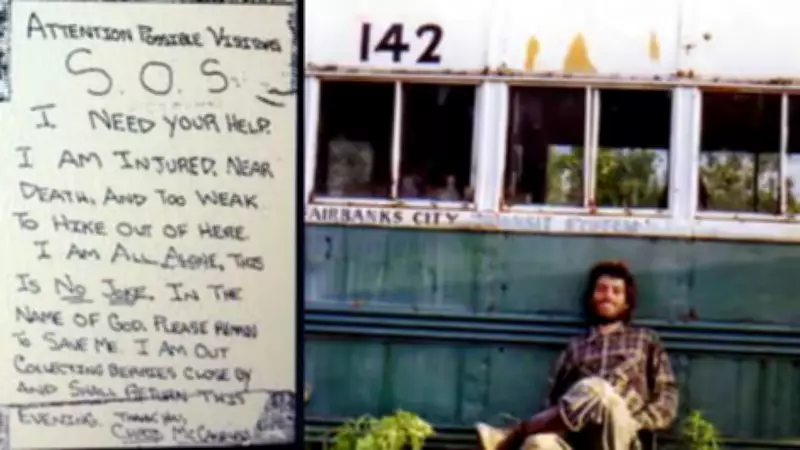
The bus on the Stampede Trail was never intended to become a monument. Originally a crude shelter for construction workers, it had been deserted years before McCandless arrived. By the time he discovered it, the structure was a rusting metal box perched on the frontier of the untamed wild—a place where he could sleep, read, write, and attempt to subsist solely on what the land provided. Early investigative reporting, notably by The New Yorker, catalogued the sparse remnants found within: a toothbrush, worn boots, a backpack, a small collection of books, an SOS note, and a terse, revealing journal.

This paper trail is a primary reason his story has resonated for decades. It allows observers to trace the final contours of his thoughts and experiences. Initially, McCandless appeared exhilarated by his austere experiment. He photographed himself smiling proudly in front of the bus and filled its interior with declarations, philosophical notes, and underlined passages about the person he aspired to become.
The Harsh Reality of Wilderness Survival
However, the wilderness does not long indulge romantic idealism. McCandless successfully hunted a moose but then faced immense difficulty preserving the meat. Subsequent journal entries grew somber and despairing. He lamented that his smoking preservation efforts were failing and expressed profound regret for having taken the shot. The man who journeyed north to test his limits was abruptly confronted with the crushing feeling of insignificance when nature ceased to cooperate.
The Haunting Final Record Inside the Bus
Inside the bus, McCandless maintained a sparse yet profoundly revealing chronicle of his days. His notes were not lengthy meditations but concise, clipped survival logs: what he hunted, which berries he foraged, and how the relentless landscape dictated each passing day. In the early weeks, the journal reads almost like an adventurous field report, noting small victories—a squirrel caught, edible plants identified, the quiet fulfillment of solitary existence in Alaska's vast expanse.
As weeks turned into months, the entries grew shorter, more strained, and increasingly desperate. He recorded shooting the moose but later mourned the loss of most of the meat due to improper preservation. By July, the tone had shifted to stark, urgent survival language. One poignant entry reads simply: "Weakness. Fault of pot seed." In his final days, he affixed a desperate plea to the bus door: "S.O.S. I need your help. I am injured, near death, and too weak to hike out of here. I am all alone, this is no joke." Even in this moment of extreme peril, the young traveler signed his name with calm finality: "Christopher McCandless. August."

The Tragic Turning Point and Inescapable End
The final chapter of McCandless's story is what renders it so indelible and haunting. He appears to have realized he was effectively trapped by the Teklanika River, which swelled with summer snowmelt, cutting off his potential escape route. He spent approximately 114 days in the bus before succumbing to starvation. His body was discovered on September 6, 1992.
The official cause of death was listed as starvation, though subsequent reporting and research have explored potential contributing factors, such as poisoning from toxic seeds. Regardless of the medical nuances, the undeniable fact remains: he died alone in a place he had entered in passionate pursuit of absolute freedom. The story's enduring sting lies not only in its conclusion but in the stark contrast between his initial grand gesture and the grim outcome.
Why the McCandless Legend Endures and Fascinates
Christopher McCandless did not merely perish in the wilderness; he inadvertently became a destination. For years, admirers inspired by Jon Krakauer's book Into the Wild and its film adaptation undertook perilous pilgrimages to Bus 142, crossing treacherous rivers and risking their lives to stand where he once stood. This led to multiple rescues and fatalities, prompting authorities to finally remove the bus from the trail in 2020. The bus was a physical relic, but it had transformed into something far more perilous than a memory: a shrine to the dangerous fantasy that utter solitude can provide all answers.
This is why his story continually resurfaces in various cultural forms. Some interpret McCandless as a reckless youth who confused intensity for profound wisdom. Others perceive in him a seeker whose quest was so authentic it becomes heartbreaking. Both interpretations contain enough truth to resonate powerfully. He sought to discover what remained when comfort, routine, and societal expectations were completely stripped away. What he ultimately encountered was harsher and more elemental: a life cannot be fully realized in total retreat from human connection. The Alaskan cold was brutally real, but so is the deeper, enduring lesson his story imparts about the balance between solitude and community.