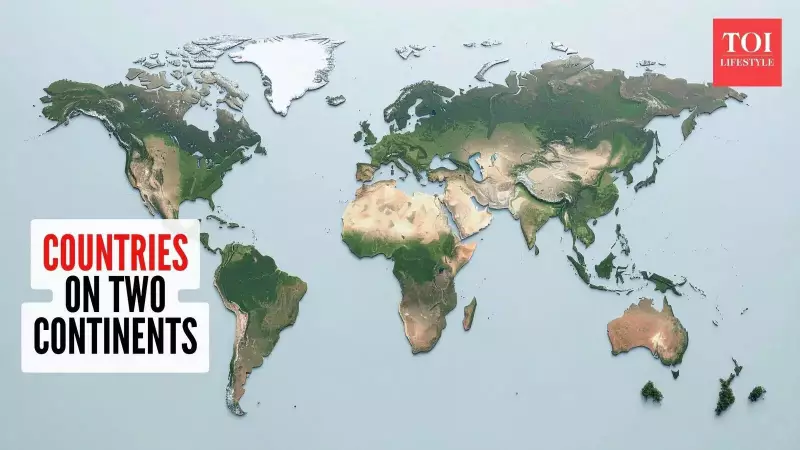
Examining a world map often presents a straightforward view, with each nation appearing to rest comfortably within a single continent. However, geography delights in delivering unexpected twists. Several countries remarkably stretch across two continents simultaneously, meaning one portion of the country belongs to one continent while another part resides elsewhere. This intriguing reality transforms maps into captivating puzzles and injects a sense of adventure into learning geography, especially for young minds.
Turkey: The Iconic Transcontinental Nation
Turkey stands as the most renowned two-continent country globally. Its territory is distinctly split between Europe and Asia, with the historic Bosphorus Strait serving as the natural divider. Istanbul, Turkey's largest and most vibrant city, uniquely straddles both continents. Children visiting Istanbul can experience the thrill of crossing from Europe to Asia in mere minutes via one of the city's bridges, offering a sensation of traveling across the world within a single day.
Russia: The Colossal Land Spanning Continents
As the largest country on Earth, Russia extends across both Europe and Asia, with the Ural Mountains traditionally marking the boundary between these continents. Interestingly, while the Asian side of Russia encompasses a vast majority of the land area, most of the population resides on the European side. This disparity highlights how geography involves not just physical space but also patterns of human settlement and lifestyle.

Egypt: Africa's Gateway to Asia
Egypt is predominantly located in Africa, but its Sinai Peninsula extends into Asia, with the Suez Canal acting as the defining separation point. This strategic waterway sees countless ships navigating daily, facilitating movement between continents and underscoring Egypt's role as a crucial junction of land, sea, and historical narratives. For children, Egypt exemplifies how man-made and natural waterways can reshape geographical perceptions.
Kazakhstan: The Subtle Continental Crosser
Kazakhstan, though less frequently highlighted, also possesses transcontinental characteristics. A small portion of its territory west of the Ural River falls within Europe, while the remainder lies in Asia. This fact, though not widely publicized, adds another layer to the diverse tapestry of global geography.
Denmark: An Oceanic Continental Connection
Denmark introduces a unique variation on this theme. While Denmark itself is situated in Europe, it administers Greenland, which is geographically part of North America. This connection spans oceans rather than contiguous land, demonstrating how political and geographical boundaries can intersect in fascinating ways.
The Magic of Transcontinental Countries
Nations that bridge two continents function as cultural and geographical bridges, facilitating the exchange of people, cuisines, stories, and ideas across continental divides. For children, learning about these countries reveals that boundaries are not always rigid or immutable. Geography evolves from a subject of rote memorization into a dynamic, living discourse. Just as individuals can cherish multiple homes, a single country can authentically belong to more than one geographical realm, enriching our understanding of the world's interconnectedness.
Disclaimer: This article is crafted for educational purposes and to spark curiosity. It is important to note that continental boundaries can vary slightly depending on different cartographic interpretations and expert opinions. The information presented here aligns with widely accepted geographic conventions.