Party Is Elsewhere: Delhi's Abandoned Nightclub Transforms into Unconventional Art Space
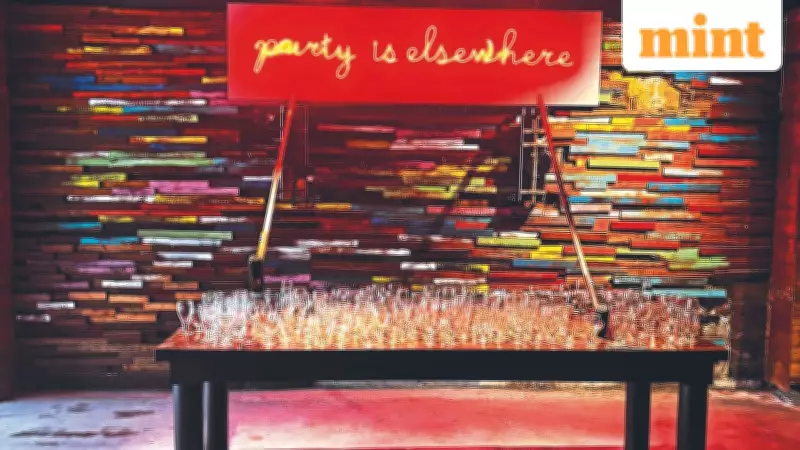
Step into a 5,500 square foot hall, and your eyes are immediately drawn to a table laden with 365 empty wine glasses, illuminated by a neon sign proclaiming "Party Is Elsewhere". Two hammers rhythmically strike the table, often missing the glasses, sparking curiosity and confusion. Is this a game, a twisted invitation, or an art piece? This enigmatic scene sets the tone for Party is Elsewhere, an ongoing exhibition at The Radial in Delhi's bustling Connaught Place, where 58 artworks challenge conventional gallery experiences.
Breaking Away from the White Cube
The venue itself is a character in this artistic narrative. Once an abandoned nightclub, it was recently repurposed into a temporary museum by curators Amit Kumar Jain and Reha Sodhi. Peeling walls, spider webs, stained toilet tiles, and broken floors form the raw backdrop for contemporary paintings, textile works, installations, and digital art. None of the pieces are labeled or explained, deliberately eschewing the pristine white-wall conventions of typical exhibitions.
Amit Kumar Jain, an independent collections adviser with experience at Devi Art Foundation and Saffronart, explains the philosophy behind this unconventional setting. "Museums worldwide struggle to attract visitors, and galleries often feel exclusive, meant only for the elite. The white cube isn't very inviting. We aim to break that barrier by hosting a show in a vibrant area like Connaught Place," he says. "None of the works here are for sale, and they lack labels. We want viewers to engage with the art and space without instructions, prompting questions and personal interpretations."

Artworks That Provoke Thought
Among the standout pieces are two life-size heads facing each other. One, made of sand, depicts a smiling, content man; the other, cast in white camphor, is disintegrating, symbolizing evaporation over time. Created in 2004 by Alwar Balasubramiam, this installation invites reflections on life's transience or chemical decay, depending on the viewer's perspective.
In a corner, a pillar from the former nightclub era features a sketch of a hookah with bubble quotes like "happy to serve" and "OMG"—the club's name, once famous for hookahs when they were legal. "We considered removing it but decided against it. Past and present can coexist to shape the future," Jain notes.
The old kitchen, marked by yellow-stained tiles, now houses a striking installation by Vivan Sundaram from 1997. A heap of photographs of old Delhi bazaars, pasted onto red phone covers, mirrors the chaotic browsing of local markets or documents the evolving moods of places like Jama Masjid and the Red Fort.
Upstairs Explorations and Artistic Legacy
Upstairs, in a hall that once served as a media office, a series of toy TVs play film stills of a melancholic Meena Kumari, perhaps highlighting her iconic tragic roles in Indian cinema. Another unsettling piece features a toilet with a light projection of ants crawling on the floor, possibly symbolizing decay or neglect.
Jain emphasizes that artists are comfortable showcasing their work in this shabby space. "They want their art interpreted in diverse ways, which happens when presented beyond the white cube. That's the essence of art—it makes you think," he asserts.
Visitor Experience and Practical Details
Visitors can opt for guided tours to learn about the artists, such as Sudarshan Shetty's Party is Elsewhere (2004) or Sheba Chhachhi's The Mermaid's Mirror (2005). Alternatively, they can leave with bemused wonder, embracing the mystery. The exhibition runs at The Radial, F Block, Connaught Place, New Delhi, until February 28, from 11 am to 7 pm, closed on Sundays and Mondays.
This innovative approach not only revitalizes a forgotten space but also democratizes art appreciation, encouraging dialogue and personal connection in an unconventional setting.