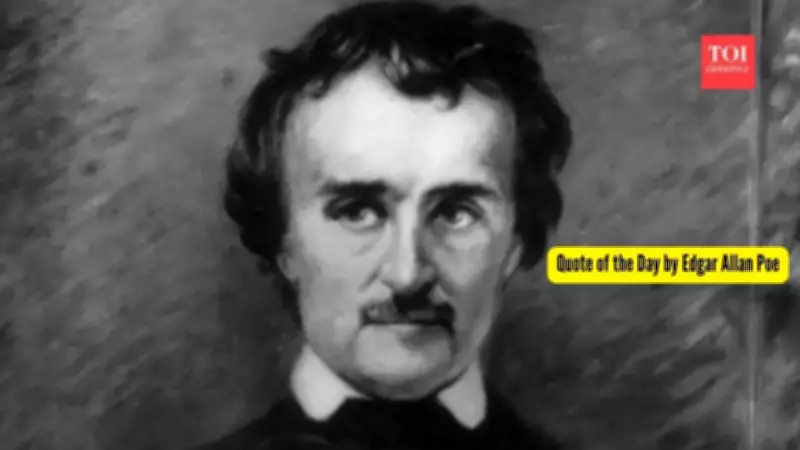
The Enduring Legacy of Edgar Allan Poe: Master of the Macabre
Edgar Allan Poe stands as one of the most significant and transformative literary figures of the 19th century, fundamentally reshaping the landscape of short stories, detective fiction, and psychological horror narratives. His innovative approach to exploring the human psyche established new paradigms in literature that continue to resonate with contemporary audiences.
A Life Marked by Turmoil and Creative Genius
Born on January 19, 1809, in Boston, Massachusetts, Poe's personal life was characterized by profound instability, repeated loss, and persistent financial struggles that deeply influenced his artistic vision. Though taken in by John and Frances Allan of Richmond, Virginia during his childhood, Poe never experienced formal adoption, creating a foundation of insecurity that permeated his existence. His particularly strained relationship with John Allan, centered around financial disputes and conflicting views about Poe's literary ambitions, contributed to a lifelong sense of displacement that found powerful expression in his writing.
From Poetry to Prose: The Evolution of a Literary Pioneer
Poe began his literary journey as a poet, publishing his first collection, Tamerlane and Other Poems, in 1827. While poetry remained a passion throughout his life, it was through his masterful short stories and incisive critical essays that Poe achieved lasting fame and influence. Serving as an editor and critic for numerous literary magazines, he developed a reputation for his uncompromising, often scathing reviews that challenged prevailing literary norms. Poe championed the principle that artistic merit should be the sole criterion for evaluating literature, rejecting popularity contests and didactic moralizing as valid measures of literary worth.

The Poe Aesthetic: Unity of Effect and Psychological Depth
One can immediately recognize Poe's distinctive literary style, which prioritizes mood, atmosphere, and psychological complexity over conventional plot structures or moral lessons. His writing employs meticulously crafted, almost musical language designed to produce specific emotional responses in readers. Poe famously articulated his "unity of effect" principle, insisting that every element of a literary work should contribute to a single, overwhelming impression. He advocated for poems and stories brief enough to be consumed in one sitting, ensuring that their emotional impact would not dissipate through interruption.
Thematic preoccupations with death, grief, madness, guilt, and obsession dominate Poe's oeuvre. Rather than relying on external violence to generate horror, he pioneered the exploration of internal psychological disintegration. His narrators frequently prove unreliable, their obsessive thoughts, heightened sensory perceptions, and flawed reasoning revealing profound mental instability. This psychological focus represented a revolutionary departure from contemporary literary conventions and established foundational principles for modern psychological fiction.
Iconic Works That Redefined Literary Genres
Among Poe's most celebrated poems, "The Raven" (1845) brought him immediate fame with its haunting repetition of "Nevermore" capturing profound grief and hopelessness. Other significant poetic works including "Annabel Lee," "Ulalume," and "The Bells" demonstrate his preoccupation with themes of love, loss, and the musical properties of language.
His short stories proved equally groundbreaking:
- "The Tell-Tale Heart" explores guilt and paranoia through the perspective of a murderer obsessed with proving his sanity
- "The Fall of the House of Usher" depicts parallel physical and mental deterioration, using setting as metaphor for psychological collapse
- "The Black Cat" examines moral decay and self-destruction
- "The Masque of the Red Death" confronts the inevitability of mortality
Poe essentially invented the detective fiction genre with "The Murders in the Rue Morgue," introducing the character C. Auguste Dupin whose logical deduction methods would influence countless successors including Sherlock Holmes.

A Philosophical Framework: Skepticism and Subjective Reality
Poe's literary philosophy explicitly rejected the notion that writing should primarily serve moral or educational purposes. He believed art possessed intrinsic value and that literature's fundamental purpose was to expand perception and emotional experience. Poe viewed truth as frequently subjective, dependent on individual perception rather than objective reality. This skepticism manifests throughout his work in recurring themes of sensory deception and unreliable narration.
The famous quotation "Believe nothing you hear and only half of what you see" encapsulates Poe's profound mistrust of surface appearances and conventional wisdom. This statement reflects his enduring concerns with deception, perceptual fallibility, and the unreliability of human judgment. Poe recognized the mind's susceptibility to manipulation—in his stories, sounds become false confessions, shadows transform into threats, and appearances conceal deeper truths.
The quotation also demonstrates Poe's resistance to social narratives and popular opinion. As a critic who frequently challenged literary trends, he understood how unexamined ideas gain power through repetition. "Believe nothing you hear" serves as warning against rumors, gossip, and untested assumptions, while "only half of what you see" acknowledges how emotion, prejudice, and belief distort visual perception.
Ultimately, this quotation illustrates Poe's overarching philosophical perspective that truth remains fragile, perception proves inherently flawed, and certainty often constitutes illusion. In a world dominated by appearances and assumptions, Poe encourages readers to question, analyze, and look beyond the obvious. His death in 1849 did not diminish his relevance—Poe's work continues to disturb, captivate, and resonate because of his enduring invitation to doubt and self-examination.