

Major Archaeological Find in Egypt's Sinai Peninsula Unveils 10,000 Years of Human History
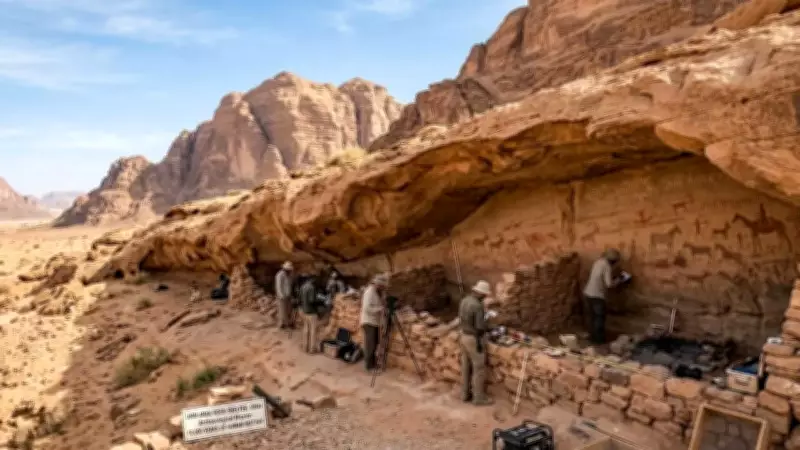
A groundbreaking archaeological discovery in Egypt's Sinai Peninsula has revealed an extensive rock shelter spanning 100 meters in length. This site provides an uninterrupted chronicle of human activities over the past 10,000 years, offering unprecedented insights into cultural evolution and adaptation.
Location and Chronological Significance
Located near the ancient mining centers of Serabit el-Khadim, this rock shelter on the Umm Arak plateau has enabled researchers to establish a detailed timeline of rock art. The record begins with Epipaleolithic hunter-gatherers from the early Holocene era, around 10,000 BCE, and extends through medieval periods up to modern times.
The archaeological team from Egypt's Supreme Council of Antiquities documented various artistic styles created by different groups over millennia. These include red-pigmented animal iconography, such as depictions of ibexes and wild donkeys, and hunting scenes carved using sunken relief techniques.

Evidence of Human Habitation and Strategic Use
Beyond art, the shelter contains substantial evidence of human settlement. Excavations uncovered stone living units, hearths, and pottery, with dates ranging from the Middle Kingdom to Roman times. This indicates the site was not only a canvas for expression but also a functional living space.
Strategically, the shelter's eastern edge served as a natural lookout over the plain leading to the Tih Plateau, making it advantageous for ancient populations. Its proximity to mining areas suggests it housed workers engaged in nearby extraction activities.
Cultural and Environmental Evolution Recorded
The rock art layers form a unique visual library, tracing environmental changes and cultural shifts from the Bronze Age through the Nabataean period. Later carvings from late antiquity feature Nabataean writing and images of camels and horses, reflecting increased trade and travel in the region east of Cairo.
Medieval markings, including tribal identifications known as 'Wusum' and geometric symbols from the 6th to 15th centuries CE, confirm continued use by traders and Bedouin tribes. This continuous use highlights the shelter's role as a crossroads for diverse cultures over ten millennia.
Implications for Understanding Human Adaptation
This discovery is significant for providing an unparalleled window into how multiple cultures adapted to the same geographical location across vast time spans. It underscores the Sinai Peninsula's historical importance as a hub of human activity, from early hunter-gatherers to complex trading societies.
The findings, reported in sources like The Ancient Near East Today and Archaeology Magazine, emphasize the shelter's value as a record of human resilience and innovation. Ongoing studies aim to further decode the artistic and structural remains to enrich our understanding of ancient civilizations in this region.






