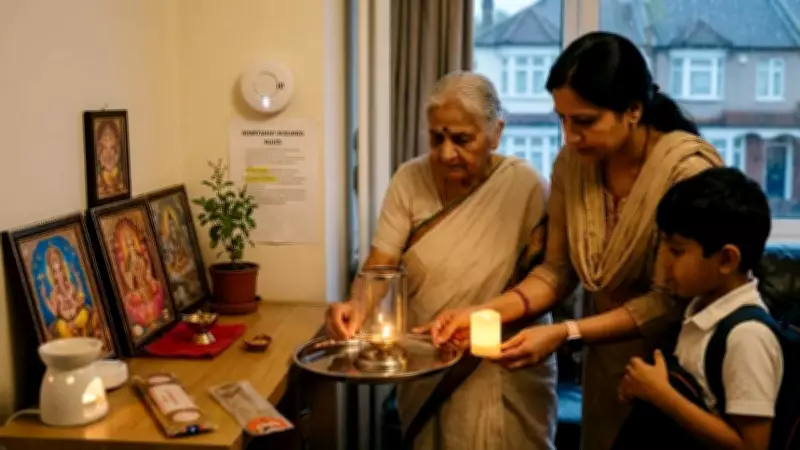
When the Fire Alarm Meets Your Aarti
The first time your building's fire alarm goes off during a quiet evening aarti, your heart drops in a way that has nothing to do with devotion. It is the real-life math of diaspora practice. A rental lease, a smoke detector that does not care it is Diwali, neighbours who do not know the difference between incense and a kitchen fire, and a child who has school at 7:45 a.m. tomorrow. None of this means you are rejecting tradition. It means you are trying to keep it, in a flat or a semi-detached, inside rules written for people who never imagined a havan in the living room.
Real Flame vs. Safe Adaptation
In most families, there are layers, and it helps to name them clearly before you decide what to do in a rental. Canonical ritual is what your sampradaya or temple teaches as the proper method. For some, that means an oil diya with cotton vatti, specific mantras, and a real agni for havan. This is the gold standard, and you should not pretend an LED is the same thing. Family custom is what your home has always done, even if it varies by region. Maybe your family uses ghee in the diya, or you do dhoop instead of agarbatti, or elders insist the diya must be lit at the tulsi plant. These are not wrong. They are your family's way of keeping the thread intact. Pragmatic adaptation abroad is what you do when the building, your work schedule, asthma in the house, or a strict lease makes the canonical option risky. An electric diya is not canon. It is a safety adaptation. If your family priest agrees it is acceptable for that context, you can still hold the purpose in your mind, do the prayers, and keep the habit alive without turning your rental into a hazard.
Lease Rules Still Matter
In the US and UK, your lease and building rules can absolutely restrict open flames, charcoal grills on balconies, smoke-producing items, and even where candles can be used. Many rentals ban any open flame outright. Some allow candles but prohibit burning incense because it triggers alarms or leaves residue. Read the actual wording. Do not rely on what your friend in another building gets away with. If the lease forbids open flames, treat that as a hard boundary. Not because the landlord is spiritually right, but because an eviction notice in the middle of Navratri will not feel like a victory for dharma. If you are unsure, ask the property manager a neutral question. Are candles allowed? Is incense allowed? Keep it practical. You do not have to explain your entire practice to get a clear answer.

Incense Is Smoke, Not Just Fragrance
Incense creates smoke, and smoke is what most alarms detect. In UK flats with sensitive detectors in hallways and open-plan kitchens, one enthusiastic dhoop session can set off the whole corridor. In US apartments, alarms are often interconnected. Your one living room can become everyone's midnight. If you are committed to incense, scale it down. Choose one stick, not four. Choose lighter agarbatti over heavy dhoop if your home traps smoke. Keep it away from detectors and from doorways where smoke drifts into common hallways. If someone in the home has asthma, do not force it out of sentiment. A practical alternative many diaspora families use is a small amount of camphor, often called kapoor, waved briefly for aarti and extinguished fully, but even this can trigger alarms in some buildings. Treat it like a test, not a guarantee.
A Smaller, Safer Havan Approach
A traditional havan uses a havan kund and specific offerings, guided by a trained priest in many traditions. In a rental, especially in the US and UK, you are often choosing between doing it smaller and not doing it at home. Some families use ready-to-use havan cups, especially around festivals like Holika Dahan, because they are contained and simpler. That does not make them canon across sampradayas. It makes them a practical container. If your family priest says no, accept that and do a non-fire puja instead. Also remember, many griha pravesh sequences include a havan, followed by Ganesh puja and other shanti rites as per family and local priest guidance. Abroad, you may do that at a temple instead of at home, or you may do a shortened version at home and a full version later with a priest.

Start with the Building Reality Check
Before you set up the thali, look up. Where are the smoke detectors? Are they in the hallway outside the living room, in the kitchen, or in every room? Is there a sprinkler head above your preferred puja corner? Pick a location that is not under a detector, not under a low shelf, and not near curtains. If your only option is an open-plan kitchen living area with a detector right above, treat open flame and smoke as no for that home.
Choose a Safe Diya Setup
If open flame is allowed and you are comfortable, use a stable diya with a wide base. Put it on a metal tray, not directly on wood. Keep the wick short. Long wicks smoke more and can flare. Keep ghee or oil amounts modest so it does not spill if someone bumps the table. If open flame is not allowed, use an electric diya. Say it plainly in your mind: this is an adaptation. Then keep the meaning intact. The diya is about bringing light, attention, and reverence into the home. You can still do the same prayer, the same sankalp, and the same aarti gesture. If you want one real flame moment, consider doing it at the temple, even briefly, and keeping home practice flame-free.
Handle Incense Like Kitchen Smoke
Open a window. Turn on the extractor fan if you have one. Close the bedroom doors so smoke does not linger in fabrics. Place incense in a heavy holder on a tray, away from drafts that can tip ash onto carpet. If you are in a tiny UK flat where windows barely open, switch to a lower-smoke option or skip it. Some families replace daily incense with a few drops of essential oil on a diffuser. That is not a ritual substitute in a scriptural sense, but it can keep the home feeling set apart for prayer without triggering alarms.
Keep Any Home Havan Contained and Confirmed
First, confirm your lease allows any open flame. Second, confirm with your family priest whether a small home havan is acceptable in your sampradaya, and what minimum elements matter. If you proceed, keep it short. Keep water nearby. Keep a metal tray under the container. Keep children and pets out of the room. Do not do it on carpet. Do not do it under a smoke detector. And do not treat a contained cup as risk-free. It still produces heat and smoke. If any of those conditions cannot be met, move the havan to a temple. In many US and UK cities, temples will accommodate sankalp-based havans if you book ahead, especially around major festivals. Call early. Priests' calendars fill fast, and diaspora weekends are crowded.
If the Alarm Goes Off
Do not panic and do not wave a towel at the detector like it is a stubborn relative. Extinguish the flame first. Open windows. Turn on fans. If your building has a central alarm, follow the evacuation rule. Your puja can wait. Your neighbours' safety cannot. If the fire department arrives, be calm and factual. We had a small candle for prayer, it is out. Then learn from it. Next time, switch to electric diya and skip smoke.
What Changes and What Stays the Same
What does not change is the core intention. You are creating a moment of cleanliness, attention, gratitude, and remembrance. You are teaching children that prayer is not only for temples in India, it is also for the home in New Jersey or Newcastle, between homework and bedtime. What changes is the material expression. A real diya may become an electric diya. Incense may become occasional, or it may move to a temple visit. A full havan may become a temple booking, or a priest-led service on a video call, or it may be postponed until you are in a setting where fire is safe. These are not equal replacements in every tradition. They are safety choices, and you should say so without shame. If your elders push back, try a simple line: We are keeping the prayer, we are changing the fire. It lands better than an argument. Some sources and priests also advise flexibility with timing for ceremonies like griha pravesh when logistics make exact dates hard, with a few days' adjustment mentioned in popular guides. Treat that as guidance, not universal law. Ask your family priest, especially across time zones where a muhurat in India may fall during your workday in the US or UK. If you want one practical next step tonight, do this. Put a small steel tray in your puja corner, place an electric diya on it, and set a reminder to call your nearest temple this weekend to ask what they allow for havan bookings. Then light your lamp, real or electric, and watch how quickly a rental living room can still become your mandir.