Hubballi Villages Unkal and Gopanakoppa Impose Holi Color Ban for Sacred Goddess Idol Painting Ceremony
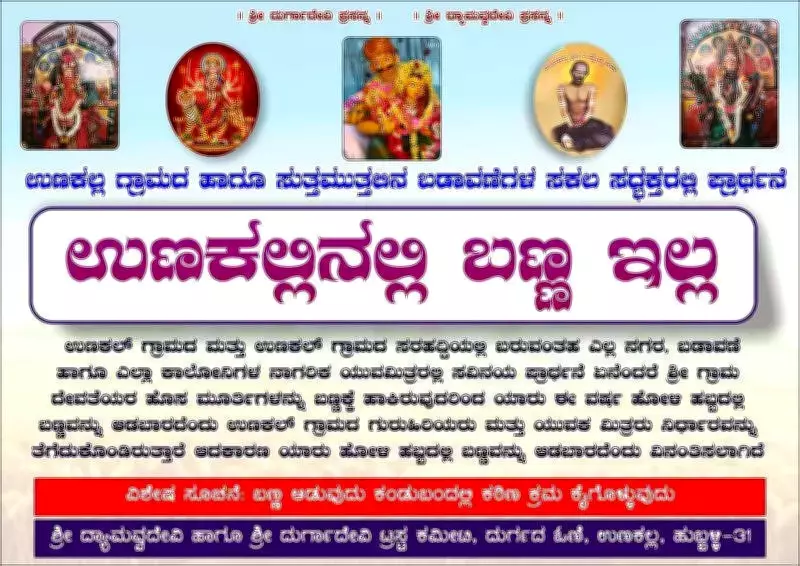
In a significant cultural decision, two major areas of Hubballi—Unkal and Gopanakoppa—will not be immersed in the vibrant hues of Holi this year. Instead of traditional color revelry, residents will participate in a sacred ritual involving the painting and installation of goddess idols. The temple committees of both villages have proactively distributed pamphlets and displayed prominent banners to communicate this instruction, ensuring widespread awareness among the community.
Sacred Ritual Takes Precedence Over Festive Celebrations
The focus shifts to a spiritual endeavor as idols of goddesses Dyamavva and Durgamma are set to be repainted and installed in Unkal between March 12 and 17. This move stems from a deep-rooted belief that whenever these statues undergo repainting, villagers must refrain from playing with colors during Holi. Rajanna Koravi, a corporator from Unkal, emphasized this tradition, noting it is a respected practice passed down through generations.
Elders and Temple Committees Lead the Initiative
Hanumantappa Suryavanshi, a 63-year-old elder from Durgada Oni in Unkal, provided detailed insights into the decision-making process. He explained that 21 members of the Sri Dyamavvadevi and Sri Durgadevi Trust Committee unanimously decided to repaint the statues. "This marks the fourth time in my life I am witnessing this repainting," Suryavanshi stated. "There is no fixed schedule; it occurs whenever devotees perceive the statues as faded. This time, alongside repainting, the temple is also undergoing renovation."

He further elaborated on the enforcement measures: "This oral rule and tradition, inherited from our elders, is being passed to the next generation. We have distributed pamphlets, displayed banners, and made public announcements. Additionally, we have formally requested police assistance to prevent Holi revelry within Unkal village limits, encompassing areas like Lingaraj Nagar, Mahalaxmi Layout, Rajeev Nagar, Taj Nagar, Sainagar, Kaveri Colony, and Nrupatunga Nagar." Typically, Holi is celebrated here on the day following Holi Hunnime, but this year will see a deviation due to the ritual.
Gopanakoppa Joins in Upholding Tradition
In Gopanakoppa, a similar sentiment prevails. Ishwargouda Patil, an elder from the village, highlighted that Dyamavva serves as the village deity, with her temple located in Badiger Oni. "The statue was last repainted in 2013," Patil noted. "As per our elders' teachings, we abstain from Holi whenever the statue is being painted. This repainting work must be completed before Ugadi, and we will commence announcements from Monday."
Patil detailed their outreach efforts: "We have already distributed pamphlets and displayed banners. Given that the village includes approximately 15-20 layouts such as Manoj Estate, Saptagiri, Santosh Nagar, and JK School, we are intensifying efforts to sensitize all residents."
Impact on Holi Celebrations in Hubballi
With these measures in place, nearly 40% of Hubballi city is anticipated to remain devoid of Holi color revelry this year. When questioned about potential color play in other areas, both Suryavanshi and Patil expressed confidence that no residents would participate, out of reverence for their village deities. This collective adherence underscores the profound cultural and spiritual significance attached to the goddess idol painting ritual, temporarily altering festive norms in these communities.