A New Wave of Artistic Voices Addressing Land and Loss
In the realm of contemporary Indian art, a profound shift is underway. A rising community of young artists is moving beyond traditional themes to tackle urgent ecological and social issues with deeply personal and research-driven works. These creators, hailing from the very communities they depict, are forging powerful narratives that resonate with the complexities of modern India.
Memorializing Extinction and Ecological Violence
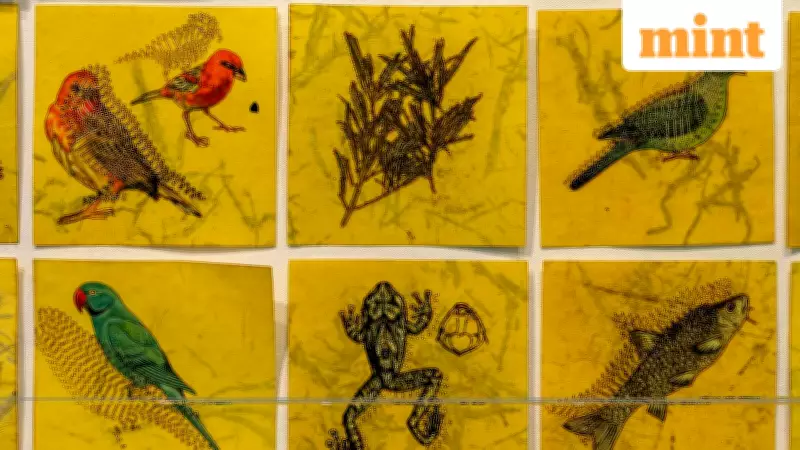
At the forefront is Kulpreet Singh, a 40-year-old artist from Patiala, whose Extinction Archive installation commands attention. Since 2022, Singh has meticulously studied the IUCN Red List of Threatened Species, creating intricate drawings of endangered or extinct beetles, amphibians, birds, fungi, and plants on laser-cut rice paper. His work goes beyond mere representation; he creates fossilized silhouettes around these species to signify their loss.
"Extinction is not just about the loss of a particular species but an entire ecosystem," Singh explains, highlighting his research into vanished riverlines and farmlands washed away by floods. His poetic approach is evident in works like Indelible Black Marks, a video and painting series at the Kochi-Muziris Biennale, where he uses ash from burnt stubble fields and soil, embedding them into canvases dragged across charred landscapes. This year, his significant contribution has been recognized as he was chosen as the Future Awardee from India at the Asia Society India Centre’s Asia Arts Game Changer Awards.

Giving Voice to the Invisibilized Labor of Migration
Parallel narratives emerge from Birender Yadav’s compelling installations. At the Birla Academy of Art and Culture in Kolkata, his work Debris of Fate features broken bricks scattered on the floor, alluding to the invisibilized labor of migrant workers who leave their farmlands behind. Through images of tools, handprints, and gestures on bricks, Yadav makes their presence felt.
This installation is part of Zameen, a group show curated by Ina Puri, on view until February 8. Yadav’s exploration continues at the Kochi-Muziris Biennale with Only the Earth Knows their Labour, where he molds tools, clothes, and trunks in clay to represent migrant lives. His project Erased Faces artistically documents the identities of brick workers whose thumbprints were washed away by kiln heat, hindering their access to Aadhar cards and salaries.
Intertwining Capital, Ecology, and Personal History
Sidhant Kumar’s solo project, Studies from a Quiet Harvest, supported by the Prameya Art Foundation and India Art Fair’s Discover 09 grant, exemplifies this trend. Hailing from a farmer’s family in Siwan, Bihar, Kumar moved to Delhi for education. His work combines film, photo performance, and installation to document the lives of migrants from Bihar, Uttar Pradesh, and Jharkhand working on leased farms in Delhi’s Ranholla fields.
He critically examines the capitalist bataiya sharecropping system, where tillers have no say despite their labor, and the impact of sewage from the Najafgarh drain on soil and farmer health. For his first photo performance, he donned a cactus costume to symbolize the thorns of capitalism shaping this unfair system. His latest performance-based film, Given them a piece of bread and circus and they never revolt, furthers these ideas.
Celebrating the Overlooked: Weeds and Urban Biodiversity
At the India Art Fair’s outdoor section, Deepak Kumar’s installation Breathing Space features three large brass and concrete debris sculptures representing Mexican Poppy, Chinese Mullein, and Smooth Sowthistle—plants often dismissed as weeds but vital for urban biodiversity. The 32-year-old artist, who grew up in Bihar, began documenting these plants in 2017 after moving to Greater Noida.
"No one talks about the impact that loss of weeds has on urban ecology. They are an important source of pollination," Kumar states. He chooses brass as a medium to signify that these plants may become relics of the past, much like metal artefacts unearthed by archaeologists.

The Critical Role of Materiality and Process
Materiality is central to these artists’ practices. Found objects, industrial materials, and soil carry deep material memory. Yadav’s work, for instance, reflects his family’s migration from Balia, Uttar Pradesh to Jharkhand, and his own "in-between" identity. He highlights the generational knowledge of ironsmiths like his father, whose skills are often undervalued.
Singh’s process-driven approach mirrors farming itself. "The paper is like a field, which needs to be prepared. Like seeds, I scatter and sow drawings on this paper—a dot here, a mark there. I don’t know what the final result will look like," he says, comparing his artistic uncertainty to a farmer’s unknown yield.
Recognition and the Future of Ecological Art in India
The pertinence of these themes is gaining recognition through grants, commissions, and awards. Singh’s Extinction Archive has been commissioned by the Kiran Nadar Museum of Art for an outdoor installation at the India Art Fair 2026. Curator Anushka Rajendran praises Kumar’s work for situating the migrant crisis within developmental and ecological concerns, noting that "data-based research comes together with material and artistic formulations."
This movement, which includes voices like Umesh S, Gyanwant Yadav, and others, shuns labels like "artist-activist," focusing instead on witnessed realities. As Puri notes, the power of works in Zameen lies in each artist exploring land as inheritance, resource, memory, and contested ground through a personal lens. Their art not only chronicles crises but also seeds hope for a more conscious and connected future.